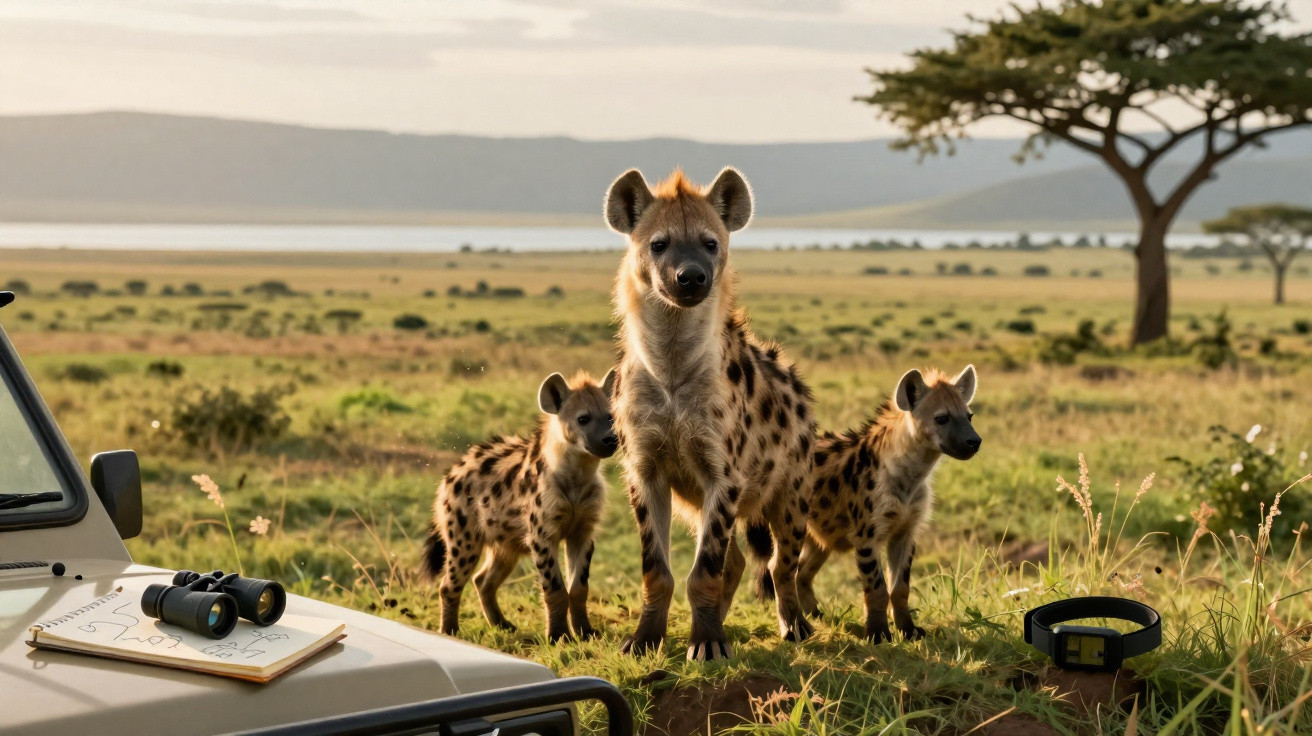
A female spotted hyena in the Ngorongoro Crater died in 1996. By 27 years later, every surviving hyena born into her clan was descended from her.
Nearly half of the females in the same crater did not produce even one grandcub.
When researchers count a single generation of cubs, male hyenas are the more unequal sex, as biologists would predict. Yet when grandcubs are included, females become the more unequal sex.
Marta Mosna and her colleagues at Berlin’s Leibniz Institute for Zoo and Wildlife Research monitored all eight hyena clans in the crater over 29 years.
Field workers distinguish each hyena through its unique spots and ear notches. Identifying fathers visually is more difficult, so the researchers extracted DNA from tissue, hair and mucus collected from fresh droppings.
Ultimately, they reconstructed the maternal ancestry of 2,743 hyenas, spanning eight generations.
Cubs measured one generation at a time
Sperm cost little to produce. Eggs do not, while female mammals also bear the costs of pregnancy and milk production.
Because males benefit more from frequent mating, a small number can father very many cubs while most father none.
Biologists refer to this idea as the Darwin-Bateman paradigm. It predicts that males will be the more unequal sex.
In 2016, Janicke and colleagues examined this pattern across the animal kingdom and found the same disparity in most species.
Mosna’s group tracked 287 females and 205 males from the beginning to the end of their reproductive lives. They assessed how evenly cub production was distributed in each sex.
A score of zero on this measure would mean that every animal reproduces at an identical rate.
Females received a score of 0.19, compared with 0.41 for males. As predicted, males were the more unequal sex.
Across an entire lifetime, however, the sexes were evenly matched. The highest-producing fifth in each sex accounted for half of all cubs: 19.5 percent of females and 19.8 percent of males.
A small number of mothers shape the family tree
The researchers then counted descendants in the following generation, and the generation after that.
Only 8.2 percent of females produced half of all grandcubs, compared with 12.4 percent of males. In the next generation, 6 percent of females and 9.4 percent of males produced half of the great-grandcubs.
No grandcubs were left by 47 percent of females, versus 33.7 percent of males. One generation later, 56.5 percent of females and 43.1 percent of males had left none.
“Reproductive inequality among females increased with every generation we included. Privileged lineages didn’t just remain successful - they grew ever larger,” said Eve Davidian, who co-directs the Ngorongoro Hyena Project and works at the Institut des Sciences de l’Évolution de Montpellier.
Among hyenas that produced 10 or more cubs, females with the highest number of cubs generally also had the most grandcubs. The same was not true for males: those with many cubs often had few grandcubs.
Most of these females were born close to the top of the hierarchy, with 71.4 percent having a high-ranking mother.
Daughters retain rank while sons surrender it
Each clan follows a rigid rank order, led by a single alpha female. Cubs join this hierarchy immediately below their mother. Daughters retain their status throughout life, whereas sons lose it when they leave their home clan to breed.
Philemon Naman, a field assistant with the project in Tanzania, explained: “A high rank confers advantages on both sexes in the early stages of life, such as priority access to food, faster growth and a higher survival rate.”
Roughly 85 percent of males leave their natal clan before breeding, while females almost never leave. A male immigrant enters his new clan at the bottom of its hierarchy and must wait to move up.
A son of a high-ranking mother still receives priority at a carcass when he returns to his birth territory. Around two years after leaving, he loses that privilege. His sisters retain theirs permanently.
Females of high rank begin breeding sooner, have shorter intervals between litters, rear more cubs to adulthood and live longer than low-ranking females.
Rearranging the Ngorongoro hyena family tree
Alpha females produce more cubs, meaning that their descendants would naturally be more numerous. The researchers therefore needed to address this possibility.
They tested it by scrambling the family tree. Every hyena was assigned a randomly selected mother from the same clan that had given birth during the previous two years.
High-ranking females were still more likely to be selected, because they had produced more cubs. But this removed one link alone: the passing of social rank from mother to cub.
The team repeated this scrambling process a thousand times. Hyenas born to alpha females still became widespread in the altered family trees, but across none of the thousand runs did they spread as rapidly as in the real tree.
Around 9.5 percent of hyenas had an alpha mother. Looking back one more generation, 21.6 percent had an alpha grandmother.
When researchers traced those same hyenas through their fathers, far fewer had an alpha female in their lineage.
Within each of the eight clans, the team identified the female with the highest number of living descendants. All eight had occupied the alpha position at some stage.
The hyena introduced at the start of this story was M-003 of the Munge clan. On January 1, 2023, her 52 living descendants made up the clan’s entire home-born population.
A pattern that may extend beyond hyenas
Mosna’s team based the great-grandcub calculations on the study’s smallest group: 291 hyenas that started breeding in or before 2006.
At the point when counting ended, 150 of the 1,284 cubs produced by this group were still alive and breeding.
It is not yet possible to disentangle the effects of social rank from all the other traits and circumstances a mother transmits. The team considers a high-ranking mother to influence almost every aspect of the environment in which her cub is raised.
Biologists had already identified two ways in which females can become the more unequal sex. Male seahorses carry the young, while in meerkats a single dominant female undertakes almost all breeding.
“This study identifies a third route to the same outcome: the inheritance of social privileges along the female line,” said Alexandre Courtiol, one of Mosna’s co-authors in Berlin.
Long-tailed macaques, yellow baboons and vervet monkeys also inherit rank from their mothers. High-ranking macaque and baboon mothers have more young over their lifetimes, while high-ranking vervet mothers lose fewer infants.
Nobody has studied these species for long enough to establish whether the sexes reverse positions as they do in the crater.
Anyone attempting this will require what Ngorongoro provides: every mother identified, every father DNA-confirmed, and records extending eight generations. Only a small number of field teams worldwide maintain data of this kind.
The complete study appeared in the journal Science Advances.

















Comments
No comments yet. Be the first to comment!
Leave a Comment