Just as people respond to stress in different ways, corals do too. Colonies from the same species can grow next to one another yet show different levels of tolerance to pressures including heatwaves.
In research published today, we found striking new evidence that coral heat tolerance varies. These differences matter as oceans around the world continue to warm.
Earlier this year, the fourth global mass bleaching event was declared. Since 2016, the Great Barrier Reef has experienced five mass bleaching events, with the latest occurring this past summer. These declarations came after the warmest year ever recorded globally.
Keeping the world’s coral reefs healthy and functional requires a dramatic reduction in global carbon emissions, slowing the pace of ocean warming. While humanity works towards this aim, interventions could give corals time to persist in increasingly warm environments.
How we measured coral heat tolerance
Coral heat tolerance can be assessed by examining how corals respond when water temperatures rise. Our study measured bleaching thresholds in more than 500 colonies of the table coral, Acropora hyacinthus.
Acropora hyacinthus is a widespread coral that creates “tables” of small branchlets. It is ecologically significant but also highly susceptible to heatwaves, making it an important species for conservation.
Corals gain their distinctive colour from algae that live within their tissues. These algae also supply most of the coral’s food. If water remains too hot for too long, corals expel the algae, leaving them bleached and without nourishment.
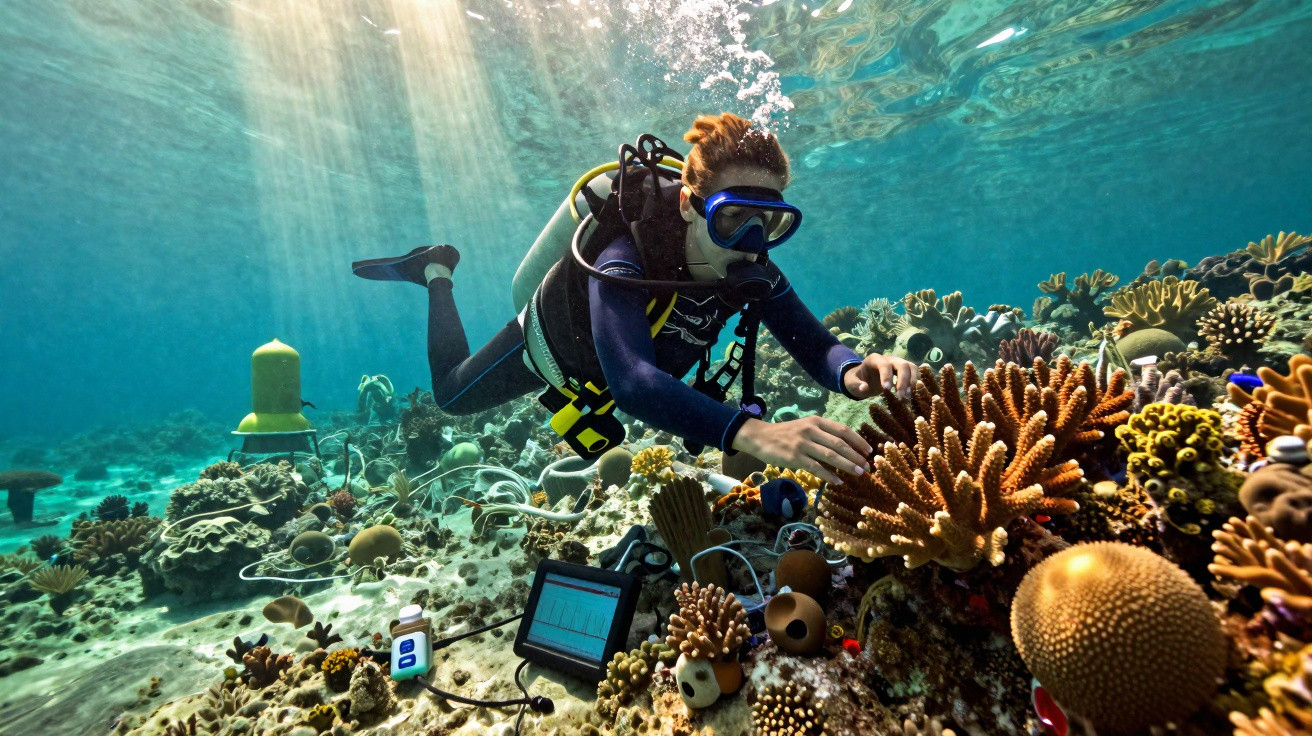
We visited 17 reefs by scuba diving to locate Acropora hyacinthus. Samples were then taken aboard a research vessel for experimentation.
Our purpose-built portable experimental system included 12 tanks, set across four temperatures. Fragments from the corals were placed in the tanks and exposed to short-term heat stress at varying temperatures.
We then measured the pigment remaining in each coral fragment, which directly corresponds to the quantity of algae still present in the coral’s cells.
From this, we established the bleaching threshold for each coral: the temperature at which its pigmentation falls to 50% of a healthy level. This showed both the scale of variation and the locations of the colonies most tolerant of heat.
What did we find? In our experiments, pigment retention at high temperatures ranged from 3% to 95%. At these temperatures, some coral colonies bleached completely, whereas others appeared scarcely affected.
Of the 17 reefs examined, 12 had colonies with bleaching thresholds within the top 25%. This indicates that heat-tolerant corals occurred on most of the reefs we surveyed.
Nature versus nurture
Corals respond differently to stress for two reasons: nature and nurture.
Every coral has its own “nature”, or genetic makeup, which may influence its heat tolerance. Our findings indicate that corals throughout the Great Barrier Reef could contain distinct genetic resources that are valuable for recovery and adaptation.
Yet features of the marine environment can nurture, or constrain, a coral’s response to heat stress. These include water temperature, nutrient conditions and the symbiotic algae within coral tissue.
Corals in warmer areas, including the northern Great Barrier Reef, were able to withstand higher water temperatures. But because waters in these regions are already so warm, those corals are close to their temperature limits.
Corals on the southern Great Barrier Reef cannot tolerate temperatures as high as those endured by northern colonies. However, our findings suggest that they can cope with a greater increase above local temperatures than corals in the north.
These patterns of tolerance may influence which corals survive marine heatwaves.
Giving coral reefs a future
Our results may have important implications for corals’ capacity to adapt to warmer seas under climate change.
They could also guide reef restoration and conservation work. For instance, heat-tolerant parent corals may be selectively bred to produce offspring that are better adapted to warmer water.
The effectiveness of these programmes depends on how strongly a coral’s genetic makeup determines its heat tolerance. The next stage of this research will therefore investigate these genetic differences.
Selective breeding trials using the most heat-tolerant corals identified in this study are already under way.
Cutting greenhouse gas emissions is essential to protecting coral reefs. However, interventions such as selective breeding may provide valuable support, helping to give coral reefs the best possible future.
Melissa Naugle, PhD Candidate in Coral Ecology, Southern Cross University; Emily Howells, Senior Research Fellow in Marine Biology, Southern Cross University, and Line K Bay, Research Program Director, Australian Institute of Marine Science
This article is republished from The Conversation under a Creative Commons licence. Read the original article.

















Comments
No comments yet. Be the first to comment!
Leave a Comment