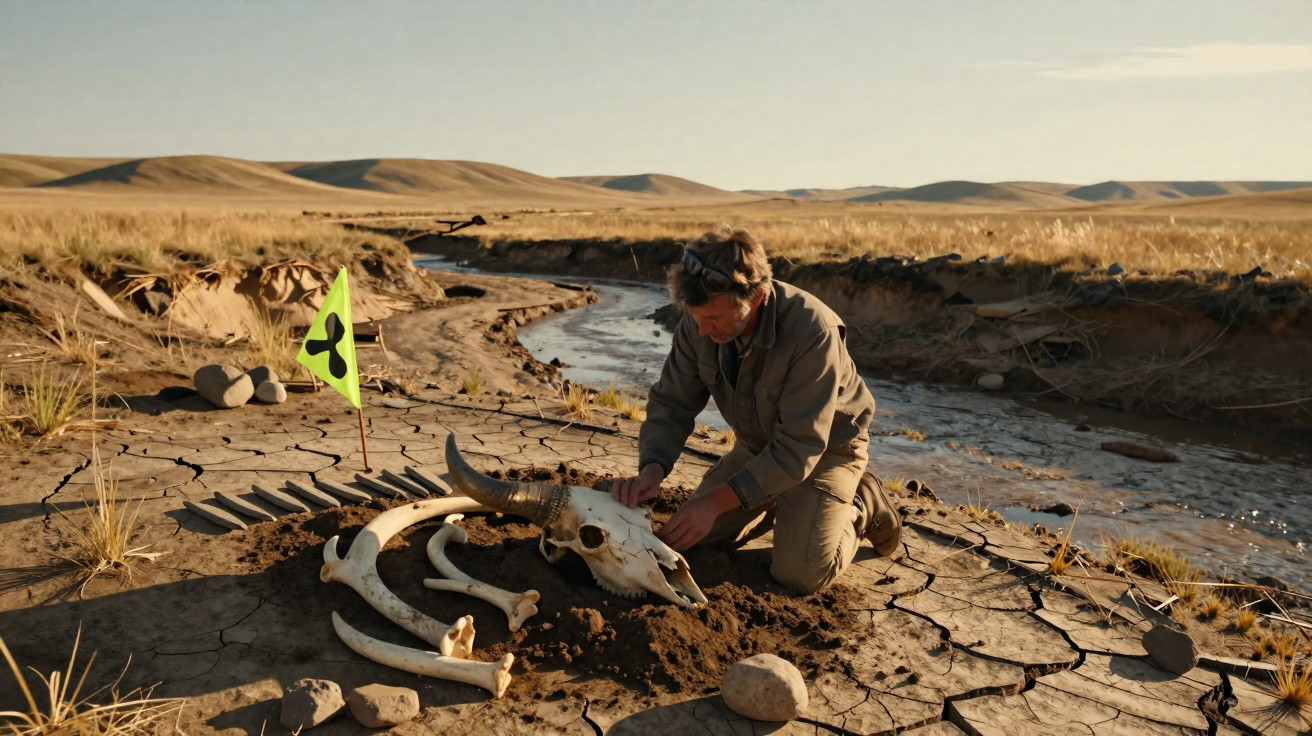
For centuries, bison hunters across the North American Great Plains did not follow a single fixed approach. They travelled, adjusted their methods and repeatedly returned to the same locations – until, at some point, they stopped.
A recent study examines one such hunting location in central Montana: the Bergstrom site, where bison were killed at intervals for around 700 years.
Then, approximately 1,100 years ago, hunters ceased returning to Bergstrom, despite bison remaining plentiful in the wider area.
The researchers set out to explain why a place used for so long was suddenly left behind. Their conclusion is not that “the bison disappeared”. Instead, it points to human factors: drought, access to water and a change in the way hunting was organised.
The abandoned Bergstrom bison kill site
The Bergstrom site was essentially a recurring point within a far broader hunting landscape. Hunters visited it intermittently, suggesting that they made deliberate decisions about when conditions and practical arrangements made its use worthwhile, and when they did not.
The timing of its abandonment is what makes Bergstrom particularly notable. Bison numbers had not collapsed, and the local ecosystem showed no dramatic transformation. Nevertheless, people no longer used the site.
The study’s lead author, John Wendt, is a paleoecologist and assistant professor of rangeland ecosystem management at New Mexico State University.
“We found that bison hunters ceased using a kill site in central Montana around 1,100 years ago. It appears that hunters stopped using it because severe, recurring droughts reduced the water available for processing animals at a small nearby creek,” said Professor Wendt.
“Site abandonment was a response to environmental stressors and changing social and economic pressures.”
The point about “processing” is crucial. Killing an animal was only the first stage. Harvesting several bison required water for butchering, cleaning, cooking, and preserving meat and hides.
A location might be ideal for the hunt itself yet become unusable afterwards if essential resources – especially dependable water – could not be relied upon.
How researchers investigated the Bergstrom mystery
To establish what had changed, the team drew on more than one line of evidence. They combined archaeological findings with environmental information in an effort to eliminate straightforward explanations.
In 2019, they excavated nine small pits, each measuring 1 × 1 metre, recorded the material uncovered and radiocarbon-dated charcoal to establish the chronology.
They also collected sediment cores immediately beside the excavation area. These were examined for pollen and charcoal fragments, providing evidence of vegetation, fire activity and wider ecological conditions.
In addition, the researchers used climate reconstructions and searched for evidence of the presence of large herbivores through time.
Had Bergstrom been deserted because environmental change had made it a poor hunting location, the sediment record should have revealed this. It did not.
“Abandonment wasn’t because the site became ecologically unsuitable in any absolute sense. Bison were still around, vegetation hadn’t changed, and there was no substantive shift in fire activities,” said Professor Wendt.
“Bison hunting activity was not simply following prey populations.”
The researchers therefore had to move beyond the question of whether bison were available and consider whether the location was still practical for organising hunts in the way people wished to conduct them.
When drought made the creek a deciding factor
The climate conditions surrounding the abandonment were harsh. The area experienced severe droughts lasting decades both before and after Bergstrom’s final period of use.
During dry periods, a small creek may shrink, become seasonal or prove too unpredictable to support a major operation.
Even with bison nearby, hunters would have needed to judge whether the site still worked for them, particularly if alternative places had more dependable water supplies.
Drought probably affected more than the creek alone. Dry conditions can alter travel routes, fuelwood availability, the timing of hunts and the places where bison gather. However, the study’s main argument is more straightforward: Bergstrom may have represented one risk too many.
Bison hunting groups became larger
The other element of the explanation is social. Over time, some bison-hunting groups seem to have moved away from smaller, mobile and opportunistic hunts towards larger, more carefully coordinated operations.
This meant bigger kills, more participants, more processing and, potentially, surplus meat and hides that could be stored or traded.
“These larger operations were based on large kills and could produce surplus for trade and winter storage, but they also meant more dependence on specific resources like water, forage for larger herds, and fuel for processing fires,” Wendt said.
That shift brought a different kind of constraint. Feeding a larger group and processing many animals meant that a marginal water supply was no longer a risk worth taking.
Reliable natural “infrastructure” became necessary: water, wood, shelter and terrain capable of helping hunters control a herd.
A hunting site with the wrong layout
Moreover, not every location offered the right physical arrangement. The large-scale hunting sites used most repeatedly often included features such as cliffs for bison jumps or landforms that could channel and hold animals during a drive.
Such places were less common, and once groups committed to them, they often returned for generations.
Seen in this context, Bergstrom may have become unsuitable for the “new” hunting approach: adequate for smaller expeditions, but too risky as large operations grew more frequent and drought made water uncertain.
What Bergstrom reveals about adaptation
It is easy to mistake an apparently stable ecosystem for a stable human system.
The Bergstrom evidence indicates the reverse: people may leave a location not because the landscape has collapsed, but because its costs and risks have changed. The researchers describe this as a form of climate adaptation.
As droughts became recurrent pressures, hunters reorganised and favoured strategies better able to cope with those conditions.
At the same time, they relied on cultural knowledge and flexibility to react to changing circumstances.
The team also stresses significant limitations. Bergstrom is only one site, and other locations may have been abandoned for entirely different reasons.
The available evidence cannot show how long each episode of use lasted or how often people came back. The site may also have received occasional, low-impact use after its “abandonment”, with traces too limited to identify.
Even so, the central lesson remains: in a landscape rich in bison, water and logistics could determine where hunting took place, while prolonged drought could quietly lead people to abandon a once-dependable location.

















Comments
No comments yet. Be the first to comment!
Leave a Comment