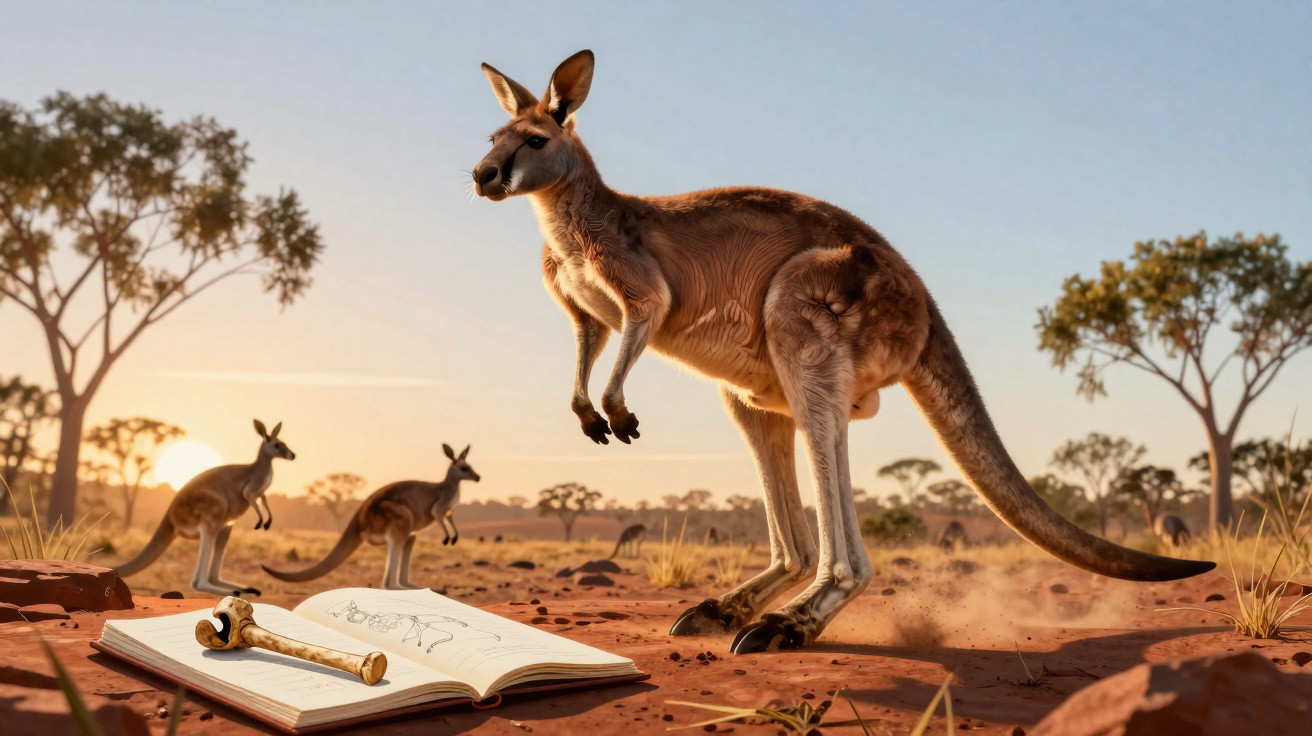
Australia was once home to kangaroos much bigger than any species alive today. Fossil evidence points to animals weighing over 200 kg, while some approached 250 kg.
That scale prompts a straightforward question: could an animal of this weight still travel by hopping, or did its bulk demand another form of movement?
For decades, researchers assumed there was a firm upper weight limit for hopping. Fresh research disputes that view by examining bone mechanics, muscle forces and fossil remains.
Body size influences movement
How an animal moves is closely tied to its mass. Greater body weight places increased strain on bones, muscles and tendons.
To lower these stresses, many large mammals adopt a more upright stance, reducing the distances over which forces act around their joints.
Bipedal hopping mammals cannot entirely adopt this approach, since hopping depends on keeping the legs bent.
Living kangaroos are still the largest animals that hop, with red kangaroos weighing up to nearly 91 kg. Ice Age kangaroos were more than twice as heavy.
Previous research indicated that hopping would become impossible at roughly 141 to 159 kg. However, those studies largely enlarged the body proportions of modern kangaroos without assessing the structure of fossil bones.
Giant kangaroos had a different build
Straightforward scaling treats giant kangaroos as though they resembled, and moved like, enlarged living species. Their fossilised bones indicate otherwise.
“Previous estimates were based on simply scaling up modern kangaroos, which may mean we miss crucial anatomical differences,” said Megan Jones, a postgraduate researcher at the University of Manchester.
“Our findings show that these animals weren’t just larger versions of today’s kangaroos, they were built differently, in ways that helped them manage their enormous size.”
The anatomy behind hopping
Researchers examined two principal constraints on hopping: the strength of bones in the foot and the strength of tendons at the ankle.
The fourth metatarsal is particularly important when landing. Bones commonly fail because of bending stress rather than compression.
Measurements from fossils revealed that giant kangaroos possessed metatarsals that were both shorter and thicker. A shorter bone bends less when force is applied, making it more resistant to breaking.
The calculations found that safety margins remained above failure thresholds, even when subjected to hopping forces.
The second constraint concerned ankle tendons, notably the gastrocnemius tendon, which supplies the force for take-off. Tendons need to withstand powerful muscular forces without rupturing.
Fossil heel bones had broad attachment sites, providing room for thick tendons. Muscle-force calculations showed there was sufficient space for tendons strong enough to enable hopping.
How giant kangaroo muscles drove hops
Muscle force increases with muscle size, generally assessed through cross-sectional area. Bigger muscles can generate more force.
Calculations indicated that the force needed for hopping was still realistically achievable for giant kangaroos.
Modern kangaroos can hop efficiently across long distances because they store elastic energy. Having less of this capacity probably limited the speed and stamina of giant kangaroos.
Dr. Katrina Jones, a research fellow in the School of Earth Sciences at the University of Bristol, explained that although thicker tendons are safer, they retain less elastic energy.
“This likely made giant kangaroos slower and less efficient hoppers, better suited to short bursts of movement rather than long-distance travel,” said Dr. Jones.
“But hopping does not have to be extremely energy efficient to be useful, these animals probably used their hopping ability to cross rough ground quickly or to escape danger.”
More than one way to travel
Hopping was not their sole means of getting about. Fossil anatomy indicates that different species used a range of movement styles.
Some kangaroos probably mixed hopping with upright walking. Others may have travelled on all fours at slower speeds. Rather than relying on one gait, the evidence points to a flexible set of movement options.
Certain species display characteristics associated with an upright posture, including the shape of the pelvis and ankle structure.
Other species have traits connected with quadrupedal movement. This variation suggests they were adapted to differing habitats and ways of life.
Giant kangaroos occupied varied roles
Their varied locomotion was matched by a varied diet. Fossilised teeth and skulls indicate that some giant kangaroos grazed on grasses, much like modern species.
Other large species browsed on leaves and shrubs, a feeding niche not found among today’s large kangaroos.
“Our findings contribute to the notion that kangaroos had a broader ecological diversity in prehistoric Australia than we find today, with some large species grazers like modern kangaroos while others were browsers – an ecological niche not seen in today’s large kangaroos,” noted study co-author Dr. Robert L. Nudds.
The study indicates that hopping was mechanically viable for giant kangaroos. Robust foot bones, broad heel bones and thick tendons enabled brief, powerful hops. Other gaits were probably used for long-distance journeys.
Fossils now portray animals shaped for power, adaptability and survival, not speed alone.
Giant kangaroos were not giants unable to hop. Evidence now suggests that bouncing was one element in a far more varied story of movement.

















Comments
No comments yet. Be the first to comment!
Leave a Comment