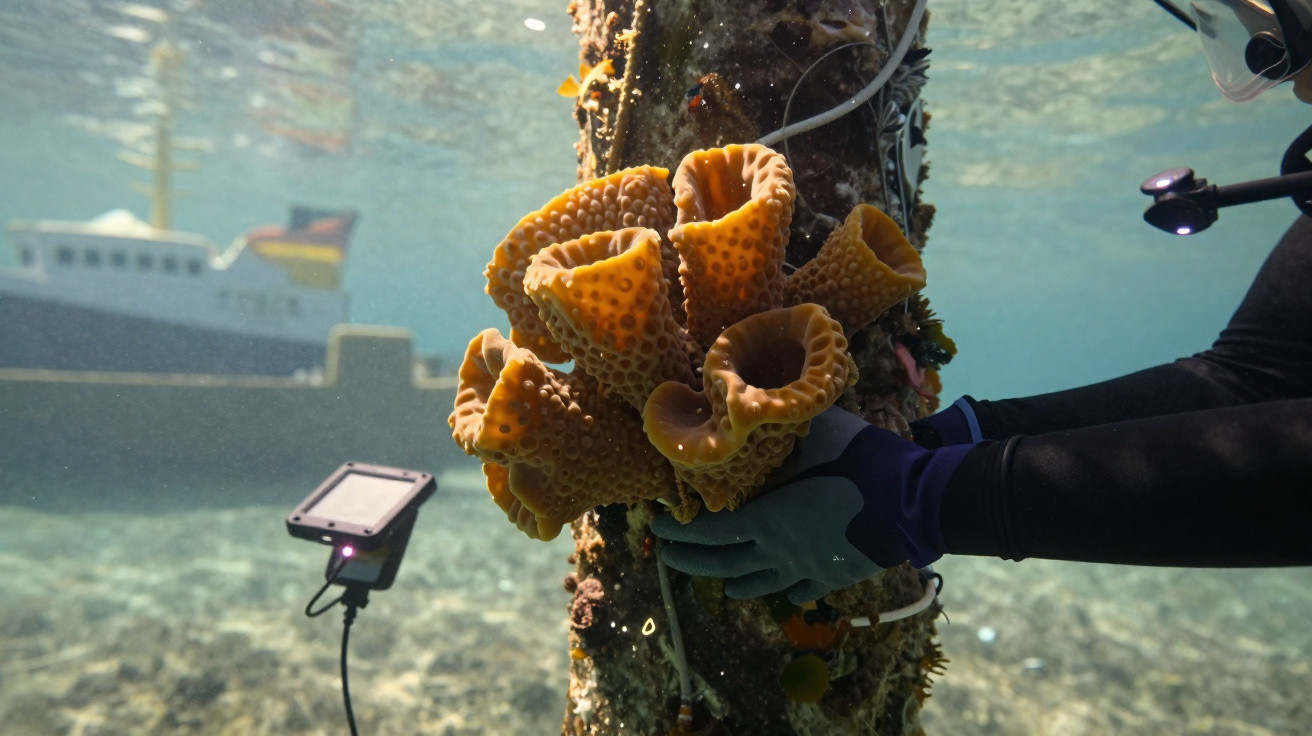
A sponge is expected to remain exactly where it settles. After finding a rock as a larva, it anchors itself permanently and occupies that same place for the rest of its life.
Yet one Mediterranean species defies this rule. During 455 days in an active harbour, chicken kidney sponges lifted themselves and crept across their plates.
One travelled almost five inches (12.7 cm). Nearly every other species the researchers placed in the harbour died.
The moving sponge achieved more than mere survival.
Why polluted harbours need sponges
Ports rank among the most degraded marine environments. Water circulation is limited within them, allowing oil, rubbish and toxins from antifouling paint to accumulate rather than disperse.
Vessels also create noise from propellers and dredging, while ballast water introduces non-native species that can displace local wildlife.
A possible approach is to introduce resilient pioneer species that withstand contamination and progressively improve water quality.
Sponges are well suited to this role: one population can filter hundreds of gallons of seawater each day, taking out metals, bacteria and viruses.
“Here we show that some sponge species have exceptional potential for use in the restoration of degraded harbor habitats,” said Dr. Manuel Maldonado, a group leader at the Center for Advanced Studies of Blanes (CEAB) in Spain.
Five sponges face the test
Maldonado and his colleagues set out to identify the most resilient candidate. They gathered five widespread Mediterranean sponge species from rocky walls near Santa Anna Point, at depths of 23 to 39 feet (7 to 12 m).
The five species are only distantly related, with fundamental differences including whether they possess a mineral skeleton or host dense microbial communities. This variation was intentional, as it could show which characteristics enable sponges to persist.
The team secured the sponges to ceramic plates in 130-gallon (500-litre) tanks supplied with flowing seawater.
Next, they installed metal grids covered in calcium carbonate on a seawall in Marina Palamós recreational port, roughly 19 miles (30 km) along the coast.
The artificial reefs were positioned just 33 feet (10 m) from the fuel dock. Altogether, 42 sponges were transplanted, and the researchers recorded their progress with underwater photographs every few weeks.
Four died, one held on
Results differed sharply between species. All 15 Corticium candelabrum specimens died in the laboratory before deployment because they could not attach to their plates.
Three further species made it to the harbour but subsequently declined. Crambe crambe, Scalarispongia scalaris and Ircinia oros each shrank and died within around 165 days.
By contrast, the chicken liver sponge thrived. Of the 24 specimens transplanted, 22 remained alive at the end of the study, giving a survival rate of 91.7 percent.
The two losses did not result from gradual decline. One specimen became detached before its first inspection, while the other deliberately separated after altering its body shape.
Sponge crawls across harbour
Once attached, most sponges are unable to move. Chondrosia reniformis is an exception, and the researchers followed its movement image by image.
All of the specimens crept over their plates. One covered almost five inches (12.7 cm), approximately the long side of an index card, while several more travelled two to three inches (6 to 8 cm).
“Unlike many sponges, the chicken kidney sponge can ‘creep’ away if local conditions deteriorate – for example, when nearby organisms compete,” said Maldonado.
“It can also relocate from the exposed upper surface of a rock, where it is subjected to UV radiation, polluted sediments, and predators, to sheltered crevices where these stresses are greatly reduced.”
“It also reproduces asexually by fission: this allows populations to expand rapidly and later reproduce sexually, increasing the chances of successful fertilization.”
Healing after harsh conditions
This sponge can also reproduce by splitting itself apart. Seven specimens divided during the warmer months, with each creating between one and five clones.
These divisions took place when boat activity and fuel contamination were highest, rather than when the water was cleanest. Nonetheless, fission raised the harbour population from 24 to 40.
One clone passed through a drilled hole to reach the shaded underside of its plate, where it expanded by around 486 percent in less than three months.
A single sponge developed an infection on two occasions, recovered from the damage and kept the resulting scars.
However, growth did not tell the entire story. Following transplantation, most specimens became smaller, losing an average of 18.6 percent of their size. Just three of the 24 finished the study larger than at the start.
Researchers need more evidence
The researchers are cautious about what the findings demonstrate. The study identifies one pollution-tolerant species; it does not prove that a harbour can be restored.
Sample sizes for two unsuccessful species were limited to five and three individuals, meaning their weak performance remains preliminary.
When the team later examined the plates for juvenile sponges produced through sexual reproduction, they found none.
“Our next step is to monitor the transplanted sponges over several years,” said Maldonado.
The scientists are especially keen to follow changes in the sponge’s community of symbiotic microbes.
These microbes occur in great numbers within chicken kidney sponge tissue, making it a so-called high microbial abundance species, and they may contribute to its ability to withstand pollutants.

















Comments
No comments yet. Be the first to comment!
Leave a Comment