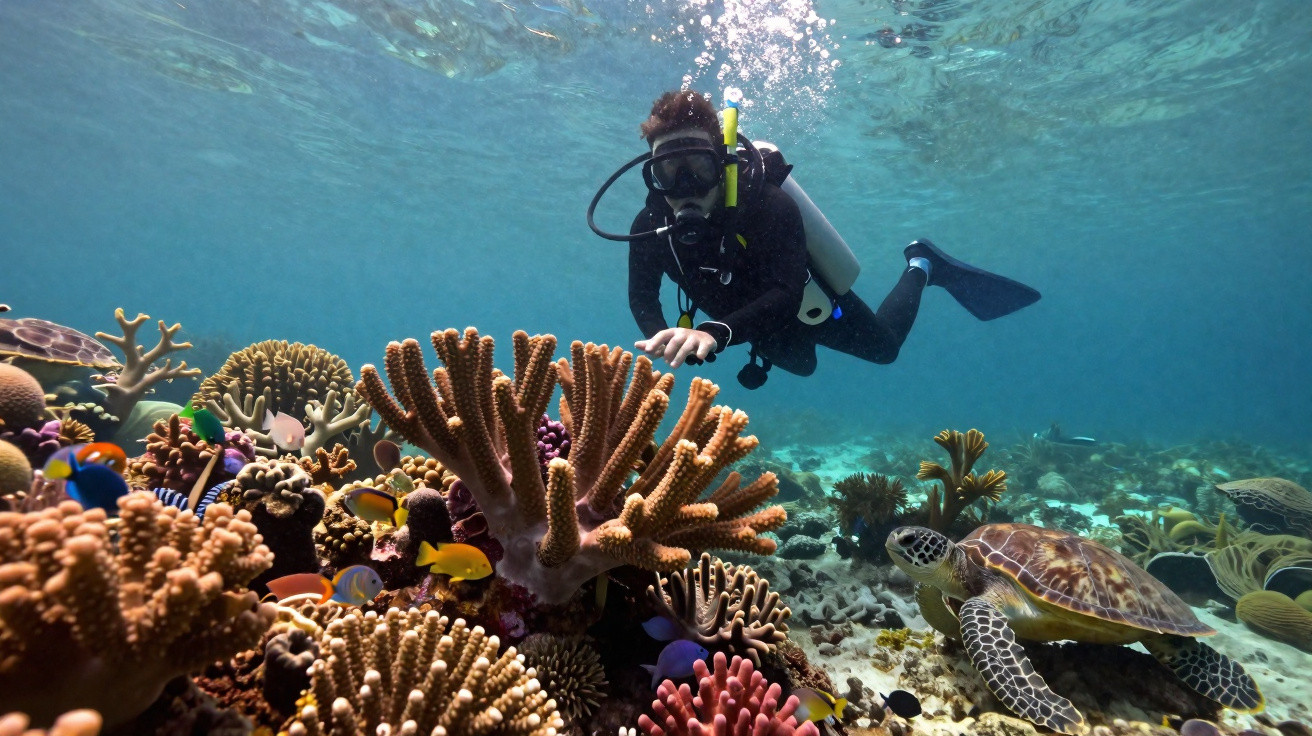
A newly published study has identified living coral reefs off Benin’s coast, on a section of West African seabed that scientists had considered dead for more than 60 years. Soft corals and sea fans flourish at roughly 54 metres deep, while reef fish weave through the colonies.
Until now, no living coral community had been verified at this depth anywhere on this section of the West African continental shelf. Trawlers currently operate in the waters above the corals, which have no official protection.
Pursuing an overlooked footnote
During 1963 and 1964, French scientists investigated the seabed off Dahomey, now Benin, and neighbouring Togo on behalf of the two governments. Their aim was to locate ground suitable for trawling and document the fish inhabiting it.
Their report mentioned a coral barrier at depths of 52 to 56 metres – a detail that could easily have gone unnoticed. Relying on dredged samples and sound measurements, rather than cameras, the researchers decided that the coral was dead.
That assessment remained unquestioned for six decades. No subsequent coral studies were carried out on Benin’s continental shelf, leaving both the reef’s condition and its full extent unclear.
Gérard Zinzindohoué, an oceanographer and National Geographic Explorer at the Benin Fisheries and Oceanological Research Institute (IRHOB) in Cotonou, chose to investigate the site again.
He headed the project, which began in 2025 with the objective of finding the corals recorded in the historic survey.
When Earth.com asked what the search revealed about the ocean beyond this individual reef, Zinzindohoué said, “This project shows the value of combining historical scientific observations with modern exploration technologies to rediscover ecosystems that were previously overlooked.”
Locating Benin’s corals
From April to May 2025, the researchers completed 35 survey tracks using small motorboats and side-scan sonar, mapping 11.4 km of seafloor.
This method involves towing a torpedo-shaped sensor behind a vessel, which detects sound waves reflected from the seabed. “It was not an easy field campaign,” said Zinzindohoué.
Rock produces a powerful echo, whereas sand creates a weaker return. On around 6.9 km of otherwise sandy shelf, the team detected two bright areas separated by approximately 5.5 km.
One area contained formations measuring up to 207 metres long and 7 metres high. The second comprised a ridge 274 metres in length and 10 metres in height. Both lay at 52 to 56 metres below the surface, precisely matching the depths documented during the 1960s.
Camera systems verify the discovery
Two separate camera systems were needed to establish what was living on the formations. A tethered drone equipped with a 4K camera and 5,000-lumen lights completed two dives at the first location.
In addition, researchers deployed a baited camera developed by the National Geographic Society’s Exploration Technology Lab five times that August.
The device records footage from within a glass sphere before burning through a wire, releasing a 10 kg weight and rising back to the surface independently.
A 2021 paper outlining the technology found that it cost substantially less than a crewed submersible.
This lower cost was a key reason why a small national institute was able to undertake the survey. Funding and logistics nevertheless posed major obstacles, and close-range observations were limited to the first of the two sites.
A garden dominated by soft corals
Video footage revealed coral growing at 54 metres on large, angular rock blocks. Nearly all of the colonies were octocorals – soft corals with flexible internal skeletons instead of hard, stony structures.
Speaking to Earth.com, Zinzindohoué said, “When we observed living corals and associated fish communities on the footage, we realized that these formations were not simply old structures, but living ecosystems.”
The scientists recorded at least six separate growth forms, including fan-shaped and sheet-like colonies, as well as two types of black coral. In some places, sea fans were dense enough to occupy the entire frame.
Stony reef-building corals were scarcely present. Those observed were small and pale, and there was no evidence of the accumulated limestone that shallow tropical reefs create over centuries.
Wildlife in the coral garden
This lack of limestone is why the researchers classify the location as a coral garden: a coral community that occupies rock rather than constructing it. The difference is important, because once a garden is scraped away, the underlying surface does not regenerate it.
At this depth, the corals belong to the world’s mesophotic coral communities, which persist below the reach of straightforward diving by using the limited light that penetrates that far.
Cameras captured eight reef fish species feeding and taking shelter among the colonies, including snapper, angelfish, soldierfish and damselfish.
Several soft corals had died and were already covered by tube worms and other small colonial creatures, indicating that the garden changes over time rather than remaining static.
Water in constant motion
Sensors fitted to the seafloor camera measured bottom-water temperatures ranging from 19°C to 26°C during the five deployments. This represents a substantial variation across one small area of seabed.
The corals occupy the boundary between warmer surface water and the colder layer beneath it, with that boundary shifting vertically. Oxygen concentrations varied just as greatly, ranging from slightly below half the water’s potential oxygen capacity to almost its maximum.
At equivalent depths off Cotonou in August, the 1960s survey recorded temperatures from 16°C to 18°C. The more recent measurements are warmer.
However, a few days of data cannot distinguish a seasonal fluctuation from a permanent shift, and the researchers do not argue that the water has become warmer.
Previously, the Gulf of Guinea’s only confirmed mesophotic community was found off São Tomé, several hundred miles farther south. A 2017 survey there reported black coral forests between 30 and 50 metres deep.
Both locations occur on hard rock in a region dominated almost entirely by sediment. This suggests that the main constraint on where these communities occur may simply be the presence of rock on which to grow, rather than any exceptional feature of Benin.
Protecting Benin’s reef
Benin now has a documented living coral community on its continental shelf. The survey delivered coordinates, video evidence, and the first temperature and oxygen measurements ever obtained at the site. No earlier baseline existed.
The sonar findings also resolve a long-standing claim. Historic accounts had described a continuous barrier extending about 40 km along the coast.
Instead, the sound data indicate distinct patches of coral on hard substrate rather than one uninterrupted wall, although the survey examined only a small portion of the area previously described.
What remains uncertain
Two central issues are unresolved. Because no coral samples were taken, every identification is based solely on video footage.
Images alone also cannot determine whether the colonies died during the 1960s and later recovered, or survived throughout and were simply never observed.
Resolving these questions will require another visit to the reef. The researchers plan to collect coral fragments and analyse their chemistry to establish the age of the structures and identify evidence of earlier ocean conditions.
In an email to Earth.com, Zinzindohoué said, “Our next steps are to return to these reefs to collect coral samples for radiocarbon dating and palaeoclimate analyses.”
From discovery towards protection
The immediate consequences could precede the scientific answers. Bottom trawling equipment is used across Benin’s continental shelf, and before this survey, no chart identified coral that should be avoided.
The sites can now be incorporated into fishing regulations and the maps used to determine activity on the seabed.
The broader significance extends beyond a single country. Other reefs rejected as dead during mid-20th-century fishing surveys along the West African coast may still remain below the surface, intact but undocumented.
Photo credit: Gérard Zinzindohoué

















Comments
No comments yet. Be the first to comment!
Leave a Comment