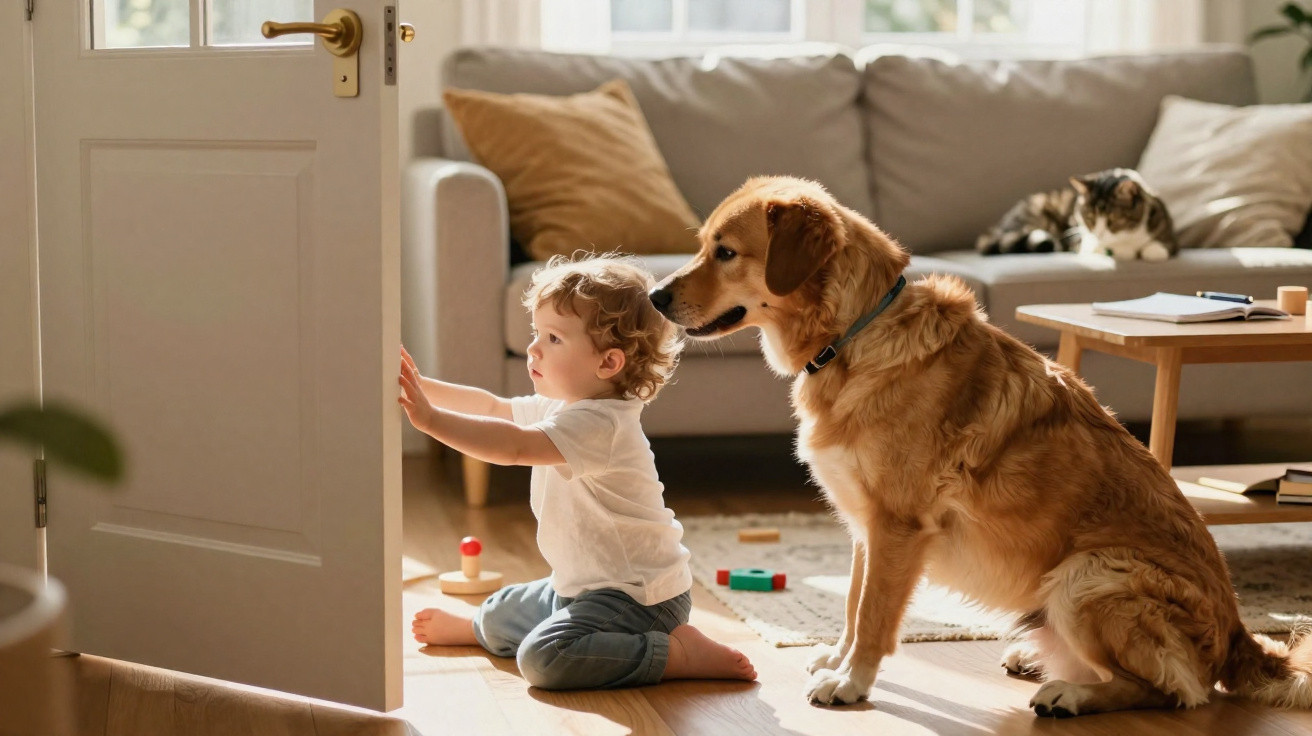
Have you noticed that your dog comes straight over when you begin searching for something, whereas your cat may simply sit and watch? This familiar household scene has now become the focus of scientific research.
New findings suggest that the contrast could have roots stretching back thousands of years. In certain circumstances, dogs may even behave more like young children than cats do. Although that may initially seem unexpected, controlled experiments support the idea.
Researchers set out to discover why dogs can appear so willing to assist without training or a reward, while cats are more likely to remain relaxed observers.
Comparing dogs, cats, and toddlers
The research was carried out by scientists at Eötvös Loránd University in Hungary and the HUN REN ELTE Comparative Ethology Research Group.
They examined three groups: untrained companion dogs, pet cats and toddlers aged from 16 to 24 months.
Their aim was to establish whether these groups displayed prosocial behaviour in everyday settings. Prosocial behaviour is helping another individual without anticipating anything in return.
The scientists also wanted to find out whether living alongside people encourages animals to behave in helpful, human-like ways during straightforward daily events.
A simple test at home
The team designed a simple, naturalistic task. While a child, dog or cat watched, a parent or pet owner concealed an object.
Once it had been hidden, the adult acted as though they were trying to find it. They neither requested assistance nor provided an obvious cue. Instead, the researchers watched to see what followed.
They recorded subtle forms of assistance. Would the subject shift its gaze between the object and the adult? Would it move towards the object? Would it attempt to bring the item to the adult?
Watching for helpful actions
The concealed item was deliberately uninteresting: an ordinary washing-up sponge. This was important because it held no particular value for the child, dog or cat.
The researchers wanted to determine whether the subject would offer help when the object provided no personal gain. The scenario was intended to reflect real life.
People frequently look for an item without explicitly asking somebody else to help. The experiment assessed whether the child or animal would independently intervene and show spontaneous concern for the adult who was searching.
Dogs and toddlers act alike
The findings surprised many observers. A high proportion of dogs responded in much the same way as the toddlers, with both groups showing considerable interest in what was happening.
More than 75 percent of the dogs and children either showed where the object was or collected it and handed it to the adult. Their response indicated a clear wish to help, despite there being no reward.
None of the dogs involved had received specialist training for the task. Even so, most decided to take part in the search.
Dogs help without rewards
“Children were already known to help others at this age. The fact that they performed similarly to what has been reported in earlier studies confirmed that our method and the experimental setup were suitable for measuring prosocial behavior,” noted Melitta Csepregi, first author of the study.
This outcome indicated that the task was dependable and performed as intended.
“Interestingly, the majority of dogs and children showed similar behavior patterns,” said Csepregi.
“They readily engaged with the situation, and more than 75% of them either indicated or retrieved the object, suggesting strong motivation to help – despite being untrained, receiving no reward, and the hidden object, a dishwashing sponge, being irrelevant to them.”
Cats choose a different response
Cats responded differently. Many paid close attention as the adult looked for the object, but only a small number attempted to signal where it was or bring it nearer.
Most cats remained in place. The researchers also ran a control task in which the concealed object was something the cat particularly valued, such as a preferred toy or treat.
Under those conditions, more cats approached the object. This indicates that cats may be more inclined to act when a situation is linked to their own interests.
Dogs and cats evolved differently
“This suggests that domestication, sharing our home, and forming close bonds are not sufficient to produce spontaneous, human-like helping behavior,” explained Márta Gácsi, senior author of the study.
Evolution may account for the difference. Dogs are descended from strongly social ancestors that lived and hunted in groups, and people selected dogs for cooperative traits over thousands of years.
Cats, by contrast, came from largely solitary ancestors and drew closer to people independently.
The research does not imply that cats are unkind. They may simply place greater value on independence, whereas dogs may have a stronger innate impulse to react to human behaviour because of their long shared past with people.
The next time you cannot find something and your dog hurries over, it may be worth remembering that this useful response could be tied to the deep evolutionary roots of the human-dog bond.

















Comments
No comments yet. Be the first to comment!
Leave a Comment