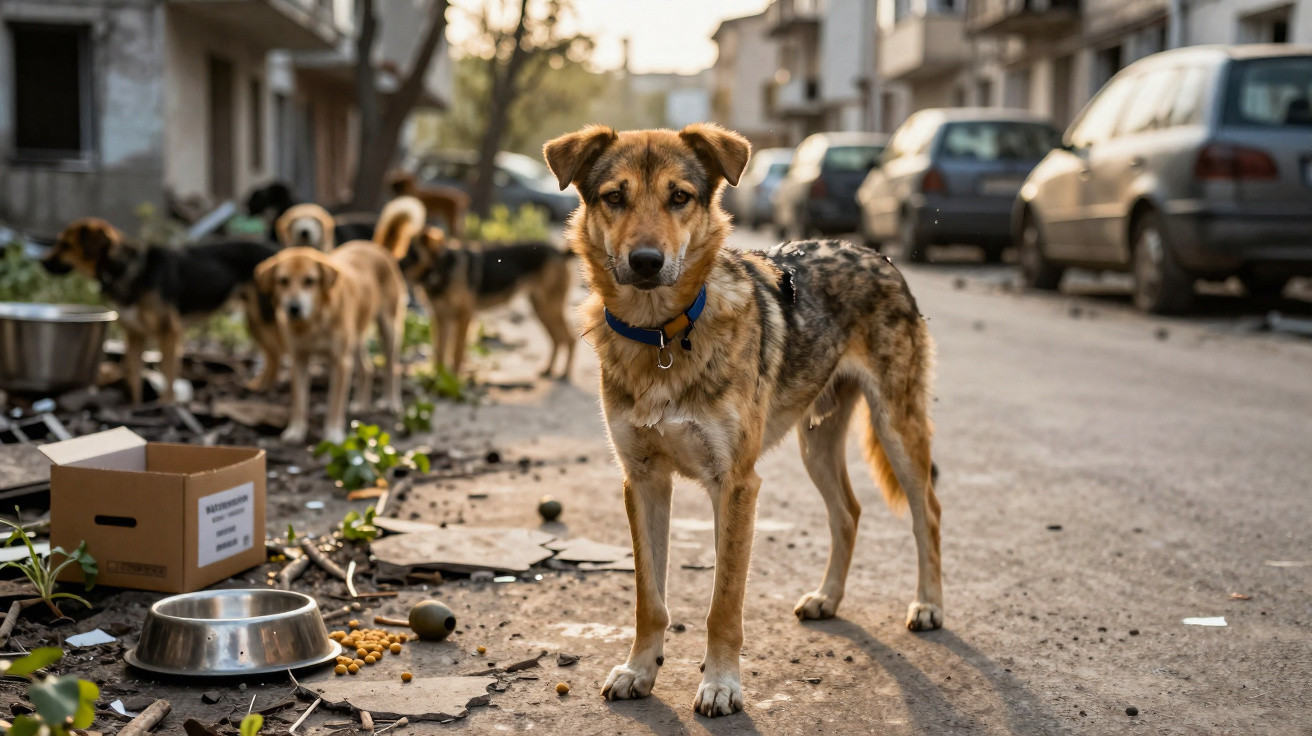
Dogs that have survived nearest to Ukraine’s front lines have, within months of continuing combat, become noticeably more wolf-like in both physique and behaviour.
Their changing appearance demonstrates how quickly war can remove characteristics formed through centuries of living alongside people.
Visible changes in dogs
In nine Ukrainian regions, free-roaming dogs close to active combat showed a concentrated combination of features that are seldom found together in populations living in peacetime.
Mariia Martsiv, of Ivan Franko National University of Lviv, recorded 763 animals and found that upright ears, slim bodies and longer muzzles were most common closest to the front.
During the ten-month observation period, the contrast between dogs at the front line and animals in safer western regions had already become pronounced.
As these shifts happened far too rapidly to result from new mutations, the evidence suggests that survival determined which body types persisted amid the fighting.
From homes to the streets
Evacuations disrupted the routines that had kept pets fed and confined, leaving many dogs abruptly dependent on scraps provided by strangers.
In a Ukrainian report, the research team noted that pets had been abandoned at railway stations and in occupied territories.
“Since the beginning of the war in Ukraine, the situation with domestic animals has been very sad,” said Martsiv.
Once their owners were gone, shortages of food and constant danger drove surviving dogs towards the behaviours and physical features most likely to keep them alive.
Rapid selection of traits
The months of warfare were not enough time for dogs to develop new genes, but they did determine which animals survived.
This process was natural selection: survival determines which traits remain widespread, and war made that process especially harsh.
“Dogs with ‘wild’ phenotypes are actually more likely to survive on the front lines: erect ears, straight tails, less white fur,” wrote Martsiv.
Describing this as reverse domestication may be misleading, since the change resulted from deaths rather than rapid new mutations.
Traits that endured at Ukraine’s front lines
Alongside body size, the team assessed every dog’s phenotype from photographs, examining outward features including ear carriage and muzzle shape.
Dogs with flat faces or especially long bodies appeared far less frequently near active combat than they did in safer locations.
Breathing difficulties among short-muzzled breeds, as well as the poor gait of short-legged dogs, can make a dash for cover unsuccessful.
As these more vulnerable forms vanished, the surviving population became less diverse, making its eventual recovery more difficult to anticipate.
Hunger and survival
Weight declined most severely in the front-line zone, where many dogs appeared undernourished even in photographs.
To measure the extent of underfeeding, the researchers compared each dog’s weight with its height and concluded that 82% were dangerously thin.
Smaller dogs were less likely to set off anti-tank mines and could more easily conceal themselves in confined spaces.
Poor body condition also indicated hunger, with the team associating the sharpest declines with the most violent areas.
Chemical evidence of hunger
Hair collected from 97 dogs enabled the researchers to examine dietary history, as hair retains a chemical record over several weeks.
The evidence came from stable isotopes – forms of atoms that provide clues about diet – in carbon and nitrogen.
Between the different zones, hair analysis indicated inadequate feeding and little animal protein, with plants accounting for some of the diet.
However, observers documented three cases of dogs chewing human remains, while aggressive strays stayed sufficiently distant to prevent sampling.
Packs emerge under fire
Photographs of 489 stray dogs indicated that solitary animals were less common near the front, while pairs and trios appeared more frequently.
Living in groups offered an advantage when food was limited, allowing several dogs to protect scraps and travel through rubble together.
In dangerous areas, larger groups contained as many as 11 dogs, and the largest clusters consisted entirely of pups.
Greater numbers of dogs moving together may also increase the risk of bites and accelerate the spread of disease, particularly where vaccination programmes have collapsed.
Disease and conflict
Elderly, ill and injured dogs were more difficult to find close to the front, not because they had recovered but because they had died.
Just three percent of front-line dogs displayed visible illness or injury, while younger animals represented a greater proportion of the population.
With veterinary care limited, lost eyes, skin conditions and infected wounds could quickly end a dog’s chance of survival.
This rapid turnover also altered which dogs bred, allowing any advantage in body shape or behaviour to become widespread quickly.
War reshapes ecosystems
Dogs provided clear evidence of these effects, but war also altered access to food and shelter for many less visible species.
As people flee, rubbish sites disappear, crops fail and new threats arise, placing animals under abrupt survival pressures.
Across towns and villages, damaged buildings and absent services can bring animals into unfamiliar contact with one another.
Monitoring animals during conflict can inform rescue work and disease control today, while also exposing longer-term ecological costs in the future.
After the ceasefire
Ukraine’s front-line dogs demonstrated that violence and scarcity can favour particular body types, diets and social behaviours within months.
Support for shelters, vaccination and humane sterilisation could safeguard both people and dogs, while providing scientists with a baseline for recovery.

















Comments
No comments yet. Be the first to comment!
Leave a Comment