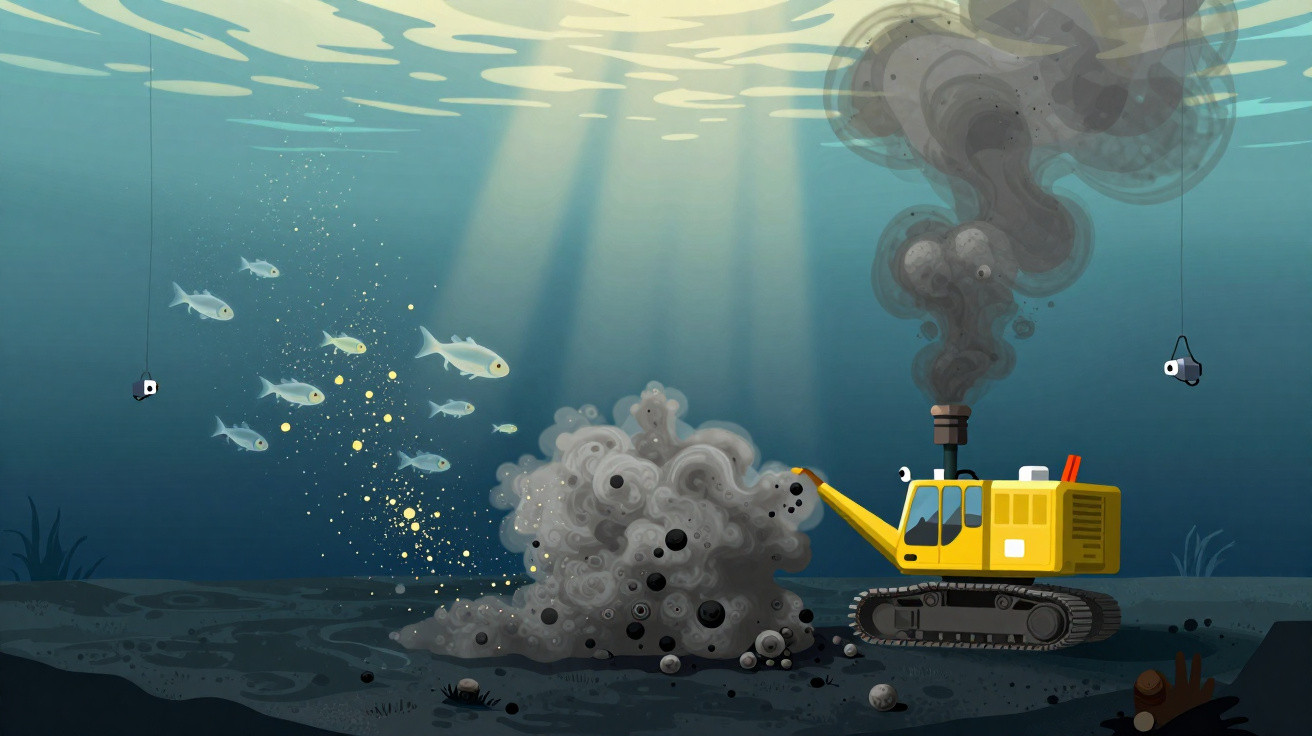
Deep ocean mining’s harmful effects are no longer confined to the seabed. The disputed practice is also emerging as a midwater concern, with possible consequences extending hundreds of metres above the ocean floor worldwide.
A new study is the first to demonstrate that waste released by mining vessels into the midwater “twilight zone” of the Clarion-Clipperton Zone (CCZ) may disturb food webs far above the seabed.
Scientists at the University of Hawaiʻi at Mānoa found that mining plumes would expose more than half of the zooplankton and about 60 percent of the micronekton found at depths of roughly 200 to 1,500 metres.
As these animals provide food for larger predators, the consequences could spread upwards through the food chain to fish, seabirds and marine mammals.
Ocean mining plumes replace nutrients
In deep-sea mining operations, sediment, seawater and crushed nodule material are pumped up to a vessel at the surface. After the nodules have been separated out, the remaining slurry is discharged back into the sea.
To prevent the seafloor from being smothered, some operators have suggested releasing this waste in midwater.
However, the latest research indicates that this approach may create another problem. Through samples collected during a 2022 mining trial in the CCZ, the researchers found that particles discharged by ocean mining contain much lower concentrations of amino acids than the natural detritus that usually sustains midwater ecosystems.
Put simply, the plume waters down the ocean’s “pantry” with poor-quality material. That replacement is significant for tiny drifting zooplankton, which already survive with limited resources.
Micronekton – including small fish, shrimps, squid and other swimming animals that feed on zooplankton – can then transmit this nutritional shortfall further up the food chain.
The ocean’s middle layer is vital
The twilight zone supports abundant life adapted to dark, resource-poor conditions, including krill, lanternfish, siphonophores, gelatinous predators and many other species.
Many of these creatures take part in the world’s largest daily migration, moving towards the surface after dark to feed before descending again at dawn.
This movement transfers carbon from the upper ocean into deeper waters, helping to regulate the climate. Most food in this zone arrives as tiny particles that slowly sink from above, and the animals living there are adapted to this reliable supply.
If a substantial share of that material is replaced by nutrient-poor sediment and crushed rock, their diet changes even though the animals remain in the same place.
Plankton unable to swim away from a plume have no choice about their exposure. The effects on predators that rely on them may be indirect, but they remain genuine.
Nutrient loss in the deep ocean
The study’s particle-chemistry comparison is central to its findings. Natural “marine snow” contains plentiful amino acids and other compounds needed by midwater organisms. Mining plumes can appear similar in particle size and form, yet they do not contain the same nutritional value.
The researchers characterise this as replacing nutrient-rich particles with “empty calories.” In an ecosystem where every available resource matters, the change could lower growth, reproduction and survival among species at the food web’s foundation.
Micronekton are a primary food source for many tuna, seabirds and marine mammals. Consequently, even relatively small declines at depth could affect fisheries and wildlife well beyond the area where waste is released.
Ocean mining rules remain unformed
Covering millions of square kilometres, the CCZ contains the world’s largest known reserves of polymetallic nodules. These nodules hold cobalt, nickel and copper used in batteries and other low-carbon technologies.
About 1.5 million square kilometres are already covered by exploration licences. Commercial mining has yet to start, while rules governing the location and method for releasing waste plumes have not been established.
The authors say there is a limited opportunity to develop suitable regulations. Should midwater discharge become standard practice before its biological costs are understood, the resulting harm could be extensive and persistent.
Trade-offs of ocean mining
The depth at which waste is discharged will determine which organisms face the greatest risk. Releasing plumes into the twilight zone could lower food quality for communities that connect surface waters with the deep sea, undermining food webs and carbon transport.
Discharging waste nearer the surface could harm larvae and photosynthetic organisms, while also allowing currents to spread it over a wide area.
Releasing it closer to the seabed presents smothering hazards and may still send particles into midwater, depending on their density and the level of turbulence.
No option is free of risk; each involves trade-offs that must be assessed using robust evidence. The International Seabed Authority is debating mining regulations, while US agencies including NOAA will assess environmental effects for projects connected with the United States.
Both will have to account for more than seabed ecosystems, considering the entire vertical water column that mining waste may affect.
Food chains in the crosshairs
Pacific tuna fisheries operate throughout the CCZ. If declining food quality reduces midwater prey populations, tuna could grow more slowly, move to different areas or become less plentiful.
This could affect nations economically dependent on tuna, as well as communities that depend on it for nutrition.
Since midwater animals link ecosystems from surface waters to the abyss, changes to their health cannot easily be contained.
Mapping the ocean’s hidden fallout
The study provides a clear initial finding: plumes in midwater can reduce the nutritional quality of twilight-zone particles, and a substantial proportion of local organisms will come into contact with them.
Further work should map plume behaviour at varying depths and discharge rates, establish how far and for how long particle quality remains diminished, and measure biological effects across different taxa.
Field trials combining plume samples with acoustic monitoring and net surveys of micronekton should prove particularly valuable.
Models should also assess the cumulative impacts of multiple mining operations and seasonal variation in the background supply of food.
Mining, nodules and ocean health
The potential role of deep-sea minerals in a low-carbon economy does not remove the need to protect intact ocean food webs.
Until regulators and operators can show that waste discharges will not deprive the twilight zone of the nutrition it requires, caution remains the only credible approach.
Selecting discharge depths, restricting plume intensity and, over the longer term, redesigning processes to reduce waste should all be considered. The ocean’s middle depths may be unseen, but they must not be excluded from the equation.

















Comments
No comments yet. Be the first to comment!
Leave a Comment