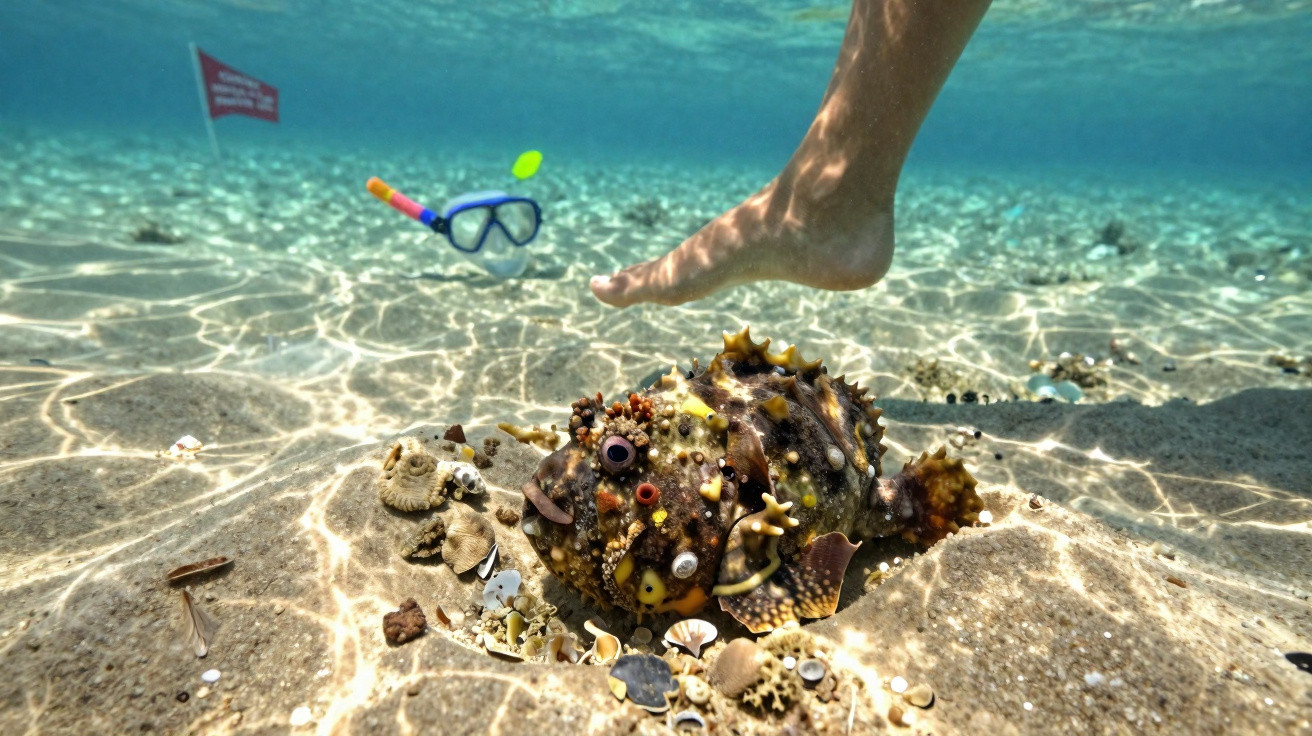
A rock coated in algae may conceal eyes, a mouth and 13 spines capable of injecting potent venom. This is how the stonefish lives: a master of stillness that can virtually vanish into the seabed. Regarded as the most venomous fish known, it pairs remarkable camouflage with a defence that commands respect.
Why does the stonefish almost vanish into the seabed?
With uneven, scaleless skin, usually patterned in shades of brown, grey, red or yellow, the stonefish resembles part of the reef. Algae and sediment can collect on its body, making it difficult to tell where the rock ends and the animal begins, even for watchful divers.
Its appearance is not solely a means of protection. The fish waits motionless for small fish and crustaceans, striking when prey comes close. It does not chase swimmers or rely on venom to hunt. Its spines are chiefly a defence against animals attempting to bite it or stepping on it.
How does the venomous defence work?
Thirteen sturdy spines run along its back and are connected to venom glands. When pressure is applied to the fish, such as from a person's foot, the spines can pierce the skin and release the substance. This is why many incidents occur in shallow water, where the animal stays concealed among sand, rocks and coral.
A scientific review published in 2021 in the journal Marine Drugs brought together studies of species from the Synanceia genus. The researchers found that the venom contains components linked to painful, cardiovascular, neurological and cellular effects, although severity differs according to the incident.
What makes a stonefish sting so painful?
Severe, long-lasting pain is the best-known symptom, often accompanied by redness and swelling. More serious cases may involve symptoms elsewhere in the body and require urgent assessment. Clinical studies place this kind of envenomation among the most painful in the marine environment.
- Intense pain may begin immediately at the affected site.
- Redness and swelling can worsen after the puncture.
- Spine fragments may remain inside the wound.
- Dizziness, nausea or breathing difficulties require immediate help.
Queensland Poisons Information Centre advises seeking hospital treatment for severe pain or a deep wound. Soaking the affected area in hot water, without any risk of burning, may ease pain while assistance is being arranged. Professional assessment remains essential.
Watch the video shared by the YouTube channel Brave Wilderness Português, demonstrating what a stonefish sting is like, the most painful sting on Earth.
Where does it live and how can encounters be avoided?
Stonefish species are found mainly in tropical regions of the Indian and Pacific Oceans. They may inhabit reefs, sandy seabeds, gravelly areas and shallow stretches near the coast. Because they remain still for extended periods, touching the seabed without being able to see it is one of the main risk situations.
Paying attention to local warnings, avoiding contact with marine animals and not placing hands or feet on unfamiliar rocks are straightforward preventive measures. In areas where the species occurs, robust water shoes can reduce certain risks, but they do not replace caution or guarantee protection from the spines.
Attention turns curiosity into safety
Despite its alarming reputation, the stonefish is not an aggressor searching for victims. It is an ambush predator and part of the marine ecosystem, using camouflage to survive. The danger arises when its unseen presence meets a hurried step or a hand placed in the wrong spot.
Before entering a tropical beach, find out which species live in the area and follow the available warnings. On the seabed, what looks like a rock may be alive. Take extra care now, share this information and turn admiration for nature into a conscious choice for safety.

















Comments
No comments yet. Be the first to comment!
Leave a Comment