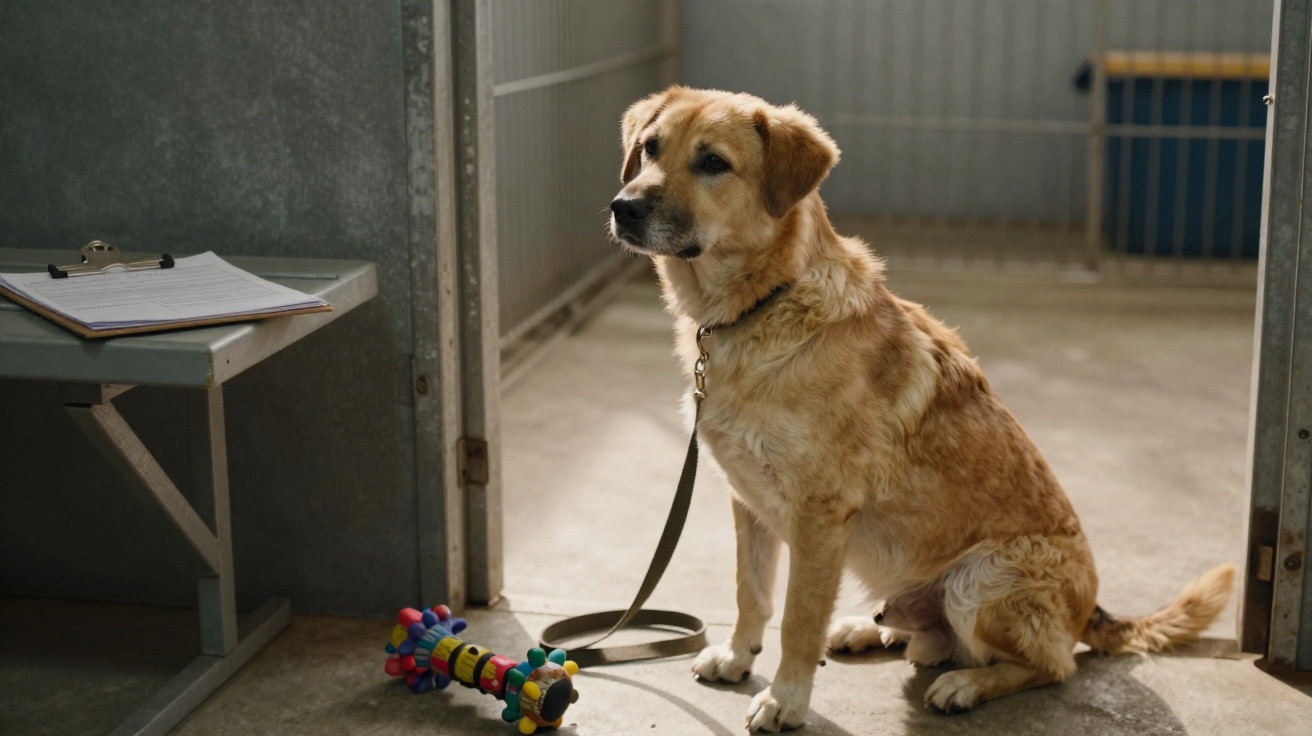
The dog had selected his place beside the metal door. With his nose nearly touching the gap, his ears flicked up whenever a latch clicked in another kennel. The staff attempted to tempt him elsewhere with treats, toys and soft blankets set aside for him. He would trail after them for a few paces, chew courteously, wag his tail once or twice… then loop back to lie down, staring at the entrance as though it led home.
He had been signed over that morning with a plastic bag of toys and a brief, trembling explanation.
The bag now sits in the office.
He remains by the door.
The dog who would not leave the shelter door
The original video lasted just fourteen seconds. It showed a healthy-looking, medium-sized tan-and-white crossbreed pressed against a shelter door as barking rang through the rest of the kennel block. The camera moved in closer. He neither barked nor cried. Instead, whenever footsteps sounded in the corridor, he looked up, his tail making small, hopeful taps against the concrete.
Staff later explained that he stayed there for hours and would not settle into his bed. He nodded off while sitting upright, then startled awake each time somebody passed. The way he searched every face was unsettlingly similar to a person scanning a crowd for a delayed train.
He was not a desperate stray rescued from a ditch. This dog had a name, a microchip, a bed and a family Christmas photograph still attached to the shelter intake form. His owners had handed him over with a strained apology and a phrase the reception staff hear all too often: “We just can’t keep him anymore.”
They departed fast. Staff took him to the back, while he repeatedly tried to turn towards the car park, confused yet compliant. Once he entered the kennel run, it was clear he was trying to make sense of it all: tracing scents and taking in unfamiliar noises. The door closed, reducing his world to chilly walls and the single rectangle that occasionally opened.
Why does he stay fixed to that door? To him, it is a waiting room rather than a prison. Dogs do not pick up a suitcase and announce, “Guess that chapter’s over.” Their lives are shaped by routines, repeated patterns and bonds that seem unchanging. Yesterday, they left and came home. Today, they leave… and nothing is the same.
In his mind, the calculation is straightforward: whenever that door opens, his people might be waiting beyond it. Every creaking hinge and echoing footstep renews that small hope. The cruel truth is that, in cases like his, that hope is almost always misplaced.
What happens after “we had no choice”
Most stories like this never become viral. They unfold unnoticed amid intake paperwork and metal ID tags. A household faces a crisis: eviction, separation, a baby on the way, or a landlord abruptly enforcing a no-pets rule. In other cases, allergies are the issue, or a ruined sofa, or the costs of age and veterinary care mounting more quickly than expected.
They arrive at the desk looking guilty and distressed, accompanied by a dog that trusts them completely. The dog sits, wags and watches the people move their attention between one another, as though awaiting the joke. A pen signs the form, the lead changes hands and, within minutes, everything the dog knows about “home” has been altered without any say from them.
Shelter workers witness trends that most people rarely see. Surrenders rise soon after Christmas, increase when rents go up, and surged after the pandemic as “lockdown puppies” were returned once life became busy again. One worker at a crowded city shelter told me that intakes are now booked like medical appointments because the number of walk-ins became too great to handle safely.
She spoke of dogs like this one that remain beside the door for days and then weeks. Initially, they are alert and full of expectation. Some hear a car outside, recognise the sound and brighten instantly. After repeated disappointments, their stance changes: they become less eager and more defeated, while continuing to occupy the very same patch of concrete. The door represents both hope and heartbreak.
From the human perspective, giving up a dog is often wrapped in gentler language: “He’ll find a better home,” or “She deserves more than we can give.” At times, that may be true. At others, it is a narrative people use to help themselves sleep. The stark fact is that a shelter is not always a safe place to land. Some are overwhelmed, some lack funding, and some still euthanise animals for lack of space when kennels are full.
To be frank, hardly anyone studies their local shelter’s capacity or policies until they are at the counter, lead in hand. The dog by the door is bearing the consequences of that lack of planning. His loyalty lasts longer than the practical pressures that brought him there. He is not an unusual case; he is the usual case with a camera trained on him.
How to stop a dog ending up at the shelter door
One difficult, unglamorous measure quietly prevents thousands of pets from meeting this fate: making plans well before anything becomes urgent. It is dull, un-Instagrammable preparation, and it begins long before you fall for a pair of brown eyes at a rescue stand.
Ask yourself the uncomfortable questions. What would happen if I lost my job? Who could care for this dog if I spent a month in hospital? Is my landlord’s pet policy merely something we discussed, or is it included in my tenancy agreement? Is there an affordable veterinary clinic nearby for those “surprise, he swallowed a sock” incidents? Creating even a small emergency pet fund, naming two back-up carers and knowing which local rescues can help is not excessive. It is kindness built gradually.
Most people do not give up their dogs because they are cruel. When a crisis arrives, their focus contracts to “today” and “survival”. Everything else can feel open to compromise, including the animal asleep at their feet. That does not excuse promises being broken, but it helps explain why blaming people seldom brings change.
What makes a difference is an honest conversation about limits. How much chewing, barking or reactivity could you genuinely cope with? What training support would you seek before deciding that a dog “doesn’t fit your lifestyle”? If you are already struggling and too ashamed to speak, there are still smaller actions that are better than entering an overcrowded shelter and shutting the door on a dog that does not know it is permanent.
A seasoned volunteer put it this way: “People think surrender is the last resort. For the dog, it’s the moment the world falls out from under them. The real ‘last resort’ should be everything we try before that drive to the shelter.”
- Create a pet safety net: Note down two friends or relatives who could foster your dog during a crisis. Speak to them now rather than waiting.
- Know where to find local support: Look up nearby rescues, behaviourists and low-cost veterinary options while you are calm, not when panic has set in.
- Train the person as well as the dog: Basic training classes benefit owners as much as pets. Understanding how dogs respond to stress can prevent problems from escalating.
- Be truthful before adopting: Disliking mud, noise or daily walks does not make you a bad person. It does mean a high-energy shepherd puppy is unlikely to suit you.
- Seek help early: Rehoming through a trusted personal network, with openness and sufficient time, is generally much safer than surrendering a dog to a shelter on the same day.
The dog at the door and what that image asks of us
A viral video of a dog unwilling to leave a shelter entrance stays with people because it feels painfully recognisable. Most of us know the feeling of waiting for somebody who will not return, long after everyone else has begun to carry on. This dog is simply experiencing it on grimy concrete, beneath humming fluorescent lights, while strangers record him for social media.
Such clips may prompt a burst of anger or pity, followed by a rapid adopt-share-comment cycle that fades within 24 hours. But their quieter force lies in the questions they leave once the phone is put away. Do we treat pets as decoration or as family? Do we support housing policies and local budgets that prevent shelters from becoming overwhelmed? Are we prepared to discuss the tedious, unromantic realities of pet ownership that never go viral, yet can determine whether a dog ends up pressed against a metal door?
Stories like his do not require us to be consumed by guilt. They require small, practical changes before another lead is passed over at a reception desk. Somewhere tonight, he is still listening for familiar footsteps beyond that door. The question remains beside him: when the next dog waits in the same place, will their story unfold differently because of what we decided to do today?
| Key point | Detail | Value for the reader |
|---|---|---|
| Emotional reality for surrendered dogs | Dogs may wait beside doors for their owners’ return long after being surrendered. | Helps readers understand the unseen consequences of “we had no choice” decisions. |
| Why surrenders happen | Housing, finances, life changes and poor preparation can rapidly lead to a shelter. | Acknowledges the pressure while continuing to emphasise responsibility. |
| Practical prevention steps | Emergency arrangements, realistic self-assessment and seeking help early lower the risk of surrender. | Provides readers with practical ways to protect their own pets from the same outcome. |
FAQ:
- Question 1: Why do some dogs wait by the shelter door rather than explore their kennel?
- Question 2: Is surrendering a dog always a cruel or selfish act?
- Question 3: What are better alternatives to taking a dog directly to a shelter?
- Question 4: How can I prepare so that I never have to surrender my dog?
- Question 5: What can I do if I cannot adopt but still want to help dogs like the one in the video?





Comments
No comments yet. Be the first to comment!
Leave a Comment