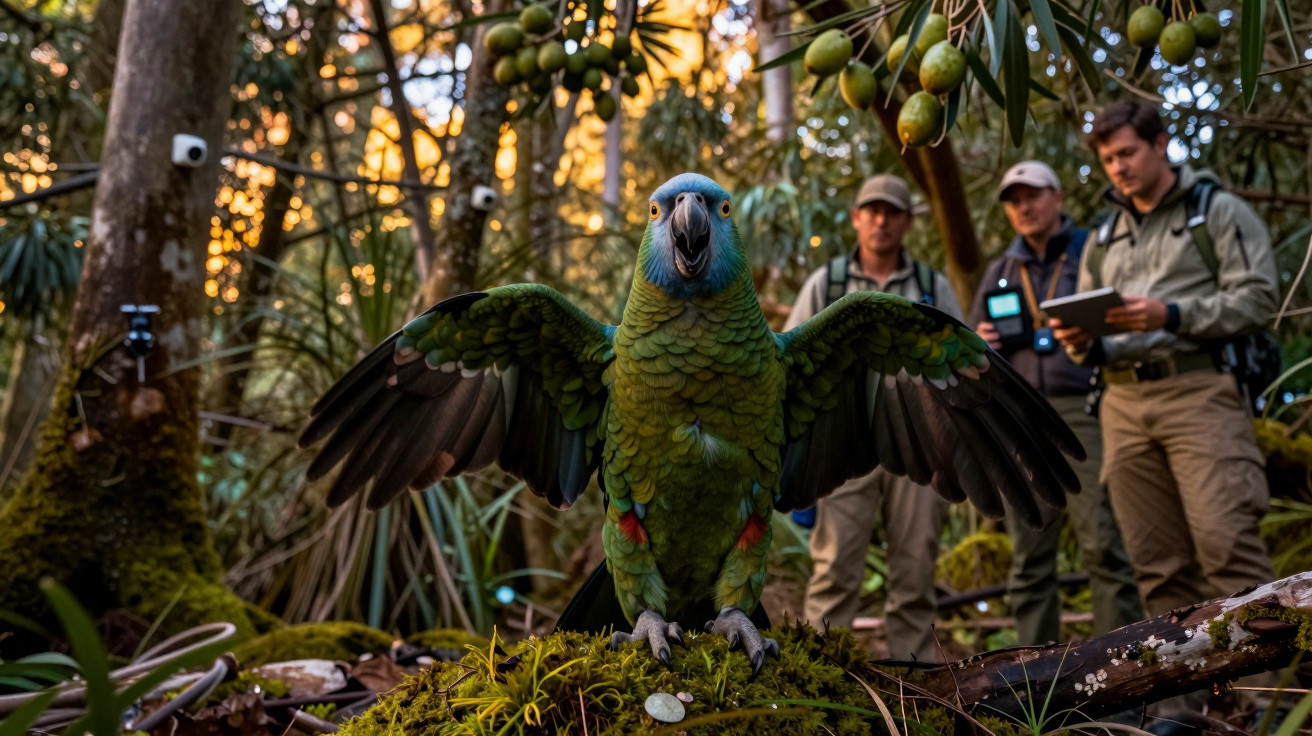
On New Zealand’s damp slopes, aerials concealed among centuries-old conifers have begun picking up signals that nobody had dared to promise.
After years of silence and tense anticipation, a plump, flightless nocturnal parrot has returned to the heart of scientific attention. Short beeps transmitted by radio collars suggest that life is, quite literally, attempting to begin again among moss-covered trunks and trees that flower only from time to time.
A parrot that defied the odds
The kakapo, at the centre of this story, is an unlikely figure in a tale of hope. It is a moss-green, heavy, nocturnal, ground-dwelling parrot. It cannot fly, moves with an awkward run and relies on a particular type of forest to survive. For thousands of years, it thrived in New Zealand, where mammalian predators were virtually absent.
That balance was swiftly broken with the arrival of people, rats, cats and stoats. The kakapo became easy prey. By the beginning of the 20th century, the species was already collapsing. In the 1990s, biologists counted just 51 living birds, dispersed across islands and isolated refuges.
Three decades later, the outlook has shifted, although it remains precarious. Official figures from the Department of Conservation (DOC), New Zealand’s environmental agency, recorded 236 kakapos at the start of 2026. Of those, 83 are breeding-age females. For an animal that nearly vanished from the wild, every one of these birds is a valuable piece in a delicate genetic and survival puzzle.
The start of the 2026 breeding season is regarded as the best opportunity in decades to bring stability to a species that has lived on the brink.
The forest signal: rimu takes centre stage
The change in 2026 was not accidental. Kakapos do not breed every year. Their cycle is tied to a native tree, the rimu, a conifer capable of living for more than 600 years. When these trees enter a rare period of mass fruiting, the entire forest changes pace.
In these exceptional years, the canopy is laden with nutritious fruit. For female kakapos, this abundance acts as a trigger. Without enough food, they simply do not begin breeding. When rimu has a “good year”, however, the response is different: hormones surge, body weight increases and behaviour changes.
The last major fruiting event occurred in 2022. Since then, the species had not recorded another mating season. In January 2026, radio sensors fitted to monitored birds began detecting movement and activity patterns typical of courtship and meetings between partners. Scientists immediately understood the message.
The unseen spectacle of nocturnal leks
Once the season gets under way, male kakapos gather in designated places known as leks. There, each bird digs a shallow hollow in the ground, like a natural bowl that acts as a resonance chamber.
At night, the forest becomes a sound stage. Males produce deep calls, almost like drumbeats, which can travel for several kilometres. Females walk through the darkness, drawn by this low vibration, until they select a mate.
These nocturnal “concerts”, rarely seen directly, act as a gauge of the health of both the ecosystem and the kakapo population itself.
After mating, the male’s role ends. The female alone tends the nest, eggs and, if all goes well, a single viable chick. The species moves at a slow, almost stubborn pace. This is why any season with few failures and some successes can make a statistical difference.
Kakapo conservation reassessed: less human input, more natural behaviour
For years, the kakapo recovery programme followed an intensive approach: removing eggs from nests, using artificial incubation, hand-feeding chicks and closely overseeing every stage. The priority was to increase numbers as quickly as possible.
That model worked to a degree. Without it, the species would probably have disappeared. Yet it also produced unexpected side effects. Some birds began to see humans not as a threat, but as social partners. One of the most widely discussed cases is Sirocco, a male that became famous worldwide for attempting to mate with people during field visits. It may sound anecdotal, but biologists see it as a clear sign of altered behaviour.
For this reason, the 2026 season represents a strategic shift. The instruction now is to intervene less and observe more. Eggs should remain in nests whenever possible. Chicks should be handled less. Mothers with two or three young should be allowed to manage on their own, even if this carries some risk.
- Less artificial incubation of viable eggs
- More intensive remote monitoring and less physical presence
- Priority given to learning natural behaviours
- Selective use of technology, only in critical cases
The aim is no longer simply to produce high numbers, but to create a population able to live without permanent human babysitting.
What is at stake in this historic season
With 83 breeding-age females and rimu fruiting on a large scale, 2026 is expected to produce the highest number of active nests in three decades of monitoring. The first chick “boom” is anticipated from mid-February.
For scientists, every chick born and kept healthy without major intervention creates scope for a more ambitious goal: recolonising former kakapo ranges in New Zealand. This plan, however, relies on another immense challenge: establishing islands and mainland areas free from introduced predators.
| Year | Estimated number of living kakapos | Defining factor |
|---|---|---|
| 1995 | 51 | Official recognition of an extreme extinction risk |
| 2022 | about 200 | Last major rimu fruiting before 2026 |
| 2026 | 236 | Highest number of monitored breeding females |
Balancing technology with ecological timing
The kakapo project has also revived a global conservation biology debate: how far should technology go? Radio transmitters, incubators and thermal cameras have saved lives. But if used without limits, they can create populations dependent on lifelong care.
In New Zealand, the recent decision seeks a middle ground. Equipment remains in use, especially to locate nests and monitor ill animals. The difference is that the focus is shifting towards behavioural independence. In practical terms, the species needs to relearn how to be wild.
The programme’s true success will be measured on the day the kakapo can sustain its own story without scientists having to watch every step.
Understanding the ecological and cultural context
Ecologically, the kakapo acts as an indicator of the health of native forests. A strong breeding season signals not only successful rimu fruiting, but also a balance involving climate, soil, pollinating insects and the absence of predators at critical levels.
There is also a strong cultural dimension. Māori communities, including Ngāi Tahu, work alongside the DOC in decision-making. For these groups, the kakapo is not merely a threatened animal, but a taonga, a living treasure connected to ancestral narratives. This perspective shapes both the pace of management and how results are celebrated: more as a renewed relationship with nature than as a purely technical project.
Risks, future scenarios and what could go wrong
Despite the encouraging signs, substantial risks remain. A single poor rimu season can halt population growth for years. Respiratory diseases, common in small and genetically closely related populations, remain a concern for veterinary teams.
Under a negative scenario, a run of years with limited fruiting combined with disease outbreaks could cause kakapo numbers to fall again. That would force a return to more intensive interventions, with greater financial cost and a higher risk of once again changing the birds’ behaviour.
In a more optimistic scenario, if the current breeding pace continues and predator eradication progresses, secure areas could be expanded to release new kakapo groups in regions that are currently inaccessible to the species. Every new predator-free island would provide additional insurance against unforeseen events.
Terms such as “lek”, “endemic species” and “mast fruiting” are likely to appear frequently in this discussion. It is useful to remember that leks are mating arenas where males compete for attention through sound and displays. An endemic species exists only within a particular geographical area, as is the case for the kakapo in relation to New Zealand. Rimu mast fruiting, meanwhile, is the quiet engine that periodically opens the window for historic seasons such as 2026.

















Comments
No comments yet. Be the first to comment!
Leave a Comment