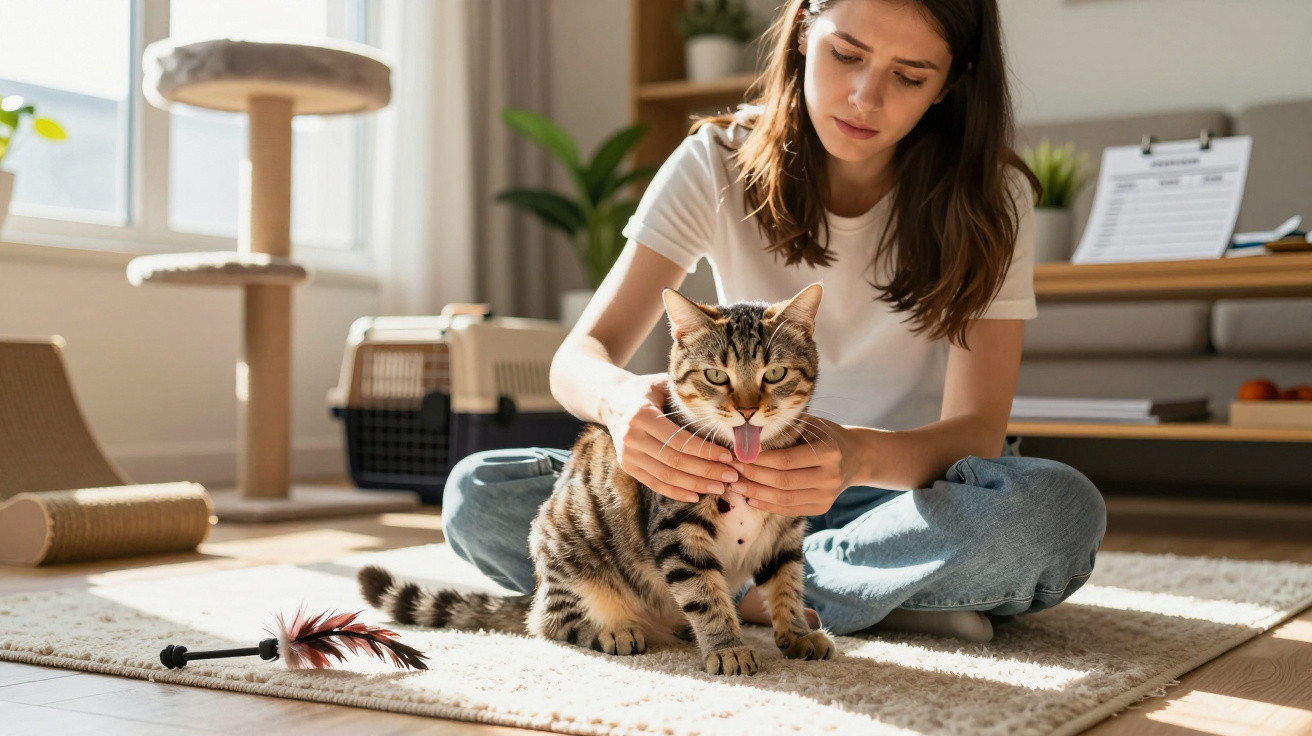
Many owners hardly register the change at first. One day, the coat seems slightly sparse; the next, there is a bald patch on the belly and a cat that appears inseparable from its fur. So when does ordinary grooming end and a warning sign of stress begin?
When grooming becomes an obsession
Cats have a well-earned reputation for cleanliness. Healthy adult cats commonly spend roughly one-third of their waking time grooming, which is entirely normal. Washing spreads natural oils through the coat, maintains its condition, helps regulate body temperature and releases soothing endorphins.
The concern starts when this behaviour no longer follows its normal pattern. A cat that leaves a game or steps away from its food bowl to lick in a frantic way is not “just washing”. It is attempting to cope with something it cannot get away from.
When licking becomes hard to interrupt, you’re no longer looking at grooming, but a nervous discharge.
Look out for the following:
- Short bursts of licking that are rapid and intense rather than slow and relaxed
- A cat that appears “stuck”, repeating the same action on one particular area
- An inability to stop even when you call it, move around or offer a toy
- Grooming that becomes the default reaction whenever the cat feels startled or unsure
At first, many owners see this as charming. The cat can look absorbed, almost meditative. However, its coat and skin eventually suffer: the hair first becomes coarse, then sparse, and finally disappears.
Symmetrical bald patches: the subtle sign of anxiety
The distribution of the hair loss is an important clue that stress may be involved. Skin conditions caused by fungi, parasites or allergies usually create uneven, irregular patches. The affected areas emerge where the irritant or infection is spreading or causing the greatest discomfort.
Overgrooming related to stress, on the other hand, can appear unusually orderly.
Symmetrical bald areas on the belly or inner thighs strongly suggest stress-related over-licking in many cases of feline hair loss.
Using both front paws to brace itself, the cat works with almost mechanical accuracy from one side to the other, focusing on spots it can easily reach while lying down or sitting. This often leaves a neat, almost geometric pattern: a bald belly, bare inner thighs and, in some cases, a band along the flanks.
Veterinary professionals may call this pattern psychogenic alopecia: hair loss caused by the mind rather than an infection or allergy. The cat is relying on the one self-comforting mechanism over which it has complete control - its tongue.
Don’t skip the medical check first
Even so, anxious behaviour can occur alongside physical discomfort. Assuming that stress is the sole cause without a thorough examination would be unsafe.
| Possible cause | Typical signs |
|---|---|
| Fleas or mites | Scratching, tiny scabs, small dark specks in the coat |
| Fungal infection (ringworm) | Round or irregular bald patches, scaly skin |
| Food or environmental allergy | Red, inflamed skin, frequent scratching, ear issues |
| Pain (e.g. bladder, joints) | Licking one area intensely, changes in urination or mobility |
| Stress/psychogenic alopecia | Symmetrical, clean hair loss; cat otherwise appears healthy |
For example, a bladder condition may lead a cat to obsessively lick its lower abdomen because pain is felt in that area. A vet alone can rule out these causes through testing and a physical examination.
Why stress affects cats more than we realise
After pain and parasites have been excluded, attention should turn to everyday life. Many cats live indoors with little influence over their environment. They depend on routine and predictability, so changes that seem insignificant to people can feel seismic to them.
Common triggers include:
- New furniture or rooms that have been rearranged
- Building work, noisy neighbours or regular visitors
- The arrival of a baby, new partner, dog or another cat
- A change to the owner’s timetable, particularly lengthy absences
- Ongoing boredom through long, dark winter days
A species built to stalk, climb and patrol its territory can develop a constant, low-level strain when confined to a quiet flat with too little stimulation. Grooming then becomes the cat’s own stress-relief app.
Rebuilding calm: change the environment, not the cat
Creams applied to the skin and bandages seldom solve these cases, as most cats simply lick them off. The key lies instead in the animal’s living environment and the way it can interact with it.
The more a cat can act like a cat, the less it needs to lick itself to cope.
Give your cat more control
For cats, elevation offers reassurance. Being high up allows them to observe their territory and feel secure.
- Install shelves, tall scratching posts or a sturdy bookcase with safe resting places
- Provide at least one elevated area in every main room the cat uses
- Put beds or blankets in places the cat already chooses to sit, rather than only where they look attractive
Food can offer more than nourishment, too. In the wild, cats must work to obtain every meal, whereas indoor cats rarely receive that mental challenge.
- Try puzzle feeders or activity bowls that require your cat to “hunt” for dry food
- Divide meals into several small portions and hide them around the home
- Keep part of the daily ration for brief tracking games or for throwing pieces for the cat to chase
Shape behaviour with calm, not punishment
Telling a cat off for licking creates a confusing response. The cat is already unsettled, and a raised voice or physical gesture only adds more stress, potentially making the grooming more intense.
A better approach is to:
- Remain neutral while the cat licks: do not shout or clap your hands
- Gently offer a toy, a brief play session or a treat as soon as it pauses
- Reinforce relaxed body language, such as stretching out, soft eyes and slow blinking
With time, the cat learns that quiet moments without grooming lead to pleasant experiences, while obsessive licking receives no particular reaction.
Reading your cat’s “mental weather report”
A bare belly on an otherwise fluffy cat is not an unusual style preference. It is communication. The coat may act as a barometer for mental health, showing strain well before the cat becomes aggressive or withdrawn.
Think of excessive licking as an early warning system for emotional overload.
Some owners do not act until the skin becomes raw or starts bleeding. Responding earlier, once ongoing thinning is noticed, gives both you and your vet greater scope to help. Hair loss caused by stress often improves after calm is restored and routines feel secure again, although regrowth may take weeks or months.
Helpful concepts: alopecia, pruritus and self-soothing
Three terms frequently arise when discussing cats that groom excessively:
- Alopecia: the straightforward medical term for hair loss, whatever its cause.
- Pruritus: the feeling of itchiness that causes an animal to scratch or lick.
- Self-soothing: actions an animal uses to settle itself, including grooming, kneading or sucking fabric.
In cases driven by stress, there may initially be little or no pruritus. The cat is not itchy; it feels unsettled. Grooming consequently becomes self-soothing. Eventually, the irritated skin can begin to itch as well, producing a cycle that is more difficult to stop.
Real-life scenarios and what you can do
Consider a cat that begins overgrooming when its owner moves to night shifts. No one is home during the evening “zoomies window”, play sessions become less frequent and the flat is considerably quieter. Several weeks later, the owner spots a bare area on the cat’s tummy.
In this situation, relatively simple changes may make a difference: timed feeders to structure the night, window perches for observing activity outside, and 10–15 minutes of dedicated play before the owner goes out. Pheromone diffusers can provide additional support by creating a familiar scent environment associated with safety.
In homes with several cats, one cat may begin excessive licking after being subtly intimidated by another. There may be no obvious fights, only blocked access to litter trays or corridors. In this case, providing additional resources - more litter trays, extra feeding stations and further hiding places - alongside separate play sessions can reduce friction and lessen the need to self-comfort through grooming.
Left unaddressed, ongoing stress can contribute to other conditions, including cystitis, digestive disturbances and aggression. Improving environmental enrichment and emotional balance does not merely protect the coat; it also supports the cat’s wider health and household harmony.

















Comments
No comments yet. Be the first to comment!
Leave a Comment