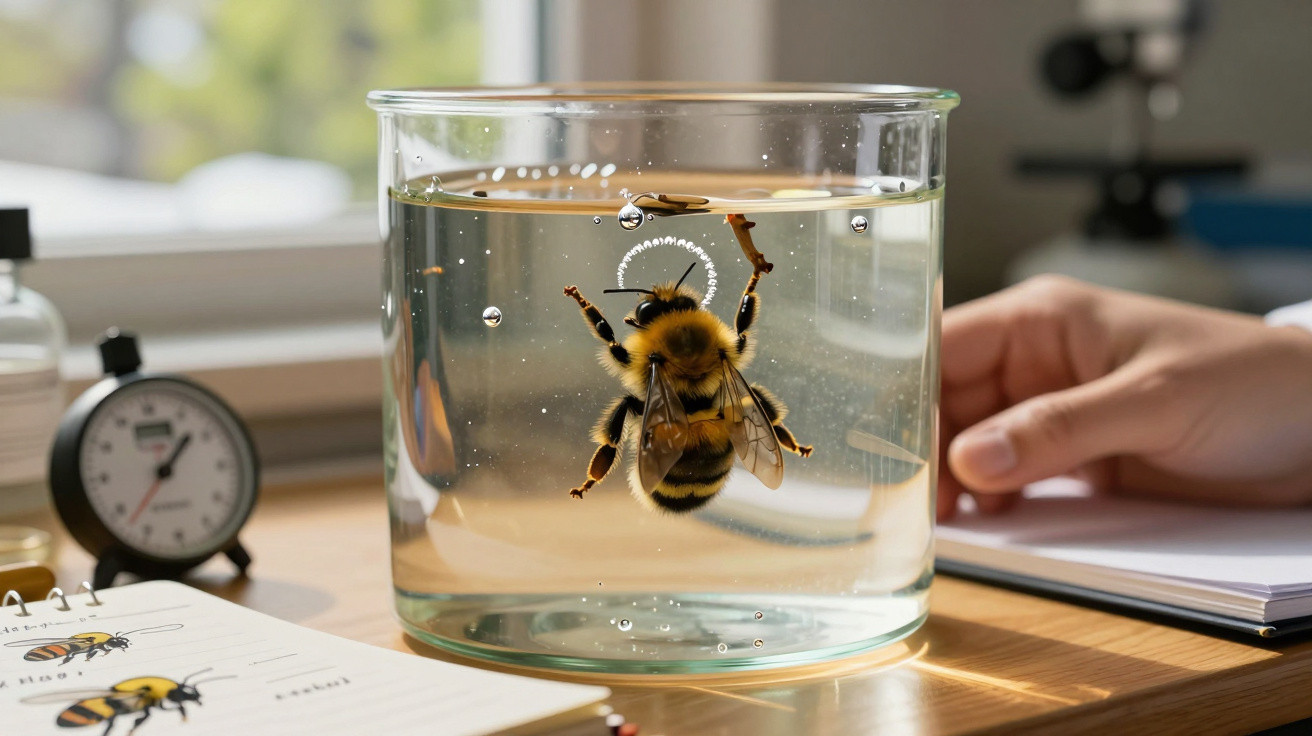
Most people picture bumblebees as furry insects humming over flower-filled meadows. Yet a different drama unfolds deep below ground during winter. New research suggests that bumblebee queens can not only remain motionless in the soil for weeks, but can also survive prolonged flooding – while breathing directly underwater.
A burst cooling hose, four ‘dead’ bumblebees – and every one survived
This remarkable story began not in a woodland setting, but in a laboratory at the University of Guelph in Canada. In 2020, biologist Sabrina Rondeau was preparing overwintering bumblebee queens for experiments. The insects were resting quietly in small tubes, chilled as though they were in an artificial winter burrow.
During the night, a refrigerator leaked and flooded the compartment. By the following morning, four bumblebee queens had been floating in their flooded containers for more than 12 hours. For insects that live on land, this would normally mean certain death. Rondeau expected to find lifeless bodies – but all four insects were still moving.
What appeared to be a laboratory mishap proved to be evidence of an ability no one would have expected in a terrestrial insect: surviving underwater for weeks.
The researcher decided to investigate further. In a systematic series of tests, she exposed 143 bumblebee queens to cold water. The insects were in diapause, the dormant state in which they normally rest alone in small underground chambers from November to March.
The findings challenge conventional assumptions: after seven days of continuous submersion, 81 per cent of the bumblebee queens were still alive. Some individuals even survived a full eight days underwater. More surprisingly still, the proportion of survivors was higher than in the control group, which spent the same week in normal air.
How bumblebee queens truly survive winter
In autumn, bumblebee queens naturally burrow several centimetres into loose soil. There, they spend winter immobile and in deep cold-induced dormancy. The ground acts as a protective barrier against frost, predators and weather-related fluctuations.
In wet winters, however, this strategy has a weakness: soil can become saturated, with underground spaces filling completely with water. For an animal without gills, that sounds like a death sentence. Until recently, no one had seriously tested how long bumblebee queens could withstand such flooding.
This is precisely where the new study begins. Its results indicate that bumblebees may have quietly evolved to cope with recurring winter floods. They appear to do so through an astonishing combination of physics, biology and energy conservation.
The bumblebee queens’ trick: breathing without gills
How can a bumblebee queen breathe when she is surrounded by water? To answer this central question, the research team measured both oxygen consumption and carbon dioxide production in the submerged insects in the laboratory.
The measurements clearly show that bumblebee queens are not simply holding their breath. They continue to absorb oxygen underwater – but use it extremely sparingly.
Three elements create this survival mode
The study authors describe a three-part mechanism that enables survival in water:
- Passive gas exchange through the body covering: A bumblebee’s outer layer, known as the cuticle, is not entirely airtight. Dissolved oxygen slowly passes from the water into its tissues.
- A hair-based ‘physical gill’ layer: When a bumblebee enters water, the fine hairs on its body retain a thin film of air. At this boundary, oxygen diffuses from the water into the air layer and then into the respiratory openings, known as spiracles.
- A radical winter energy-saving mode: During diapause, the queen dramatically reduces her metabolic rate. In the experiment, carbon dioxide production fell from an average of 14.4 to just 2.35 microlitres per hour per gram of body weight once the insects were underwater. This cuts oxygen demand to roughly one sixth.
Without such an extreme reduction, the oxygen arriving passively through the skin and air layer would never be sufficient. The bumblebees would suffocate within hours. It is this exceptional low-energy state that turns minute diffusion processes into a viable breathing strategy.
What happens inside a bumblebee queen’s body
During winter, bumblebee queens reduce many bodily processes to a minimum: heartbeat, nerve activity and digestion continue only at very low levels. The insects barely move at all. Soil temperatures are often just above freezing, which saves further energy.
Underwater, this condition becomes even more pronounced. The bumblebee uses almost none of its stored reserves and can manage with tiny amounts of oxygen. At the same time, its slow metabolism is sufficient to keep cells and organs functioning. It is a kind of biological standby mode.
How climate change affects bumblebees
Heavy rainfall events are becoming more common in Europe and North America. Soils freeze later, remain wet for longer and are flooded more frequently. For bumblebees, this could become a decisive factor – depending on how resilient their underwater survival trick proves to be over time.
At first glance, the ability to survive underwater for several days seems like an evolutionary gift – it could save bumblebees precisely as climate change makes their winter refuges less secure.
This protective mechanism is not risk-free, however. Bumblebee queens rely on fat reserves throughout winter. They do not feed, instead surviving for months on stores accumulated in late summer. Any additional strain, such as repeated flooding, uses energy.
Rondeau’s team now wants to examine how longer periods underwater affect the insects’ fat reserves. The key question is whether enough energy remains in spring to establish a nest, lay eggs and rear the first workers.
Unanswered questions: how long can they cope?
In the laboratory, some bumblebee queens survived underwater for eight days. Whether this represents the absolute limit is not yet known. The experimental series ended at that point, as the researchers did not want to deliberately push the insects to their limit.
It is also unclear how bumblebees deal with several flooding episodes during a single winter. In nature, soils can repeatedly freeze, thaw and fill with water again. Whether the insects can tolerate several cycles of submersion and re-emergence still needs to be tested.
| Question | Current state of knowledge |
|---|---|
| Maximum survival time underwater | At least 8 days in the laboratory; upper limit unknown |
| Several submersion periods per winter | Not yet systematically studied |
| Effects on the ability to found new colonies | Suspected risks from faster depletion of fat reserves |
| Occurrence in other insect species | Considered possible, but scarcely researched so far |
Why this research matters far beyond bumblebees
Many pollinating insects overwinter in ways similar to bumblebees: deep in the ground, often alone and in small cavities. These include some solitary bees, certain wasp species and ground-dwelling beetles. If bumblebee queens can tolerate flooded soil for weeks, other insects may possess comparable abilities.
This has major implications for agriculture and conservation. Bumblebees are among the most important pollinators of wild plants and crops. In some regions, they carry out much of the work otherwise performed by honeybees. Their winter survival helps determine how many colonies begin in spring and how effectively fields and fruit trees are pollinated later in the year.
What people can do in practical terms
Impressive though this underwater survival trick may be, bumblebees remain vulnerable. Anyone hoping to make a garden or balcony more bumblebee-friendly can take several steps to prevent queens from facing such extreme conditions in the first place:
- Structurally varied soil: Unsealed areas that are not constantly dug over provide better winter shelter.
- Piles of leaves and dead wood: These features offer protection from heavy rain and frost while creating microhabitats.
- Flowers from spring through to autumn: This allows future queens to build up fat reserves in good time.
- Avoiding pesticides: Toxic substances weaken the insects and reduce their chances of surviving winter.
Ultimately, the study illustrates how adaptable insects can be – and how many secrets even apparently familiar species still hold. The furry bumblebee queens that buzz among flowers in summer lead a hidden existence as underground survival specialists in winter. The fact that they can, when necessary, ‘breathe underwater’ for an entire week fundamentally broadens our understanding of these insects.

















Comments
No comments yet. Be the first to comment!
Leave a Comment