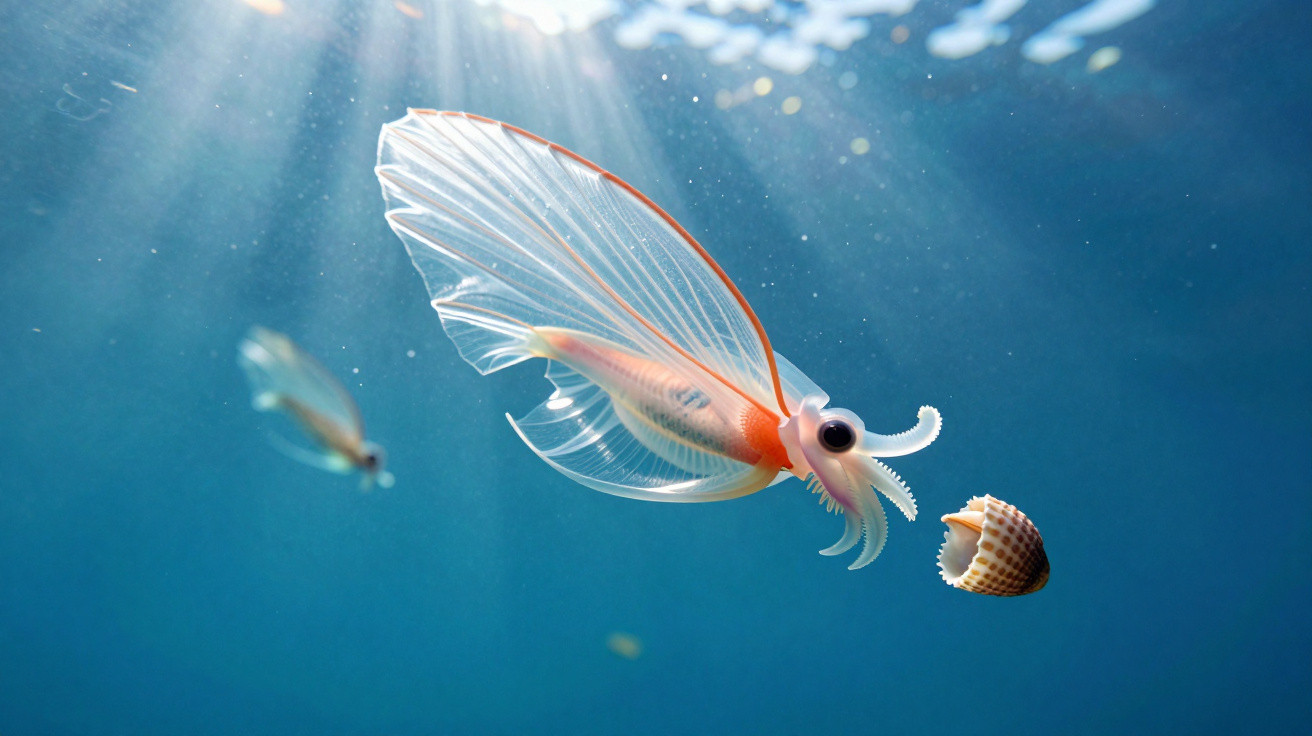
At first glance, the sea angel looks as though it belongs in a fantasy illustration: it has a small, almost transparent body, delicate colouring and two structures that move like wings. Yet the scene changes entirely as soon as prey appears. Clione is a predatory sea snail that can extend structures from its head to pull another mollusc from its shell.
Why does the sea angel appear to have tiny wings?
The sea angel belongs to a group of molluscs adapted to living in open water. Rather than crawling across a surface like many snails, it swims by using two lateral body extensions known as parapodia. Their rhythmic movement resembles beating wings, helping to explain the creature’s common name.
Its translucent body further enhances this delicate appearance. In some species within the Clione genus, internal parts are visible through the tissues, while orange or reddish areas create a striking contrast. The curious detail is that this graceful-looking animal is also a highly specialised hunter.
Is the sea angel really a snail?
Despite its unusual appearance, it is. Clione is a gastropod, related to snails and slugs, but it lost its shell during evolution. It spends its life swimming freely and feeds mainly on small molluscs called sea butterflies, which also remain suspended in the water column.
The encounter can seem like a contest between two fantasy creatures. On one side is the transparent, shell-less sea angel; on the other is a tiny sea butterfly protected by its calcareous shell. It is when they draw close that the predator’s concealed anatomy comes into play.
What happens when a sea angel finds prey?
After locating certain sea butterflies, Clione places its head against the shell opening and extends fleshy, finger-like structures. These help it grip and handle the animal while other mouthparts work to reach the protected body inside.
This process completely changes the predator’s angelic image. Within moments, tools that normally remain hidden inside its head emerge:
- Finger-like structures extend around the opening of the prey’s shell.
- Small hooks help secure the mollusc and make escape more difficult.
- Specialised mouthparts reach the body concealed within the calcareous protection.
- The prey is gradually pulled from its shell and eaten by the sea angel.
Watch the video shared by the YouTube channel PLANETA MUNDO, showing a sea angel recorded in the ocean.
Why is its hunting method so specialised?
Clione does not chase every animal it encounters. Its anatomy is particularly effective at catching certain sea butterflies, including molluscs in the Limacina genus. This has created an extremely specialised predator-prey relationship, in which the shape of its mouth and appendages helps it overcome precisely the food’s main obstacle: its shell.
Its behaviour also changes during a hunt. The animal can alter its movements to reach its prey, seize it and position it correctly before using its hooks and mouthparts. What seems to be a fragile creature drifting aimlessly suddenly reveals a remarkably precise sequence of movements.
A delicate appearance hides an impressive predator
The sea angel is an excellent example of how appearances can deceive in the ocean. Its “wings”, transparent body and small size suggest vulnerability, yet behind this image is a predator equipped to tackle shell-protected prey and extract exactly the food it needs.
The next time a marine creature seems too gentle to pose any threat, it is worth looking more closely. In the ocean, some of the most surprising hunting strategies belong to tiny animals, and discovering what they conceal can completely change a first impression.

















Comments
No comments yet. Be the first to comment!
Leave a Comment