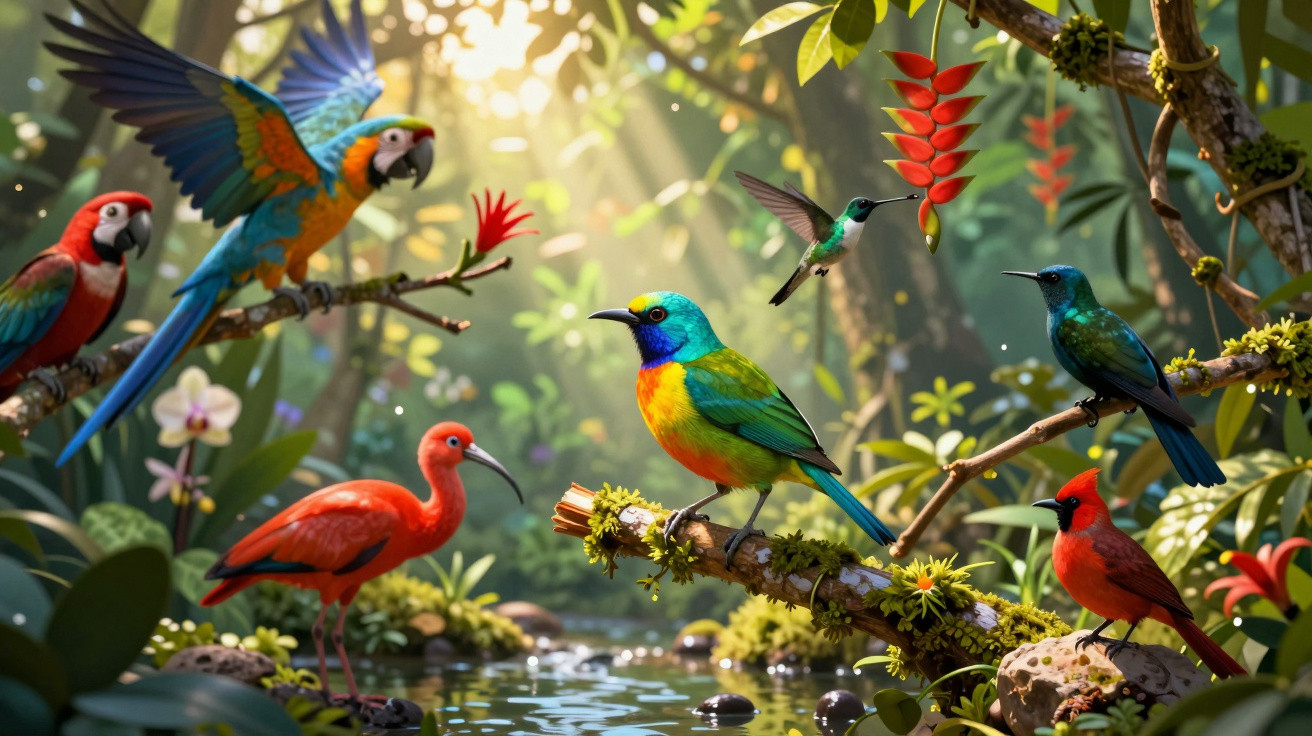
Brazil is home to one of the planet’s most diverse faunas, with birds making this natural wealth even more remarkable. Found across forests, mangroves, grasslands, savannas, wetlands and even major cities, they vary greatly in size, behaviour, feeding habits and ways of adapting to their surroundings.
Among the many species recorded in Brazil, some stand out above all for their appearance. Vividly coloured feathers, unusual combinations of shades, long tails and striking details turn these birds into a genuine spectacle of nature.
Discover some of the most beautiful Brazilian birds below.
1. Seven-coloured tanager
The seven-coloured tanager (Tangara seledon) is a small bird renowned for its extraordinary mix of plumage colours. Its body combines green, blue, yellow, black and other tones, creating an appearance that seems almost carefully painted. The species is closely linked to the Atlantic Forest, where it can occupy several forest layers, as well as coastal woodland and areas altered by human activity.
It is usually seen in pairs or small groups and may join mixed flocks of birds while searching for food. Highly active, it moves through branches in search mainly of fruit and other foods among the vegetation.
2. Hyacinth macaw
With intense blue feathers and yellow areas around its eyes and at the base of its beak, the hyacinth macaw (Anodorhynchus hyacinthinus) is one of Brazil’s most iconic birds. Regarded as the largest of all macaws, it can reach around 1 metre in length, making its presence even more impressive.
In Brazil, it is chiefly associated with the Pantanal and the Cerrado, although it also occurs in the Amazon. Like other macaws, it has a large, powerful beak. The species is also notable for its social behaviour and can be seen in pairs or groups.
3. Scarlet ibis
Few Brazilian birds have colouring as striking as the scarlet ibis (Eudocimus ruber). As adults, these birds have predominantly red plumage, a long neck and a lengthy curved beak. This colour is linked to their diet, which includes animals rich in pigments, such as crustaceans. Young birds, meanwhile, have darker feathers and gradually develop the species’ distinctive reddish colouring.
The scarlet ibis lives mainly in mangroves, muddy beaches and coastal environments, and can be found along different parts of Brazil’s coastline. It is a social bird, gathering in groups to feed, rest and breed, creating impressive scenes when numerous individuals come together.
4. Surucua trogon
The surucua trogon (Trogon surrucura) is striking for its bold colours and contrasting plumage. Depending on the bird’s sex and individual characteristics, shades of green, blue, red, white and grey contribute to its appearance. The species lives primarily in woodland and may also occur in Cerrado regions, using vegetation for shelter and food.
During the breeding season, males can be highly territorial, defending both the nesting area and important feeding sites. One interesting feature of its nesting behaviour is that the pair may excavate termite nests built in trees to create their nest.
5. Swallow-tailed hummingbird
The swallow-tailed hummingbird (Eupetomena macroura) takes its name from its long, deeply forked tail, which resembles a pair of scissors. Its plumage has dark, iridescent tones, with bluish and greenish areas that can take on different shades according to the light. It is a highly adaptable species, found in semi-open areas, forest edges, secondary woodland, parks and gardens, including those within major cities. Despite its small size, it behaves territorially and may confront other birds to defend food sources.
6. Red-cowled cardinal
The red-cowled cardinal (Paroaria dominicana), also popularly known as the galo-de-campina, is easily identified by its vivid red head, which contrasts with the pale and greyish areas on the rest of its plumage. It is a particularly characteristic bird of Brazil’s north-eastern interior and is especially associated with the Caatinga, where it occupies lower, sunnier vegetation. It may also occur near rivers in Cerrado areas. Social in nature, it often forms groups, making it easier to spot in certain regions.
7. Spix’s macaw
The Spix’s macaw (Cyanopsitta spixii) is a bird endemic to Brazil and one of the foremost symbols of national fauna conservation. It was also the species that inspired Blu and Jewel, the main characters in the 2011 film Rio. Native to the Caatinga, it displays several shades of blue in its plumage, alongside a delicate appearance that helped make it internationally known.
Historically, its distribution was mainly connected to riparian woodland in the Curaçá region of Bahia, habitats that provided food, shelter and suitable breeding sites. Capture for the illegal wildlife trade and habitat destruction had severe effects on its populations.

















Comments
No comments yet. Be the first to comment!
Leave a Comment