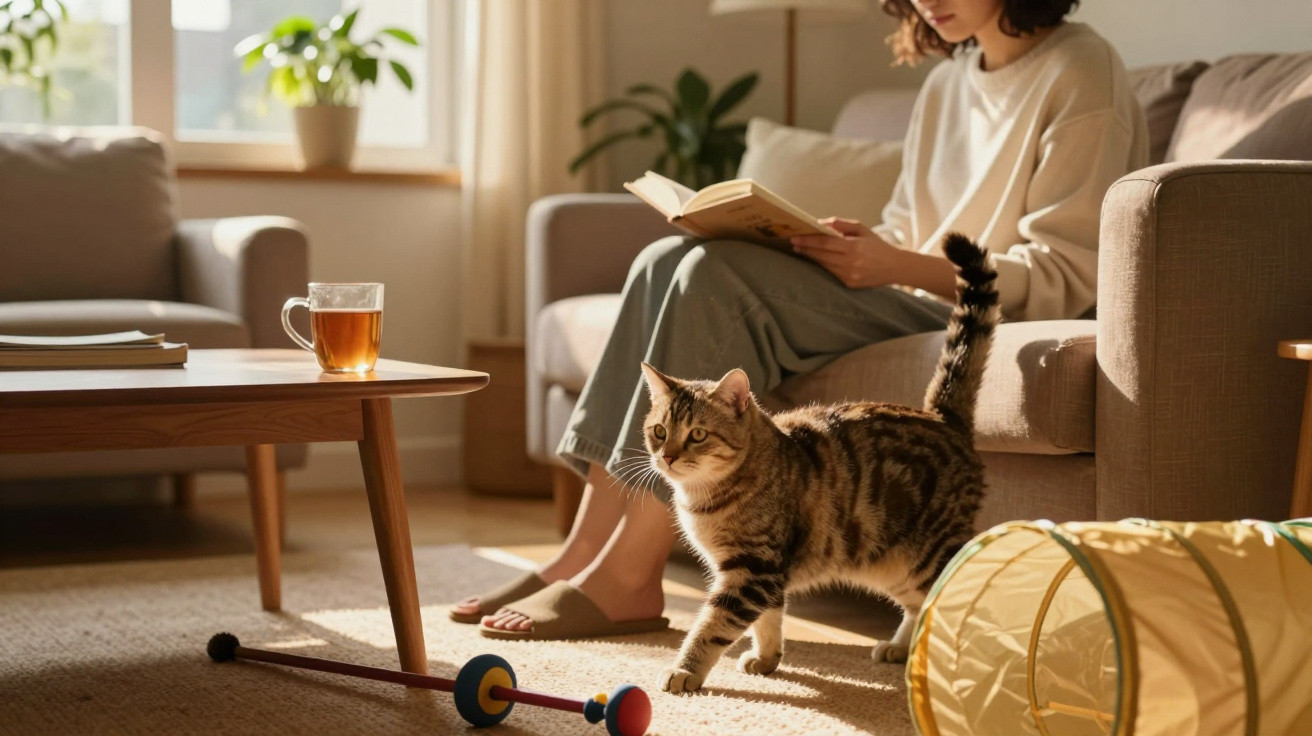
In many households, a cat appears to choose an unexpected family member, rather than the person who takes care of it most.
It is a familiar situation: one person serves the meals, cleans the litter tray, buys the toys and tries to earn a few strokes. Yet the cat settles beside the teenager who barely acknowledges it, or close to the quietest adult in the household. This is not simply a whim. Its choice follows clear principles involving trust, temperament and respect for territory.
A cat is not looking for an owner
A domestic cat has a distinctive relationship with people. It does not operate in the same way as a dog, which is generally more inclined to seek instructions, continual company and highly visible interaction. Instead, a cat views the people in the home as companions, continually assessing how comfortable and safe it feels around them.
It will therefore often select a preferred person, although that preference is not necessarily permanent. A disrupted routine, house move, new baby or another pet may alter its habits. Its attachment is also shaped by its history: a cat rescued when very young, handled kindly and accustomed to human voices will often be more sociable than one that has experienced fear or isolation.
To earn a cat’s trust, it is better to let it take the lead than to repeatedly seek its attention.
The first few weeks are particularly important. This is when a kitten learns which forms of contact are reassuring, which noises call for caution and which hands are safe to approach. A calm, consistent and predictable person can make a lasting impression, even if they are not at home all day.
Keeping your distance can show respect
This is the paradox that surprises so many cat owners: cats frequently gravitate towards the person who never chases after them. Someone who stares at the cat, repeatedly picks it up, hugs it tightly or constantly calls to it can seem intrusive. However well intentioned these actions may be, they take away the cat’s ability to decide.
By contrast, a person who sits nearby without insistence, speaks in a gentle voice and accepts rejection can feel reassuring. The cat understands that it can come closer and leave again whenever it wishes. That freedom matters greatly to a species with a strong need to remain in control of its surroundings.
Chosen contact is better than a long, forced cuddle
When a cat climbs onto someone’s lap of its own accord, rubs its face against a hand or lies close by, it is inviting interaction. It is important to recognise that opportunity without overdoing it. A few strokes on the cheeks, beneath the chin or around the ears are often enough. Many cats are less keen on prolonged touching of the belly, paws or base of the tail.
Certain signs show that it is time to stop:
- the tail lashes quickly or twitches in bursts;
- the ears turn backwards or sideways;
- the skin along the back ripples under your hand;
- the cat sharply turns its head towards your fingers;
- it moves away, even by only a few centimetres.
Heeding these warnings helps prevent scratches and bites, while also building the cat’s sense of security. Over time, a cat that feels understood often becomes more demonstrative.
Signs that reveal a cat’s favourite person
A cat does not display attachment in the way a person would. It may seem aloof while being deeply bonded to someone. The clues lie in small everyday behaviours, sometimes so subtle that they are easily missed.
Head rubbing is one of the clearest signs. By leaving scent from glands around its cheeks and neck, a cat combines its own smell with that of the person it likes. In this way, it creates a familiar marker within its territory.
A cat that follows you, rubs against you or chooses your bedroom generally associates you with a safe place.
Kneading is another common behaviour. When a cat gently alternates its front paws on a blanket, your legs or your stomach, it is repeating a movement connected to its earliest days of life. It often signals a state of deep relaxation. Purring can also accompany contentment, although it should not be interpreted on its own: some cats purr when anxious or in pain as well.
Night-time can provide the most obvious clue. An animal that sleeps near a person, on their bed or against their legs accepts close proximity while vulnerable. It is not necessarily asking for warmth; it is also making a choice based on trust.
How to build a bond without overwhelming your cat
Becoming a welcome presence does not require twice as much effort or a huge collection of accessories. The quality of interactions matters more than their number. A steady routine allows a cat to anticipate what comes next: meals at roughly the same times, regular play sessions and a peaceful resting spot.
- Sit at its level instead of suddenly leaning over it.
- Blink slowly while looking at it, without holding its gaze for too long.
- Offer one finger or a still hand, then wait for it to come and sniff.
- Choose short play sessions using a feather wand or a toy it can chase.
- Always give the cat an exit route and somewhere to hide where it will not be disturbed.
Play: a subtle way to get closer to your cat
Playing together can strengthen the relationship without forcing physical contact.
Source:
Ten minutes each day may be enough, provided you recreate a hunting sequence: the toy hides, moves away, returns and is eventually caught. At the end, a small food reward can soothe the cat and bring the activity to a coherent close.
A sudden change in behaviour still deserves careful attention. A normally sociable cat that avoids being stroked, becomes aggressive or withdraws may be experiencing pain, stress or a health issue. A veterinary appointment can rule out a medical cause before this retreat is put down to its personality.
The favourite person is therefore not always the one who gives the most, but the one who knows how to wait. For a cat, affection is often built in silence and at a respectful distance, before becoming apparent when it decides to come over on its own terms.

















Comments
No comments yet. Be the first to comment!
Leave a Comment