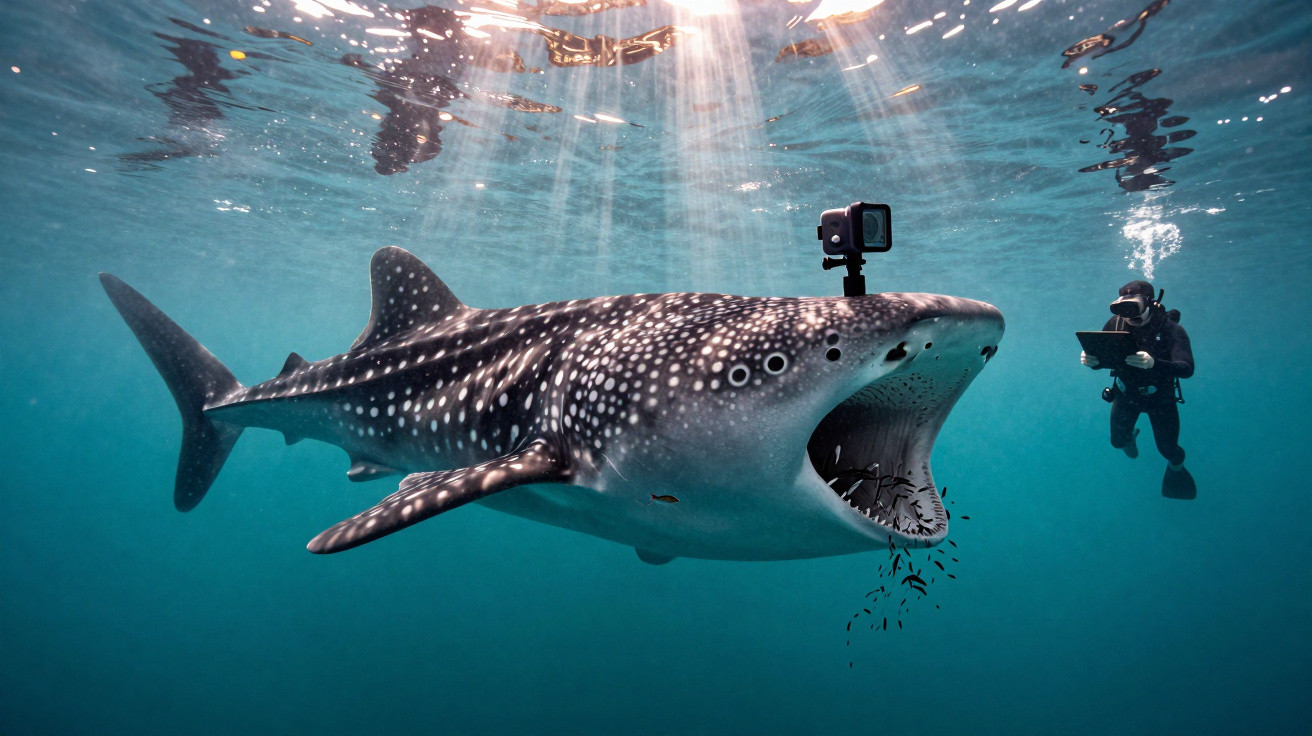
Off Western Australia, researchers have filmed whale sharks at close range to gain a clearer understanding of how they feed.
Footage collected using small cameras temporarily attached to several animals offers a perspective rarely captured in the marine environment. It reveals that these enormous fish do not feed solely close to the surface, as was long assumed. Instead, they alter their approach according to depth, currents and the availability of food.
Cameras attached to fins
The research took place around Ningaloo Reef on Australia’s west coast. At certain times of year, this area is known to host major gatherings of whale sharks. Despite their immense size, the animals are difficult to watch for extended periods without disrupting their natural behaviour.
Teams from the Australian Institute of Marine Science therefore fitted tags to the fins of several individuals. Each unit combined tracking instruments with a miniature camera, and was designed to detach naturally after 24 hours.
The whale sharks continued on their way without changing their swimming, while researchers retrieved footage recorded in the heart of their environment.
This technique represents a significant advance over conventional tags. Standard devices mainly reveal an animal’s location, depth or route, rather than exactly what it does while travelling. Video now allows scientists to connect movement with specific actions: opening the mouth, changing direction, accelerating or descending towards the seabed.
Thirty-six feeding behaviours identified
The researchers compared the filmed sequences with more than one hundred scientific publications on the species. Their work produced a catalogue of 36 distinct feeding-related behaviours. According to the institute, it is the most comprehensive repertoire yet compiled for whale sharks.
The findings challenge a widely held assumption. These animals were chiefly associated with feeding near the surface, where they can consume large quantities of plankton, fish eggs or tiny crustaceans. The footage suggests that they actually search through much of the water column, reaching areas close to the seabed.
An open mouth, even while descending
One of the observed methods is particularly energy-efficient. The whale shark slowly descends towards the seabed with its mouth open. Water then passes through its gills, while filtering structures retain edible particles. This method requires little energy, an important benefit in tropical oceans where prey is not distributed evenly.
By contrast, the animal may use a far more active tactic. When a shoal of krill or a concentration of food appears near the surface, it speeds up and actively pursues the resource. It therefore does not rely on one single method, selecting its strategy according to the opportunity.
- Slow feeding during descents towards the seabed;
- Foraging at several depths;
- Faster pursuits near the surface;
- Continual adaptation to areas where prey is concentrated.
A giant reliant on scattered resources
The whale shark is the largest fish known on Earth. Some individuals measure well over ten metres in length. Yet, despite its size, it does not hunt large prey. It is a filter feeder: it draws in vast volumes of water, then retains the tiny organisms that make up its food.
Its diet may include zooplankton, larvae, fish eggs, crustaceans and krill. The difficulty is that these resources often occur in highly localised, short-lived patches. One area may be abundant for a few hours, then almost empty the following day.
The filmed behaviours suggest that the whale shark offsets the irregular nature of its resources with a much broader range of techniques than expected.
This flexibility partly explains its ability to range across vast ocean areas. However, it does not shield the species from every threat. Whale sharks are classified as threatened and remain vulnerable to ship strikes, accidental capture in fishing gear, habitat degradation and disturbance at heavily visited tourist sites.
Why these images could help protect whale sharks
Knowing where whale sharks genuinely feed could help shape protection measures. If scientists establish that a section of seabed or a particular layer of water regularly serves as a feeding ground, they can assess more accurately the risks linked to shipping, fishing or certain offshore works.
Seasonal gatherings also draw large numbers of tourists. Managed viewing can fund local research and raise public awareness, provided strict distances are observed. Getting too close, having too many boats present, or remaining in the animal’s path for too long may disrupt its swimming and restrict access to food.
Monitoring that could expand to other oceans
Researchers now hope to fit cameras to more whale sharks at gathering sites in different parts of the world. Ningaloo Reef represents only one section of the enormous range travelled by this species, which inhabits warm seas across several continents.
The term “water column” refers to the space between the surface and the seabed. The new observations show that this entire space matters to whale sharks. Feeding may begin near the waves, continue at mid-depth and sometimes end close to the ocean floor. This mobility makes the animals harder to study, but it also provides a practical direction: protecting the species requires looking beyond the surface alone.

















Comments
No comments yet. Be the first to comment!
Leave a Comment