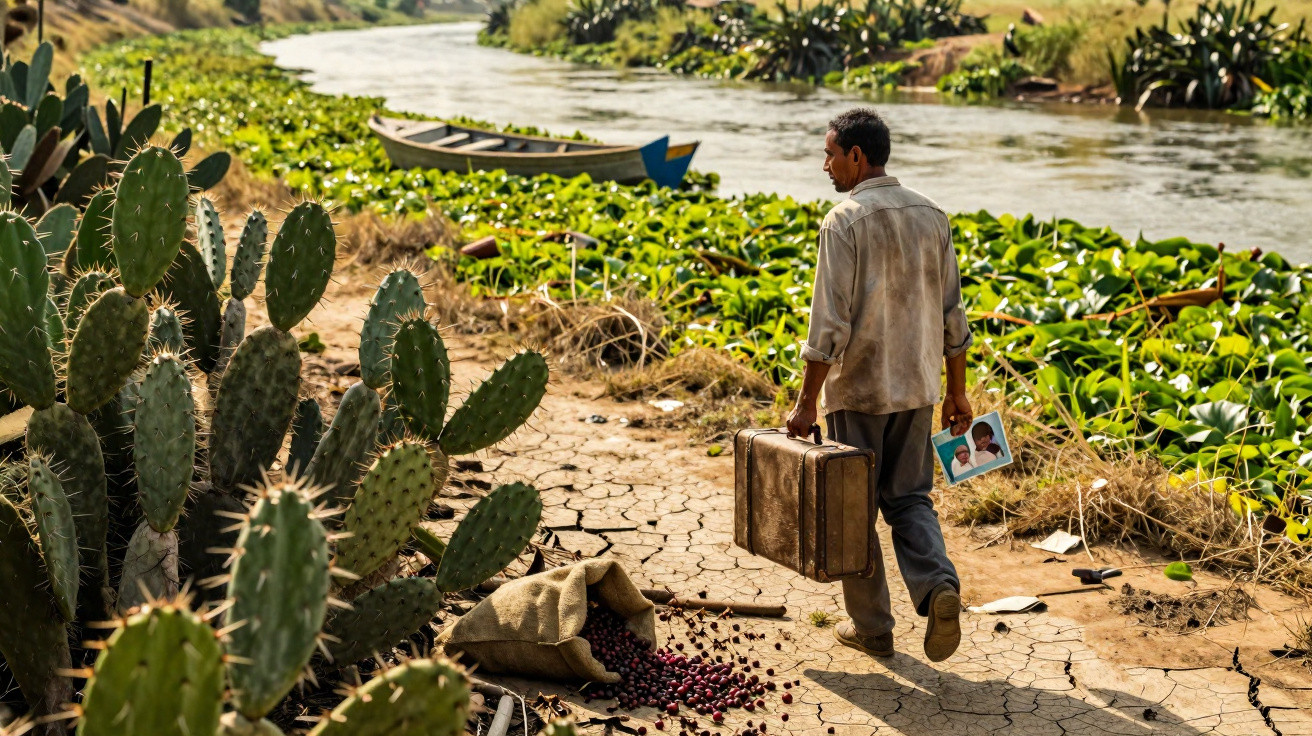
Invasive species have already driven people from their homes. At one ranch in Kenya, a cactus caused half of the farmers to leave.
A painful-stinging ant has led to the abandonment of entire farms in the Pacific. Water hyacinth has blocked rivers so severely that fishing families have stopped working and moved away.
A new paper contends that invasive species should be recognised alongside war and climate change as a driver of forced migration.
No one monitors how many people invasive species have displaced so far, as no country records displacement in those terms.
The overlooked effects of invasive species
Jamie Reaser, an independent conservation consultant, co-authored the paper with Arne Witt, an invasive species scientist at the non-profit organisation CABI.
They maintain that, although invasive plants and animals have been researched for decades, the people whose livelihoods rely on affected land and water have received little attention.
Witt said the relationship between invasive species and migration has remained largely unexplored.
“In the case of invasive alien species, too little attention has been given to the link between their spread and forced migration,” said Witt.
“Instead, more visible issues such as climate change and natural disasters often overshadow the impacts of invasive alien species on people’s lives. This is despite their close connections. Nevertheless, migration is a growing global concern.”
A cactus that cleared half a ranch
In Laikipia, Kenya, a livestock officer found that the cactus Opuntia stricta had spread over two-thirds of the Mukurian Group Ranch. Half of its 1,200 farmers moved away.
A separate regional survey found that almost 80% of respondents personally knew at least ten families that had left their homes because of the cactus.
Opuntia stricta has had similar consequences elsewhere. By 1912, it had spread across 4 million hectares (9.9 million acres) of New South Wales and Queensland in Australia.
By 1920, its coverage had expanded to 23 million hectares (56.8 million acres).
Farmers abandoned about 400,000 hectares (988,000 acres) each year, while 10 million hectares (24.7 million acres) were taken out of production altogether.
Ants that drive workers from coffee farms
The little fire ant delivers a sting painful enough to prevent workers from entering infested fields.
Entire farms have been deserted because of the ant in New Caledonia, the Galápagos Islands and French Polynesia.
Coffee and citrus plantations have been especially affected, since both crops require hand-picking.
The ant also forms a damaging association with aphids and other plant-feeding pests. This further reduces crop yields and forces additional land out of production.
Weeds that suffocate fisheries
Water hyacinth creates dense floating mats that shut out sunlight and lower oxygen levels beneath the surface.
After the plant arrived in the Wouri River Basin near Douala, Cameroon, 60% of working fishers left the industry and the local catch fell by 76 percent.
In Kenya’s Winam Gulf, fish-processing facilities and boat transport ceased operating, while fishing beaches were deserted.
At Ghana’s Tano Lagoon, farmers became unable to reach their own fields to cultivate or harvest them, eventually abandoning the land.
History offered earlier warnings
Reaser and Witt highlight historical examples that many people already associate with migration, without realising that invasive species helped trigger it.
A fungus known as potato blight reached Ireland from North America via Belgium during the 1840s.
From 1845 to 1852, about one million people died from starvation and associated disease. At least 1.3 million others emigrated, chiefly to North America, Britain and Australia.
European rabbits produced a comparable outcome, although with fewer deaths. In the 1400s, settlers abandoned a village on Portugal’s island of Porto Santo after rabbits stripped the area bare.
Once rabbits arrived in Australia in 1859, farmers around the country left properties that the animals had grazed down to bare soil.
In New Zealand, rabbits introduced in 1862 deprived livestock of food and contributed to the abandonment of half a million hectares (1.24 million acres) of farmland by 1887.
No one records this form of departure
A 2017 review of more than 9,000 papers about invasive species found that only 4.4% considered social impacts at all.
A later review by Kapitza and colleagues identified the same omission, estimating the proportion at as little as 0.6 percent.
In its 2021 assessment of 56 sustainability subjects, UNESCO found that merely 0.1% of papers mentioned invasive species.
This gap also extends to policy. Bodies that monitor global displacement, including the UN’s refugee agency and the Internal Displacement Monitoring Centre, do not include invasive species among the causes they register.
A cactus invasion and a civil war may both depopulate the same valley, yet only one is recorded in the data.
The numbers that are missing
Reaser and Witt are cautious about the limits of what their case studies can demonstrate.
Every community they examine also faced other pressures, including drought, poverty and government policy. These acted alongside the invasive species rather than independently of them.
Their paper synthesises existing case studies and reports; it is not a new dataset designed to calculate the number of people displaced worldwide by invasive species.
No such total has yet been calculated. Reaser and Witt want governments to report this type of land abandonment to the same agencies that already track displacement caused by war and disasters.
They also call for invasive species to be included in treaties and definitions concerning food and water security.
Unless governments begin gathering these data, the extent of this displacement will remain a collection of isolated accounts rather than a measured total.
The full study appeared in the journal Frontiers in Conservation Science.

















Comments
No comments yet. Be the first to comment!
Leave a Comment