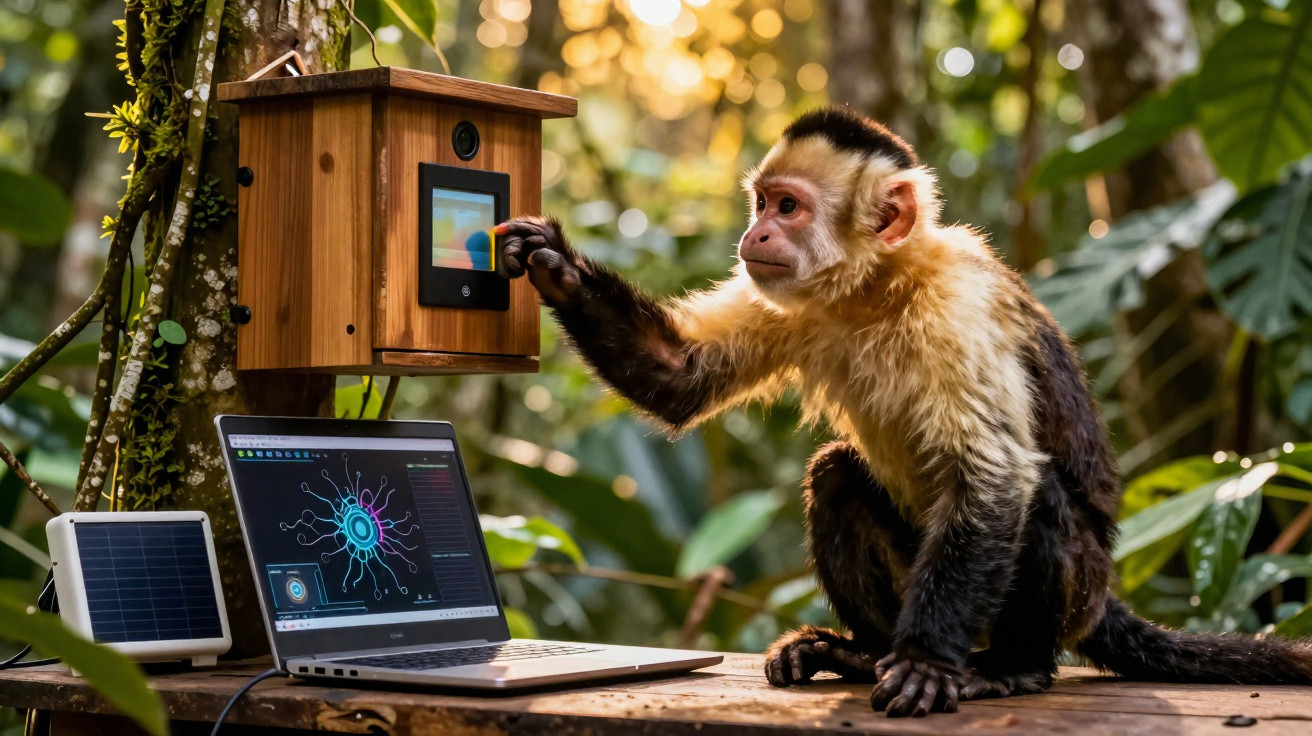
A wooden box fixed to a platform in a Costa Rican forest can recognise a capuchin monkey’s face and select a puzzle appropriate for that individual.
Give the correct response, and it releases a piece of banana. No person needs to be present to administer the test.
Studies of wild primates have generally taken one of two forms: controlled work in laboratories or observation of animals moving freely through the trees, with little opportunity for experimental control.
Scientists at Emory University and the Georgia Institute of Technology have created a system intended to bridge that divide.
Marcela Benítez, an assistant professor of anthropology at Emory, headed the project, which the researchers have named CapuchinAI.
Having spent years examining monkey behaviour in captivity and in the wild, she sought a method for bringing laboratory-level precision directly into the forest.
“The primate brain didn’t evolve in a lab, it evolved in complex, competitive environments,” said Benítez.
“Yet primate cognition is rarely studied in the wild because the experimental control needed to measure cognition is difficult in unpredictable environments.”
Training AI to recognise monkeys
The researchers’ first task was to develop a computer system capable of distinguishing one capuchin from another. They modified YOLO, an open-source facial-recognition programme.
They then trained it using thousands of close-up photographs and videos of six adult male capuchins at the Taboga Forest Reserve.
Undergraduate students at the two universities devoted hours to outlining every monkey’s face in archived field recordings and labelling each image with the right name.
The completed model was assessed with images it had not encountered before, including some that were blurred or illuminated differently from the training material.
It found a capuchin face within the frame 98 percent of the time and, when it found one, correctly identified the monkey 97 percent of the time.
CapuchinAI: a laboratory in a wooden box
Federico Sánchez Vargas, an Emory anthropology PhD student and the paper’s first author, was responsible for bringing the software into the forest.
Although his academic qualifications are in evolutionary biology and psychology rather than computer science, he learnt enough Python to simplify the recognition model. This allowed it to detect any capuchin face, rather than solely the six monkeys it already recognised.
“The model was great at identifying six monkeys, but there are 100 capuchins at the Costa Rica field site,” noted Sánchez Vargas.
“And we didn’t have high-quality video of all of these individuals, which is needed to train the model.”
He and Benítez constructed the enclosure themselves in her garage, using pine boards, decking sealant, rubber insulation strips and plastic piping from Home Depot.
“We built it in my garage,” Benítez said.
The completed box is roughly 51 cm high and weighs about 15.9 kilograms.
Inside, a compact Raspberry Pi computer operates a webcam, touchscreen and 3D-printed food dispenser for at least eight hours using standard travel battery packs.
The monkey that worked it out
The team spent three days in the field before a capuchin came near the box. Eventually, a large male called Trompudo-Spanish for “big snout”-was drawn in by the scent of dried banana stored inside.
“He climbs on the box and starts slapping the back of it,” Sánchez Vargas says. “Finally, he slaps the touchscreen and a banana slice pops out.”
Trompudo ate the reward, touched the display once more and received another piece.
“It was almost like you could see him realizing, ‘Ah, that’s what you have to do, touch the screen!'” Sánchez Vargas said. “It was amazing to watch an individual learn something so quickly.”
“Other capuchins followed his lead faster than the team expected. “Even I was surprised by their enthusiasm.”
Not every monkey learned the same way
Across six sessions involving two habituated groups, 16 capuchins engaged with the box, while a further 14 watched from afar without touching it.
Of the 16 that interacted with it, ten learnt to activate a reward by touching the screen. Eight developed a consistent pattern of approaching, touching the display and anticipating banana, while five still retained this habit a week after the box had been taken away.
The monkeys did not all acquire the skill in the same manner. Some understood it almost at once, whereas others stayed back to observe their groupmates first.
Others examined the box with their lips rather than their hands, discovering that pressing their mouths against the screen earned a reward.
The touchscreen dispenses food only when its camera verifies that a capuchin face is present. Coatis-tree-climbing raccoon relatives known for entering homes-received nothing when they attempted to access the device and soon abandoned their efforts.
Expanding research into monkey cognition
The team is currently training an improved model to identify each of the 16 monkeys from the pilot individually.
They are also developing four types of cognitive assessment around it: speed of learning, impulse control, flexibility when rules are altered, and short- and long-term memory.
A monkey already known to the system will receive the task that suits its stage of progress. An unfamiliar animal will instead be offered the basic touch-for-banana lesson as a camera records its face so the system can learn it.
It remains unknown whether a monkey that learns one task quickly will also learn the others quickly, or whether differences in upbringing may account for the outcome.
The next era of field research
“We can explore outstanding questions about how the environment, individual experiences and behaviors connect to cognitive abilities,” Benítez said.
“Why are some individuals better at some tasks than others? How do different individuals adapt to different situations? How do different cognitive strategies relate to fitness?”
Sánchez Vargas links the research to Frans de Waal, the Emory primatologist who spent decades investigating individual animal personalities before his death in 2024.
“Frans de Waal said that you cannot study cognition if you don’t understand the animals,” he said.
“Our AI methodology doesn’t replace the need for human researchers in the field. It’s essential to have rich, observational datasets gathered by people working on the ground.”
The complete study appeared in the journal American Journal of Primatology.

















Comments
No comments yet. Be the first to comment!
Leave a Comment