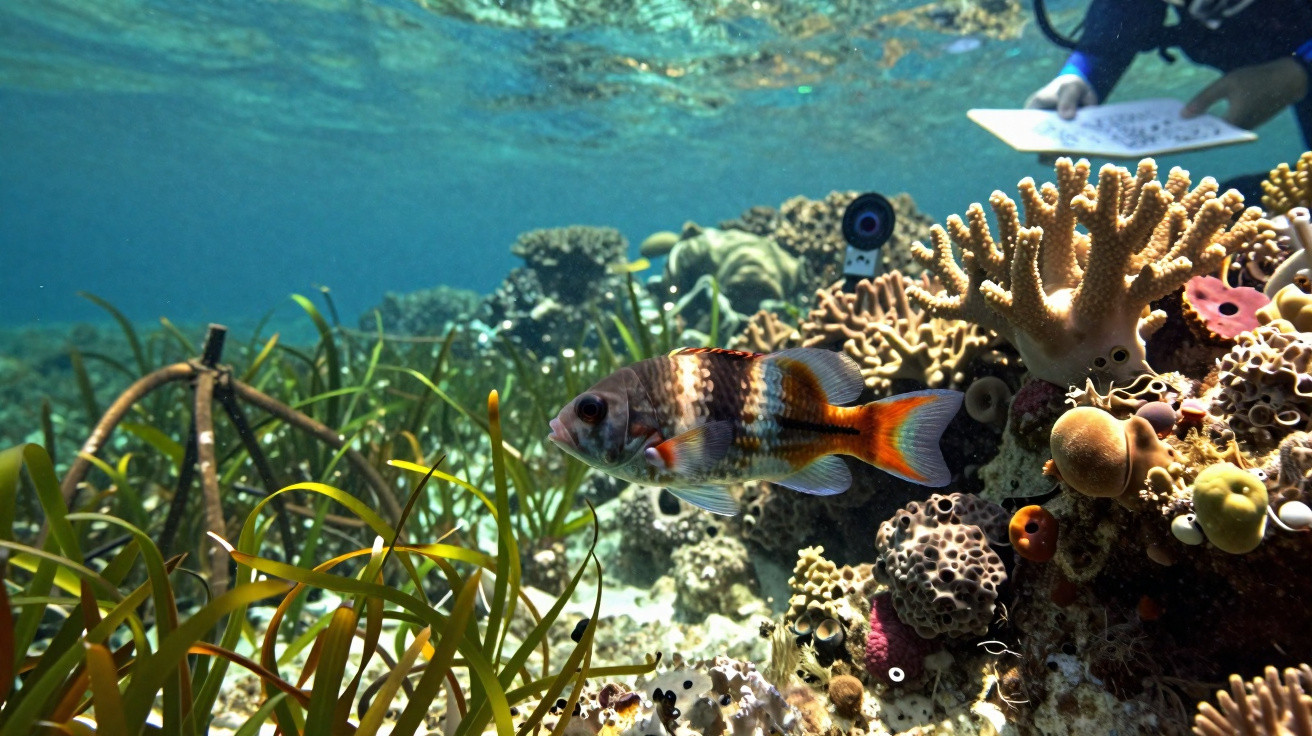
Coral reef fish do not reach their nursery grounds as fully formed animals. The convict surgeonfish spends roughly 53 days drifting in the ocean as a transparent larva, then enters shallow water and reconstructs its body within a week.
Research in French Polynesia now suggests that this reconstruction differs between habitats. Fish settling on a mangrove mudflat develop different hormone profiles and use fuel differently from those settling on a nearby sandy beach.
The difference is not genetic. Instead, the habitat modifies a hormonal system that vertebrates have shared for hundreds of millions of years.
Reef fish transform in one week
The convict surgeonfish, Acanthurus triostegus, is a striped Indo-Pacific fish that grazes on algae. In Polynesia, it is known as the manini.
Its transformation is driven by thyroid hormones, the chemical messengers responsible for reducing a tadpole’s tail and switching a newborn mammal’s metabolism at birth.
For reef fish, these hormones control the move from a drifting larval life to that of a juvenile living on the reef. Researchers from OIST and CRIOBE, the research station on Moorea, collected larvae at night during the new moon.
They placed some fish in tanks and others in cages within three natural nursery habitats. During the first 12 hours after settlement, the activity of 4,637 genes changed.
The most pronounced change involved energy. Larvae use fat to fuel weeks of swimming, whereas juveniles rely on stored sugar while rebuilding their jaws and guts - a transition underlying the emergence of reef grazers.
Nursery habitats shape development
Moorea lies within a 61-kilometre barrier reef, but its coast is far from uniform. The researchers studied three nursery habitats separated by only a short swim.
Beach rock consists of eroded coral slabs and has more than 60% bare substrate. It supports the most abundant fish community, with about 117 individuals for every 50 square metres.
Mangrove locations are 97% mud, woven through with Rhizophora stylosa roots. They have the highest and most variable temperatures, alongside the lowest pH and dissolved-oxygen levels.
According to a 2025 global estimate, mangroves provide shelter for hundreds of billions of juvenile fish worldwide. Their water chemistry is already changing as the climate warms.
Sandy beach is the least substantial option, comprising sand, some macroalgae, minimal structure and few predators. In theory, it appears to be the simplest nursery habitat, but the fish reared there indicate otherwise.
Hormones change with habitat
Thyroid hormone levels in wild juveniles corresponded with their habitat. Beach rock fish had the highest levels, at around 5.7 nanograms of T4 per gram of tissue, while mangrove fish had the lowest, at close to 1.8.
Fish from sandy beaches sat between the two groups, at approximately 3.5. When the team sampled similar sites again a year later, it found the same order.
That repetition suggests the pattern is linked to the habitats themselves rather than an unusual single season. Yet the regulatory mechanisms were more unexpected than the hormone levels.
Mangrove fish maintained active upstream thyroid processes despite low circulating hormone levels. In contrast, beach rock fish showed subdued central signalling but strong activity among downstream genes.
This means that the same developmental stage can be achieved through different pathways, adjusted to local conditions rather than being fixed across the species. Professor Vincent Laudet, the study’s senior author, heads OIST’s Marine Eco-Evo-Devo Unit.
“The most surprising thing was how responsive development appeared to be to the immediate environment, not just over evolutionary time, but within a single individual’s early life,” he told Earth.com.
Metabolism shifts by nursery
Metabolic measurements reflected the hormonal findings. Mangrove juveniles followed a growth-oriented programme, with the greatest tissue glucose level at 2.78 milligrams per gram and the lowest cholesterol level at 1.70.
Sandy-beach juveniles showed the reverse pattern. They broke down stored glycogen without oxygen, recorded the lowest glucose level at 1.49 milligrams per gram and had the highest cholesterol level at 2.12.
Genes linked to appetite divided in the same fashion. Mangrove fish increased both hunger-stimulating and hunger-suppressing signals, a combined setting that permits rapid adjustment.
By comparison, sandy-beach fish displayed a reduced, energy-conserving profile. Beach rock fish occupied the middle ground, as they did for nearly every measurement.
A separate analysis of 80 water-soluble compounds in an independent group reached the same conclusion. Thirty compounds differed between juveniles from sandy beaches and mangroves.
Flexible development may aid survival
Warming seas, declining oxygen and habitat loss are remodelling reef nurseries. Research into drops in oxygen at night has shown that modest energy costs can build up over a season.
In principle, a hormone system that interprets local environmental conditions could provide a buffer. It enables animals with identical genes to follow different physiological routes.
“Our study found that environment and development are far more tightly coupled than we assume, which raises the question of how much flexibility this gives animals when their environments change,” says Laudet.
The benefit Laudet identifies is improved forecasting, rather than any assurance that flexible fish can withstand environmental change.
“By revealing one of the mechanisms through which environmental information shapes development, our work may help improve predictions of species resilience in the face of global environmental change,” says Laudet.
Previous research found that reef settlement depends on thyroid hormones and can be disrupted by substances including the pesticide chlorpyrifos. This study extends that sensitivity to normal coastal habitats.
Study stops before adulthood
At the hormonal level, the study design is observational. The researchers did not directly alter thyroid signalling, and they identify such experiments as the next step.
Laudet is similarly clear about what the findings cannot demonstrate. “Our study did not test whether flexibility helps fish cope with degraded or changing conditions, so further research is needed,” he says.
The evidence also ends at an early stage of life. “We cannot unfortunately extend our results to adulthood,” says Laudet. Manini become adults one to two years after entering the reef and range too widely to track. “There is no way to be able to follow them during that time,” he says.
There are further technical limitations. Beach rock samples from day eight were lost because of RNA degradation, while an individual fish’s feeding history can influence appetite genes.
Differences in metabolites between habitats also remained within a twofold range, although comparable shifts have changed metabolism in other fish.
The team is now developing what Laudet calls landscape transcriptomics. The approach collects five to ten fish from each environment before sequencing the genes that are active. A related study of damselfish is in press.

















Comments
No comments yet. Be the first to comment!
Leave a Comment