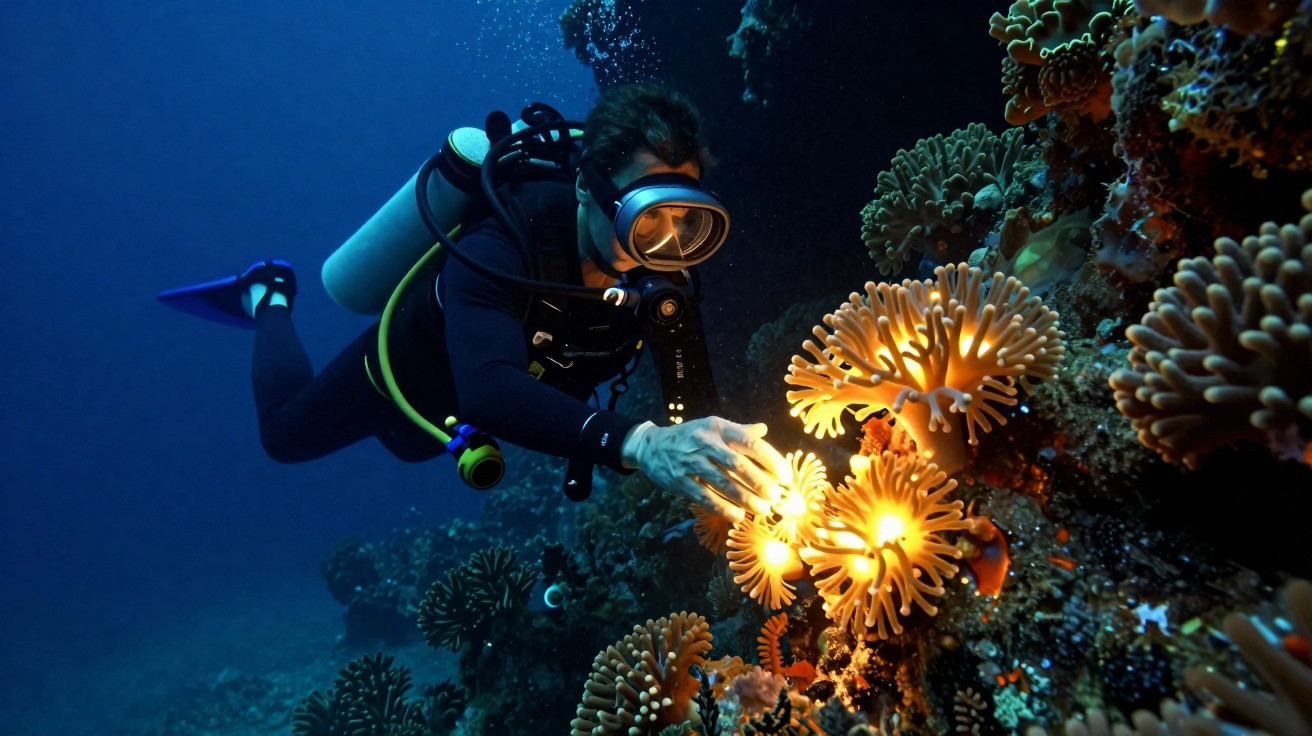
Scientists have identified a vivid yellow deep-sea animal, Corallizoanthus aureus, as a previously unknown marine coral species. When disturbed, it gives off green light, the first recorded instance of bioluminescence within a deep-sea cave.
The discovery expands the known distribution of natural light in the ocean and highlights concealed environments that remain largely unexplored by biologists.
Meet Corallizoanthus aureus
The research centres on Corallizoanthus aureus, a small yellow zoanthid formed of colonies of anemone-like polyps.
These newly recognised animals are soft corals that live on other corals around the mouths of submarine caves near Minamidaito Island in southern Japan.
Dr Hiroki Kise of the National Institute of Advanced Industrial Science and Technology (AIST) made direct observations and recordings that repeatedly captured green flashes from this same coral-associated species.
The light was seen solely after the animals had been physically disturbed. It was restricted to their exposed bodies and did not spread over the host coral.
This highly specific trigger and location set the current boundaries of the observation, while underlining the need to investigate both the mechanism behind the glow and why it occurs only in particular circumstances.
Finding Corallizoanthus aureus
Scientists formally described Corallizoanthus aureus on a precious coral at a depth of nearly 384 m near Minamidaito Island.
The animal is part of Zoantharia, a group of anemone-like coral relatives that commonly grow across other living surfaces.
Its bright yellow polyps - the animals’ individual bodies - were scattered along the coral’s branches rather than blanketing the entire colony.
Since the host coral is both slow-growing and valuable, newly discovered hitchhikers such as this may influence how collections are managed.
The survey relied on a remotely operated vehicle (ROV). Additional equipment was needed to reach the cave walls because large underwater robots have difficulty navigating narrow passages and uneven rock.
Every flash was bioluminescence: light generated by chemical processes within an animal, rather than reflected sunlight.
“To the best of our knowledge, this study represents the first report of bioluminescence observed within a deep-sea cave,” wrote Kise.
As the team examined only a limited section of this habitat, many other luminous species may still be beyond reach.
The coral animal responsible for the glow
Researchers recorded a golden-yellow body form and chose the species name from the Latin word aureus, referring to that colour.
Each zoanthid polyp on the host coral Pleurocorallium inutile had 24 to 26 tentacles, and some were joined to neighbouring polyps by slender tissue.
The team found that illumination came from the tentacled heads, whereas the connecting mat remained unlit.
As the animal appears associated with a single host and one type of cave entrance, its true distribution could be limited.
How the coral light was tested
On board the ship, researchers held coral samples in cold, dark seawater before warming them to about 27°C for experiments.
A gentle pinch or a potassium-rich splash altered the salt balance in the cells, activating the stored chemicals responsible for producing light.
The emission reached its maximum in green. By comparison, the related species Churabana kuroshioae produced a bluer blue-green signal.
A third species, Epizoanthus fatuus, did not glow at all, demonstrating that even close relatives may rely on very different mechanisms.
Clues from genetic relationships
Genetic analysis at AIST placed the luminous animal alongside Corallizoanthus tsukaharai, a close relative found on different coral hosts.
That relationship was important because these animals can appear alike, while subtle features vary as they contract and extend.
Combining genetic evidence with host selection enabled the researchers to distinguish the new species from an earlier misidentification.
However, too few confirmed glowing members of the wider family are known to establish when this trait first evolved.
What the chemistry suggests
The light probably originates from chemicals within the animal itself, rather than from bacteria living on its surface or in its body.
Researchers identified a luciferin-luciferase system - a light-producing fuel and enzyme combination - as the most likely explanation.
Microscopic examination found no bacterial cells in the new coral’s tissues, leading the team to favour an internal chemical reaction instead of microbial assistance.
Until the relevant molecules are isolated, this chemistry remains an informed hypothesis, and AIST requires further samples to test it.
What the glow might do
A flash triggered by disturbance often has a function, and a sudden signal in deep water could rapidly alter an interaction.
One proposal is that the light attracts larger predators, making the original attacker an easier target for an animal higher in the food chain.
Another possibility is that luminous mucus or shed tissue adheres to a predator and temporarily reveals where it is.
The study did not examine these potential functions, so researchers still require night-time cave footage showing real attacks.
Lessons from Corallizoanthus aureus
Bioluminescence has independently evolved dozens of times among animals, but scientists still do not have a complete inventory for many coral groups.
By documenting an unambiguously identified species, the researchers have supplied evolutionary studies with a reliable data point rather than an unconfirmed report.
The finding also indicates where biologists should search next, as host corals can help direct future investigations.
Should deep-sea caves continue to reveal discoveries of this kind, managers may have to balance exploration, conservation and coral harvesting.
This newly glowing animal demonstrates how much of the deep ocean is still unrecorded, even when scientists use cameras to investigate it.
Future research will need repeated cave surveys alongside rigorous chemical testing, because a single overlooked clue could alter how scientists classify these animals.
Image credit: H. Kise et al.

















Comments
No comments yet. Be the first to comment!
Leave a Comment