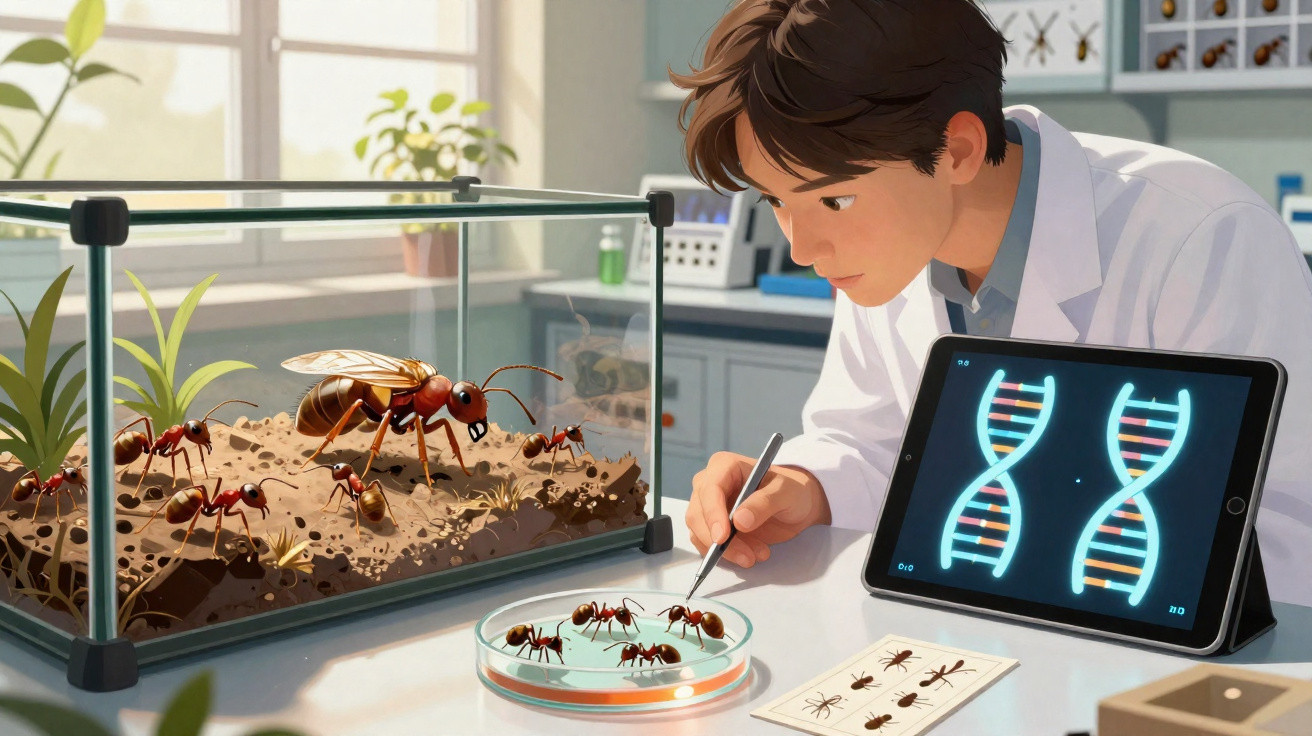
A southern European ant is doing something that once seemed possible only in science fiction: its queens create male clones of a different species. This mechanism enables Iberian harvester ant colonies to keep producing workers, even where no nearby populations of the species they need for reproduction exist.
Queens produce males from another species
Queens of Messor ibericus can lay eggs that develop into males of Messor structor, an evolutionarily distant species. Reported on 3 September 2025 in the scientific journal Nature, the finding is the first known instance of an animal producing another species as a routine part of its life cycle.
Jonathan Romiguier, an evolutionary biologist at the University of Montpellier and co-author of the research, told Live Science that the phenomenon initially appeared paradoxical. The team first considered whether sampling errors were involved, but found 69 locations in which M. ibericus colonies were thriving without nearby M. structor populations.
Worker ants rely on unusual reproduction
The workers in these colonies are hybrids, created from the genetic combination of both species. When an M. ibericus queen mates with a male of her own species, the offspring mainly become new queens rather than infertile workers, which feed, defend and organise the nest.
Researchers link this imbalance to selfish genes carried by M. ibericus males. This DNA may promote the birth of fertile females, known as “royal cheats”, ensuring that it is passed on to later generations. To produce workers, the queen must therefore use genetic material from M. structor.
How did scientists prove the cloning?
To examine the phenomenon, the researchers collected 132 males from 26 Iberian colonies. Of these, 58 were hairy and belonged to M. ibericus, while 74 lacked hairs and carried the nuclear genome of M. structor. Further testing was needed to establish which individual had produced them.
- Genetic analysis of males found inside the nests
- Sequencing of maternally inherited mitochondrial DNA
- Examination of eggs laid by 16 isolated queens
- Identification of Messor structor in 9% of eggs
- Monitoring of one queen for 18 months
Mitochondrial DNA showed that males of both species had the same maternal origin. In laboratory conditions, scientists also directly observed one queen producing both M. ibericus and M. structor individuals. This showed that she was cloning the foreign males without passing on her own nuclear DNA.
Watch the video shared by the YouTube channel 7 Days of Science to learn more about the ant that broke biology with its cloning ability.
The system has been named xenoparity
The researchers named the process xenoparity, a term meaning the birth of a different species. Its exact mechanism remains unknown, particularly the point at which the maternal nuclear DNA is removed. The system may have emerged at some stage during the past 5 million years of evolution.
Denis Fournier, an evolutionary biologist at the Free University of Brussels who was not involved in the study, described the discovery as “almost science fiction”. In his view, the case challenges the assumption that species boundaries are rigid, as these ants routinely cross that divide as part of reproduction.
The discovery could change the study of animal reproduction
Cloning allows M. ibericus to maintain its own supply of M. structor males, securing worker production even in isolated areas. The colony therefore makes another species an essential part of its reproductive system, establishing a relationship defined by dependence, co-operation and possible genetic conflict.
For Fournier, the finding is a reminder that science must remain receptive to the unexpected. Researchers can now revisit older data and unexplained biological cases in search of similar mechanisms. Urgent investigation of these ants may reveal how many other rules of nature are still waiting to be broken.

















Comments
No comments yet. Be the first to comment!
Leave a Comment