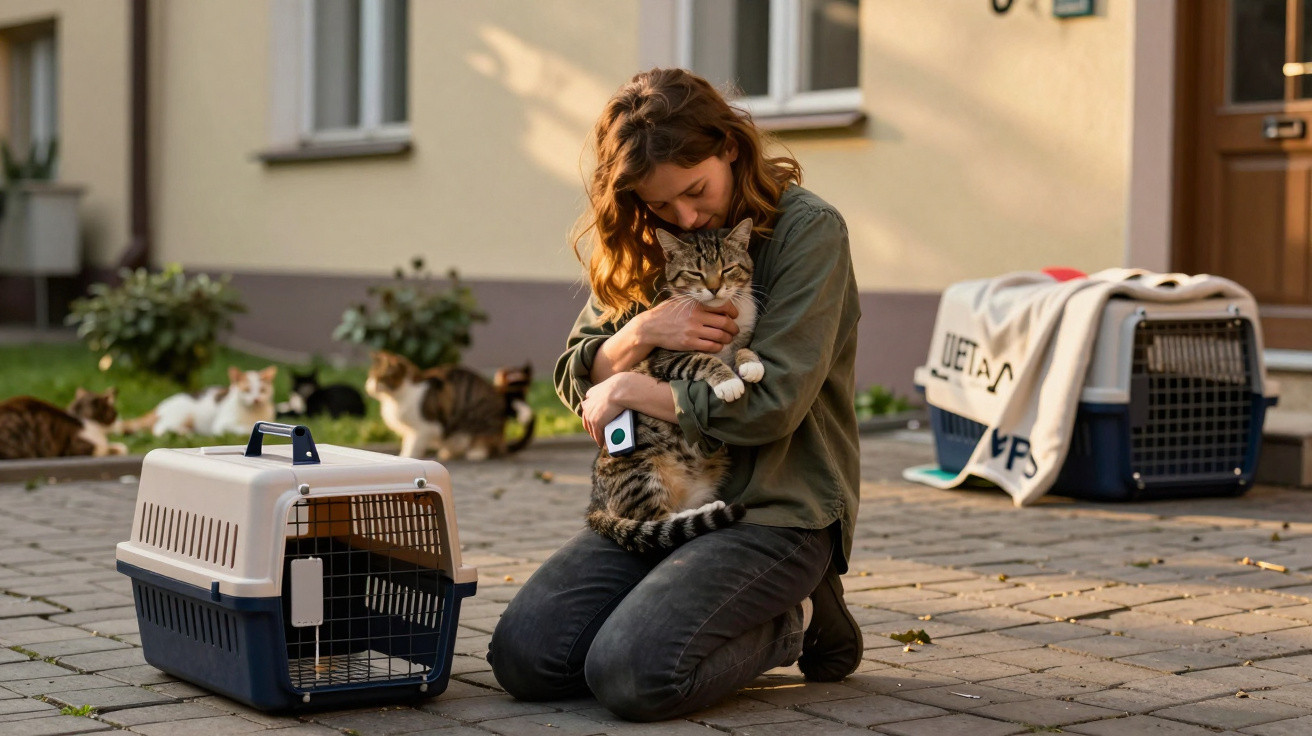
Standfirst.
During a routine neutering campaign in southern France, volunteers noticed a cat whose composed manner suggested there was more to his story.
The animal welfare team initially believed he was simply another stray from a garden colony. However, a swift scan of a tiny microchip transformed an ordinary day of trapping and neutering into a tale of loss, perseverance and an unexpected reunion, two years after a difficult house move.
A calm cat among cautious strays
Coursan Chats, an association in Coursan near Narbonne, works daily to monitor free-roaming cats. Its volunteers trap the animals, take them to a vet for neutering and identification, and return them to the territory where they were found. The cats continue living outside, but no longer contribute to an endless number of kitten litters.
For local authorities, these “community cats” can help keep populations stable while cutting noise, fights and disease. For the association, this approach also helps prevent mistreatment and reduces pressure on already overcrowded shelters.
At a 2024 neutering campaign on private land, the work initially appeared entirely routine. Traps had been placed in a garden inhabited by a small colony. As is typical of feral cats, most were wary and stayed well away from people.
One black-and-white tomcat, however, behaved very differently. While the other cats fled, he approached the volunteers without any apparent concern.
This cat was not nervous, not aggressive and not hiding. He looked at the volunteers as if he already knew people well.
He allowed the team to come close, pick him up and carefully place him in a transport crate. Experienced trappers recognise that this response can indicate a former pet cat that has somehow found itself surviving outdoors.
The microchip that changed everything
At the veterinary practice, every trapped cat was sedated and examined. The vet clipped fur, checked for injuries and made preparations for the operation. For the black-and-white tom, the next task was to pass a microchip scanner over his neck and shoulders.
The scanner beeped, and a number appeared on its display.
At that moment, he was no longer merely an unidentified stray. He was formally registered, identified and connected to a human family elsewhere in France.
Thanks to the microchip, the vet pulled up the owner’s details in a national database and found a phone number and an old address in Coursan.
The volunteers called the family recorded on the database. During that conversation, the cat’s history became clear. They had previously lived in Coursan before relocating to Béziers, a larger city around 30 kilometres away. Amid the upheaval of moving home, their cat had escaped and disappeared.
They had looked through local streets, contacted animal shelters and alerted veterinary practices. Days became weeks, then months. In time, they lost hope of ever seeing him return home. There had been no sign of him for two complete years.
From the chaos of moving day to a two-year absence
Moving house with pets can be fraught with risk. Doors may be left open, furniture is moved around and unfamiliar noise fills increasingly empty rooms. Even normally relaxed animals can become frightened and run away. This appears to be what happened in Coursan that day.
Rather than travelling with his family to Béziers, the cat vanished amid removal vans and packed boxes. He may have concealed himself in nearby gardens, or perhaps neighbours saw him once or twice and assumed that he belonged to somebody else.
As time passed, he apparently became part of a semi-feral group of cats on private property. He adjusted to life outside, learned where to obtain food and find shelter, and managed to survive alone for two years in a town he knew but without the people he had known.
His trusting response during the trapping operation indicates that he may never have completely lost his confidence in people. That trust, together with the microchip beneath his skin, offered him another opportunity.
How the reunion happened
The former owners were astonished when the association telephoned. Very few people imagine that a missing pet will be found after two years, particularly through a large-scale neutering operation.
They made arrangements to return to Coursan. At the clinic, staff explained that a cat which had survived outside could be thinner, more cautious or somewhat changed in behaviour.
Reunions of this kind often develop in a familiar way: an uncertain sniff, a measured glance and then a sudden moment of recognition. Although the precise circumstances of this reunion remain private, the association confirmed that the cat was reunited with his human family and finally left the garden colony for a warm home.
This unexpected outcome turned a simple neutering operation into a reminder that lost pets are not always gone forever.
Neutering campaigns can bring unexpected benefits
On paper, the task was simple: trap, neuter, identify and return. In practice, community programmes such as the one operated in Coursan can have consequences that reach beyond managing cat numbers.
When every animal is routinely scanned for a microchip, teams can sometimes identify lost pets which would otherwise never visit a shelter or veterinary practice. Hidden colonies may exist in private gardens, industrial estates and rural barns.
The partnership between Coursan Chats and the local council has been in place since 2019. This cooperation has already enabled the neutering of hundreds of cats. For the town, this means fewer abandoned litters and a more balanced relationship between residents and roaming animals.
For the cats, neutering can mean calmer lives, fewer fight-related injuries and a reduced risk of certain diseases. For families such as this one, the outcome is even more personal: the return of a deeply missed companion against the odds.
What this case reveals about microchipping
This case demonstrates how a small device, often no bigger than a grain of rice, can alter the future of a lost pet completely. Implanted beneath the skin, a microchip contains a unique number that identifies the animal for life.
- Unlike a collar or tag, it cannot fall off.
- Any vet or shelter can read it using a basic scanner.
- Databases connect the number with a name, telephone number and address.
- Owners can amend their details after moving home or changing telephone numbers.
Without the chip, the black-and-white cat would have been neutered and returned as another “free cat” within the colony, with his history effectively lost. Because he had one, he had a name, a past and people who had cared enough to register him correctly.
Practical ways to prevent pets disappearing during a move
This story may prompt many pet owners to consider arrangements for their own future house move. A handful of straightforward precautions can greatly reduce the possibility of a cat disappearing amid the confusion.
| Risky moment | What owners can do |
|---|---|
| Before the move | Have the cat microchipped, check its vaccinations and update its contact information on the database. |
| On packing days | Keep the cat in a closed room with food, water and a litter tray, away from open doorways. |
| Moving day itself | Put the cat in a secure carrier before the removal team arrives, and never open it outside. |
| First days in new home | Initially keep the cat in one peaceful room, then gradually allow access to further areas. |
Some animal charities also advise keeping cats indoors for several weeks following a move. This gives them time to form a mental map of their new home before they encounter unfamiliar roads, vehicles and scents.
Free-roaming cats and TNR explained
Coursan Chats’ work forms part of a broader method used across many countries, commonly referred to as “TNR”: trap, neuter, return. Rather than removing every stray cat, organisations seek to stabilise colonies by preventing further births and monitoring the animals’ health.
Once they have been neutered, these cats:
- Fight less often, reducing both injuries and night-time noise.
- Stay within smaller territories, which lowers their risk of road traffic accidents.
- Discourage new unneutered cats from entering the same area.
The idea of free-roaming cats recognises that certain animals are too feral, or too accustomed to outdoor living, to be happy in a flat. They can remain where they are with limited human assistance: food, water, veterinary treatment when required and, occasionally, a reunion such as the one that returned this long-missing cat to his family.
This story also shows how several measures can work in combination. Neutering campaigns control populations, microchips reunite families, and local councils can provide funding or access to private land. When all these elements come together, even a two-year disappearance during a stressful house move can end not in unanswered questions, but with a telephone call saying: “We think we’ve found your cat.”

















Comments
No comments yet. Be the first to comment!
Leave a Comment