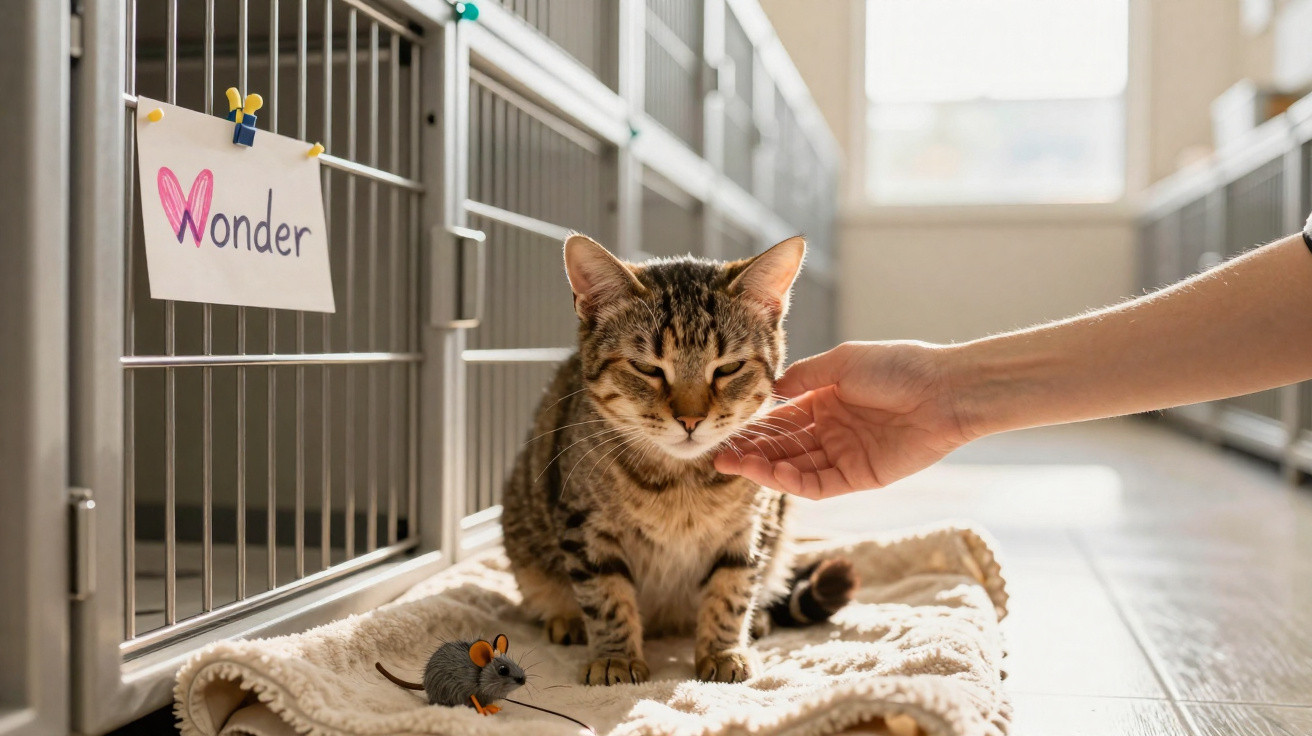
In a bustling New York shelter, an elderly tabby sits silently with his ears splayed like little aeroplane wings, observing visitors as they pass by.
He used to have a home, a person and a familiar daily life. Today, he has a metal kennel, a paper notice and volunteers determined that he will not be passed over.
A grieving cat with “airplane ears” in a New York shelter
The Queens facility run by Animal Care Centers of NYC has numerous cats awaiting adoption, yet one resident has inadvertently become a symbol for misunderstood felines. Wonder is an older tabby whose ears naturally point outwards, leaving him with the permanent appearance of being in “airplane mode”.
Wonder’s circumstances changed suddenly after his guardian died. Amid the upheaval that followed, he also lost his home. Police later brought him to the city shelter, where staff soon understood that he was not merely a timid cat. They were seeing grief unfold before them.
Wonder arrived tense, terrified and freshly bereaved, his body folded in on itself and his ears pressed flat like wings preparing for impact.
Staff member Alec Rusnack says Wonder displayed a “high level of fear, anxiety and stress.” When anyone came near his kennel, he responded with a rigid posture, wide eyes and a quiet hiss. With his ears held flat at the sides of his head, he appeared to be sending one unmistakable signal: “Stay away.”
When body language sends the wrong message
Over the following days and weeks, a quiet change started to emerge. Wonder became more at ease with people he recognised. He took treats, tentatively leaned into a hand for a soft chin scratch and began to hold himself less tensely.
Yet one feature remained much the same: his flattened ears.
To a passing visitor, he can look “angry” or “dangerous”. To the shelter team who understand him, that is simply his usual expression.
Behind the tense, wing-shaped ears is a cat that just wants a quiet lap and the chance to feel safe again.
Many prospective adopters hurry past his kennel after noticing his guarded eyes, instead choosing younger cats that seem openly friendly. It is a familiar shelter pattern: initial impressions carry enormous weight. Visitors commonly pick the cat that rushes to the front of the cage or chirps at them, rather than one that freezes or hisses because it is frightened.
The sign that changed how people saw him
To help Wonder speak for himself, shelter volunteers placed a handwritten message on his kennel door. It functions as a small personal advert for a cat slowly learning to trust:
“I’m a sweet old boy with airplane ears at rest. I might greet you with a hiss, but I just want pets. Say hello softly and I’ll love you.”
The note encourages visitors to stop a little longer. It makes clear that they are witnessing anxiety rather than aggression, while also explaining what Wonder requires: patience, kindness and someone prepared to look beyond appearances.
The volunteer who refused to give up on him
A volunteer named Chelsey felt particularly connected to Wonder after reading about him in the shelter records. She began spending time with him frequently, speaking gently and giving him calm, consistent affection.
Initially, their visits were brief and tentative. Wonder would hiss and retreat, then cautiously edge forwards for a treat. Gradually, he came to know her voice and scent. He permitted longer strokes along his back and, eventually, settled into proper cuddle sessions, which were filmed and shared on Instagram.
For Wonder, progress looks like this: less hissing, more head bumps; fewer flinches, more slow blinks.
Chelsey and the other volunteers now call him “a gentle old man” who appreciates chin scratches and peaceful companionship. His worried body language remains evident at first, but it recedes once he understands that he is safe.
The home he needs to finally heal
The shelter team has a clear idea of the adopter who would suit Wonder. They do not present him as an effortless, ideal cat, and they are upfront about both his fears and the time he needs.
They believe he would thrive in:
- a peaceful, quiet home without continual noise or frequent visitors
- a household or individual with experience of cats that need time to become comfortable
- an environment with a safe room or hiding place available whenever he needs to withdraw
- a day-to-day routine that remains reasonably predictable
Rusnack says they need someone who recognises that shy cats “sometimes need a little more time to open up.” In his view, that patience will lead to a profoundly loyal companion.
Why grieving cats can seem “difficult” at first
Wonder reflects what many shelter workers encounter when older pets lose their person. Animal grief does not always present as tears or visible sadness. More often, it appears through behaviour that people may find unappealing.
| Sign | What it may mean |
|---|---|
| Hissing or growling | Fear and self-protection, not necessarily aggression |
| Flattened or sideways ears | High alert, stress or a long-standing posture habit |
| Hiding in the back of the kennel | Feeling overwhelmed by noise, smells and strangers |
| Refusing food at first | Anxiety or confusion after a major life change |
Within a shelter, these behaviours can easily be read as a “bad attitude”. In truth, the animal may be trying to manage loss, shock and an entirely unfamiliar setting.
How to approach a fearful shelter cat like Wonder
For shelter visitors, taking more time can alter a cat’s whole future. Staff recommend several straightforward approaches when meeting an anxious feline:
- Stand or sit at an angle to the kennel instead of looming directly in front of it.
- Use a quiet, steady voice and do not make abrupt movements.
- Let the cat smell your hand through the bars before attempting any contact.
- Look for subtle encouraging signs, including a slow blink or a small lean forwards.
- Ask staff how the cat behaves once it knows someone; their experience can differ greatly from a first impression.
A cat that hisses when you first meet them can still turn into the one that sleeps on your chest every night.
For timid cats, progress is usually incremental. They may sit closer without hissing, take a treat or tolerate a short stroke. Through repetition and reliability, these small advances become real trust.
What “airplane ears” really mean
Wonder’s distinctive appearance prompts a question familiar to many cat owners: what do ears held out to the sides really mean? Generally, a cat’s ear position forms part of its emotional “dashboard”.
Common ear positions are:
- upright and facing forward: relaxed or curious
- swivelling: tracking sounds, assessing the environment
- slightly back: cautious, unsure
- flat and spread sideways (“airplane ears”): scared, overstimulated or on high alert
For certain cats, prolonged stress or a particular facial structure can make the “airplane” position appear almost constant, even when they are relaxed. This seems true for Wonder, whose ears are often low even while he enjoys cuddle sessions with volunteers he trusts.
Why adopting a shy, older cat can be so rewarding
Many families enter a shelter intending to adopt a lively kitten. Staff gently encourage them to consider older or anxious cats too, including cats like Wonder. Pets that have lost everything may form particularly powerful bonds when they are offered another chance.
Benefits can include:
- personalities that are more predictable than those of very young animals
- calm companionship rather than relentless, high-energy play
- a strong feeling of security once they understand that their home is permanent
- the reward of seeing a frightened animal gradually flourish
Adopters often say that their most nervous rescues become their most loving pets over time, almost as though they know they were chosen despite their imperfections.
Wonder is waiting for the kind of person who can look past a tense face and see the lonely heart behind it.
For the moment, he remains in his Queens kennel, his ears resembling small wings as he learns to unwind beneath the gentle hands of volunteers. The Animal Care Centers of NYC team hopes that, when somebody next stops at his door, they will see more than a frightened tabby. They will see an elderly companion ready for one final journey home.











Comments
No comments yet. Be the first to comment!
Leave a Comment