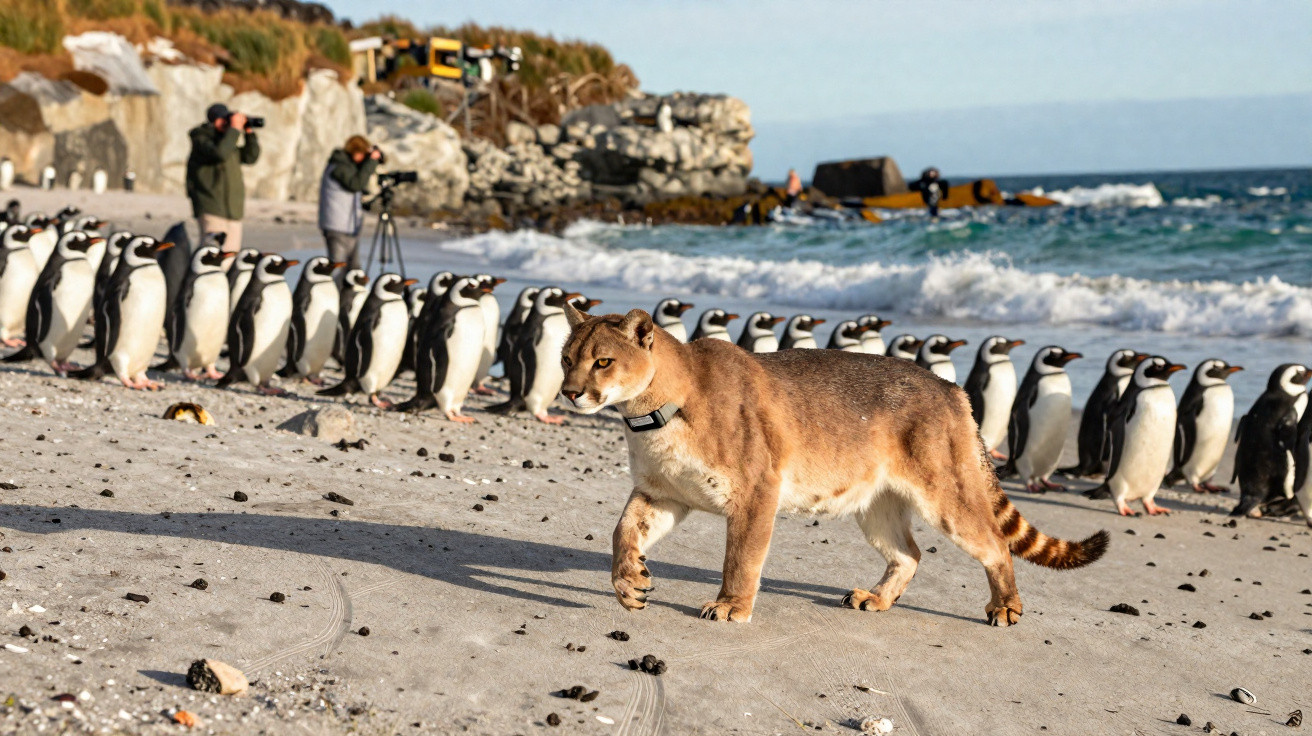
In Argentina’s Monte León National Park, pumas have learned not only to prey on Magellanic penguins but also to ease their normally solitary way of life. They are gathering at the same coastal food source, altering how large predators occupy shared territory.
Penguin hunters on a Patagonian beach
On Argentina’s Atlantic shoreline, Monte León National Park encompasses a harsh landscape of cliffs, scrub and shingle beaches. Established in 2004, the park enabled pumas to return after sheep farmers had persecuted them for decades.
While pumas were absent for so long, another species became established. Tens of thousands of Magellanic penguins formed an unusual mainland breeding colony along about 2 kilometres of coast - an area ordinarily without large terrestrial predators.
After the pumas returned, researchers started discovering penguin remains in droppings along dunes and tracks. Scientists initially believed that only one or two cats had acquired a preference for seabirds, but this idea was soon disproved.
Puma activity near the colony turned out to be far higher than expected, revealing that penguin predation was widespread, not a quirky one-off behaviour.
New research published in Proceedings of the Royal Society B indicates that the cats are doing more than simply eating penguins. This readily available prey is changing their movements, social interactions and population density in the area.
Tracking the new penguin eaters
From 2019 to 2023, the research team combined camera traps, GPS collars and field surveys of carcasses to examine events around the colony.
- 14 pumas received GPS collars
- 9 of those pumas regularly preyed on penguins
- 5 continued to target more conventional prey, including guanacos and smaller mammals
- Dozens of penguin kill sites were recorded over several breeding seasons
The work covered the narrow coastal strip and nearby scrubland inside the national park. Cameras were also used to assess the number of separate pumas using this location.
The density of pumas in the park was more than double the highest levels previously recorded in Argentina, a striking spike for a species usually spread thin across huge territories.
Ordinarily, adult pumas avoid one another and each guards a large home range to obtain sufficient prey. At Monte León, however, that arrangement began to break down as penguins returned to shore.
Seasonal boom and bust on the penguin buffet
Pumas that ate penguins used the landscape differently from cats that left the birds alone. Their home ranges expanded and contracted seasonally in step with the penguins’ migration.
While Magellanic penguins were ashore to breed, pumas remained near the colony and focused their activity within and immediately behind the nesting grounds. When the birds departed to spend months at sea, the cats dispersed across the wider landscape, travelling roughly twice as far to locate alternative prey.
| Season | Penguin presence | Puma behaviour |
|---|---|---|
| Breeding (onshore) | Thousands of penguins on the beach | Penguin-eating pumas gather close to the colony, with smaller ranges |
| Non-breeding (offshore) | Penguins at sea | Pumas travel farther, with ranges almost doubling in size |
This seasonal “accordion” effect in home-range size indicates that a concentrated, dependable food supply by the colony lets more pumas live in close proximity - and tolerate one another in circumstances that would usually lead to conflict.
Solitary cats that suddenly tolerate neighbours
A particularly notable finding emerged when researchers assessed how frequently individual pumas encountered one another.
For pumas that hunted penguins, the team documented 254 encounters, with most occurring within around 1 kilometre of the colony. Over the entire study, just four encounters were recorded among pumas that did not consume penguins.
This sharp contrast suggests penguin-eating pumas are unusually tolerant of each other, sharing space near a rich, reliable food patch rather than strictly defending it.
The cats are not becoming social in the manner of lions. There is no indication of coordinated hunts or permanent prides. Rather, they appear to overlap in their movements, use the same places soon after one another and sometimes feed in the same broad area without forcing rivals away.
Their behaviour matches an ecological pattern observed in other carnivores: territorial boundaries may become less rigid when food is highly abundant and concentrated in one place. When penguins are plentiful, accepting a neighbour carries less cost than continual fighting.
A human-shaped ecosystem with unexpected twists
Neither the puma nor the Magellanic penguin is unfamiliar in Patagonia. The new element is this specific combination: a crowded mainland penguin colony and a recovering apex predator returning after livestock farming had displaced it.
People reshaped this ecosystem on two occasions. Initially, intense persecution removed pumas from much of the area and reduced pressure on potential prey. Later, protection allowed the predators to return to a landscape whose prey communities had already altered.
Reintroducing or allowing predators to recolonize doesn’t rewind an ecosystem to some imagined “original” state; it produces novel interactions that managers need to understand.
Ecologists monitoring Monte León suggest that puma–penguin interactions may generate wider effects. If some pumas obtain much of their food from seabirds in particular months, temporary pressure on their normal prey - including guanaco, a wild relative of the llama - could decline. The consequences could extend to vegetation, smaller herbivores and even livestock beyond the park boundary.
What does this mean for penguins?
At a large, long-established colony of around 40,000 breeding pairs, predation by pumas may not prove disastrous. Many seabirds can lose some eggs, chicks or adults while still maintaining their population.
The situation would be different if pumas began visiting smaller or recently formed colonies elsewhere along the coast. In such colonies, the annual loss of a few dozen breeding adults could restrict growth or drive numbers into decline.
Managers must navigate a difficult position: both pumas and penguins are protected native species, while their relationship has been influenced by previous human activity. There is no clear “villain” that can simply be removed. Measures such as fencing sections of a colony, changing access routes or controlling puma numbers would each involve compromises for conservation aims and tourism.
Key concepts behind the strange behaviour
What ecologists mean by ‘predator density’
Predator density describes the number of carnivores occupying a particular area. Puma density at Monte León is exceptionally high. The number of top predators a landscape can sustain is affected by food supply, competition, disease and human persecution.
In this case, the penguin colony functions as a seasonal food subsidy, increasing the number of pumas the park can support. This prompts questions about whether such a dense population can remain stable if circumstances alter - for example, if penguin numbers fall or human disturbance grows.
Why a “generalist” predator switches prey
Pumas are generalist predators, so they can feed on numerous animals instead of relying on one species. When a readily captured new prey source becomes available - such as thousands of penguins moving between their nests and the sea - a generalist predator can rapidly incorporate it into its diet.
This adaptability enables pumas to persist in changing environments, including mountains, scrubland and coastal areas. However, it also means that new food sources can produce unpredictable behaviour, making conservation planning more complex.
What could happen next in Monte León
Future work in the park will seek to clarify how penguin hunting influences the rest of the food web. If penguins reduce the need for pumas to hunt guanacos during part of the year, guanaco populations could increase and alter grazing pressure on grasses and shrubs.
Researchers also hope to establish whether young pumas acquire penguin-hunting methods from their mothers or learn them independently. Should the practice spread within the population, more pumas may cluster near the colony, increasing tolerance further and challenging established assumptions about these cats’ solitary nature.
For wildlife managers in other places, Monte León provides a live case study. When major predators return to landscapes profoundly shaped by people, unexpected diets, unusual social patterns and changing threats to prey can all emerge. Recognising these changes in advance may help parks and neighbouring communities get ready before the penguin buffet becomes too crowded.











Comments
No comments yet. Be the first to comment!
Leave a Comment