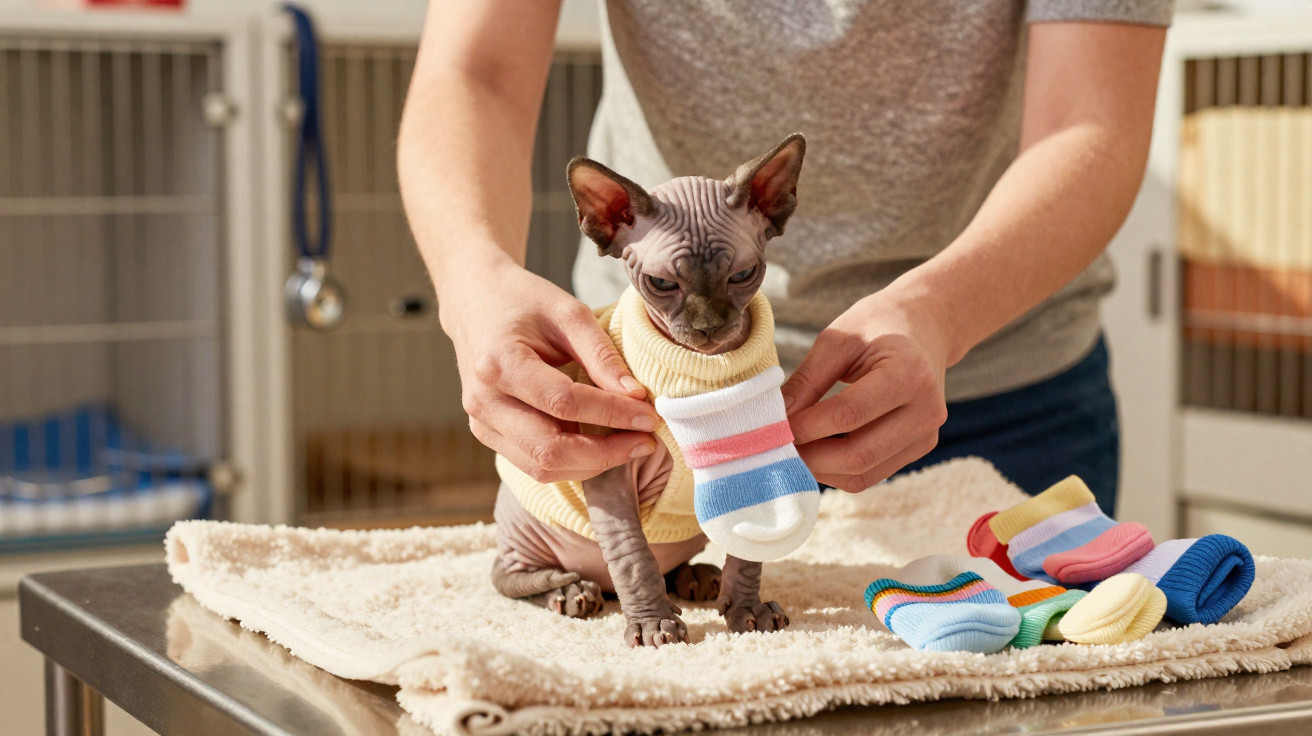
Sammie, a tiny Sphynx kitten, had a dramatic beginning: at barely two weeks old, he was seriously ill, hairless and constantly cold. At SPCA Merced, his prospects appeared bleak. Then carers and veterinary staff stepped in, tried something unusual and transformed the kitten’s life completely.
A very young kitten in an emergency
When Sammie arrived at SPCA Merced, he had barely begun his life. At around two weeks old, he was tiny, naked and far too weak. Sphynx cats are naturally born without fur, but this is especially significant in such a young kitten.
Staff described him as a thin, listless little creature who could hardly move. Rather than playing or meowing, he shivered from the cold. He also had a severe respiratory infection. The illness had progressed so far that his left eye was bulging outwards, a drastic consequence of the inflammation.
His small body was fighting an infection, being underweight and constant hypothermia all at once – a dangerous combination for such a young animal.
The vets quickly established that Sammie had little chance without consistent treatment and a reliable source of warmth.
A serious diagnosis with an uncertain outcome
His medical condition was delicate. A severe respiratory infection in a newborn can become life-threatening within a short time. His protruding eye showed just how much pressure had already built up around his head. Those responsible faced a difficult choice: euthanise him or try everything possible?
They deliberately chose to fight for him. Sammie was given medication and inhalation treatments, then placed with a foster family where someone could monitor him around the clock. Yet, even with antibiotics and intensive care, one central issue remained: his temperature.
Why hairless Sphynx cats get cold so quickly
Unlike most other breeds, Sphynx cats have no protective coat. Many people find this appearance distinctive, but it can bring health challenges, particularly for babies:
- They lose body heat much more quickly.
- They use more energy simply to stay warm.
- They are more susceptible to colds and other infections.
- They often need extra heat sources or clothing.
For a healthy adult Sphynx, a cosy blanket or heated room is often enough. For a tiny, ill kitten, it is not. The carers soon noticed that Sammie was not properly warming up despite a hot-water bottle and blanket. His body was so slight that he could barely retain the heat.
The unusual idea of using socks
At the foster home, the team looked for an answer that could do more than a blanket. They needed something soft that sat directly against his body and would not slip out of place. Special clothing for kittens this small was scarcely available. So the carers thought differently and turned to an everyday item found in most homes: socks.
They chose a soft sock, carefully cut openings for his legs and adjusted its length. Within minutes, Sammie had a kind of miniature jumper. The fabric fitted closely without putting pressure on him. He could still move around, while remaining wrapped up like he was in a small sleeping bag.
A simple sock became made-to-measure thermal protection – and a genuine aid to Sammie’s survival.
The first attempts produced a rapid effect: Sammie shivered less, slept more deeply and drank better. His body temperature became more stable. Instead of spending all his energy on keeping warm, he could finally put strength into growing and recovering.
Early progress: returning to life gram by gram
After only a few days in his “sock outfit”, Sammie’s condition changed noticeably. The kitten began gaining weight, initially by only a few grams, but steadily. For an animal so small, every gram was an important step.
His carers saw him becoming more alert. He started watching his surroundings with curiosity, responding to voices and seeking closeness with the people caring for him. The combined effect of warmth, medication, regular feeding and intensive care was becoming clear.
This also meant a great deal emotionally for the team. They no longer saw only a critical emergency case, but a small creature determined to fight. The socks became a regular part of his routine. His carers repeatedly adjusted the size and cut so that he stayed comfortable and well protected through every growth spurt.
Surgery and a turning point
Despite his progress, Sammie’s eye remained a problem. The severe protrusion carried risks, including pain and lasting damage. Having weighed up the situation, the vets decided that surgery was necessary. An operation is always risky for such a young animal, but weeks of care had substantially improved Sammie’s condition.
The procedure was successful. At first, he was exhausted after the anaesthetic, resting often while continuing to be kept warmly wrapped. The sock solution again played a part: it stopped his body from cooling down after the operation and gave him extra stability.
Over the following days, the turning point became apparent. His appetite returned, he moved with more confidence and seemed distinctly more lively. His carers reported that he began to play, nibble fingers and curiously explore everything within reach.
From vulnerable kitten to family member
Day by day, the fragile little kitten grew into a spirited, active Sphynx cat. His personality also became increasingly clear: affectionate, cuddly and slightly cheeky. Many people who followed his journey fell in love with him, and eventually a family chose to give him a permanent home.
Naturally, Sammie does not have to be cold in his new home. His family provides plenty of warm resting places, using baskets, blankets and, yes, little “jumpers” when the weather is cooler. The improvised sock solution has become something of a signature look: photographs show him in various miniature outfits, some plain and others colourful.
A seriously ill, shivering little cat has become a much-loved pet who now lives safely and securely.
What Sphynx cat owners should consider
Sammie’s story highlights how sensitive hairless cat breeds can be to temperature. Anyone considering taking in one of these cats should research their needs carefully beforehand. A few key points include:
- Room temperature: Hairless cats generally need warmer homes than other animals.
- Resting places: Cosy dens, baskets with blankets and spots near radiators are ideal.
- Clothing: Lightweight jumpers or shirts can be helpful in draughts or during winter.
- Skin care: Without fur, sebum builds up on the skin more quickly, so regular cleaning is required.
- Sun protection: They burn more easily in sunlight, so direct exposure should be limited.
Especially with kittens or unwell animals, it is worth watching their behaviour closely. If a cat frequently shivers, desperately seeks warm places or appears constantly tired, hypothermia may be the cause. A simple garment or a better heating arrangement can often make a considerable difference to its quality of life.
Improvised help in everyday animal care
The sock idea shows how inventive animal lovers can become when a situation is serious. Of course, such a solution cannot replace a vet, but it can provide useful support alongside medical treatment. Anyone making something themselves should always ensure that the animal cannot become tangled or injured.
Soft, stretchy fabrics without hard seams or buttons are suitable. Openings must be large enough that they do not restrict the animal. As well as socks, some owners use baby bodysuits, cut-down children’s T-shirts or specially adapted dog jumpers for very small cats.
Why stories like Sammie’s matter
Cases such as Sammie’s demonstrate the dedication found in animal shelters and foster homes. The people there often work with limited resources, finding creative answers ranging from improvised clothing to special feeding methods. Many of these ideas can also be used at home when an animal needs support.
Anyone choosing an animal from a rescue organisation does more than bring home a pet: they give a difficult beginning the chance of a happy ending. Sammie’s journey makes this particularly clear. A few brave decisions, a piece of fabric and a great deal of care can make the difference between a weak kitten giving up and one day confidently padding around the living room.







Comments
No comments yet. Be the first to comment!
Leave a Comment