What does a Hoopoe visit mean for your garden?
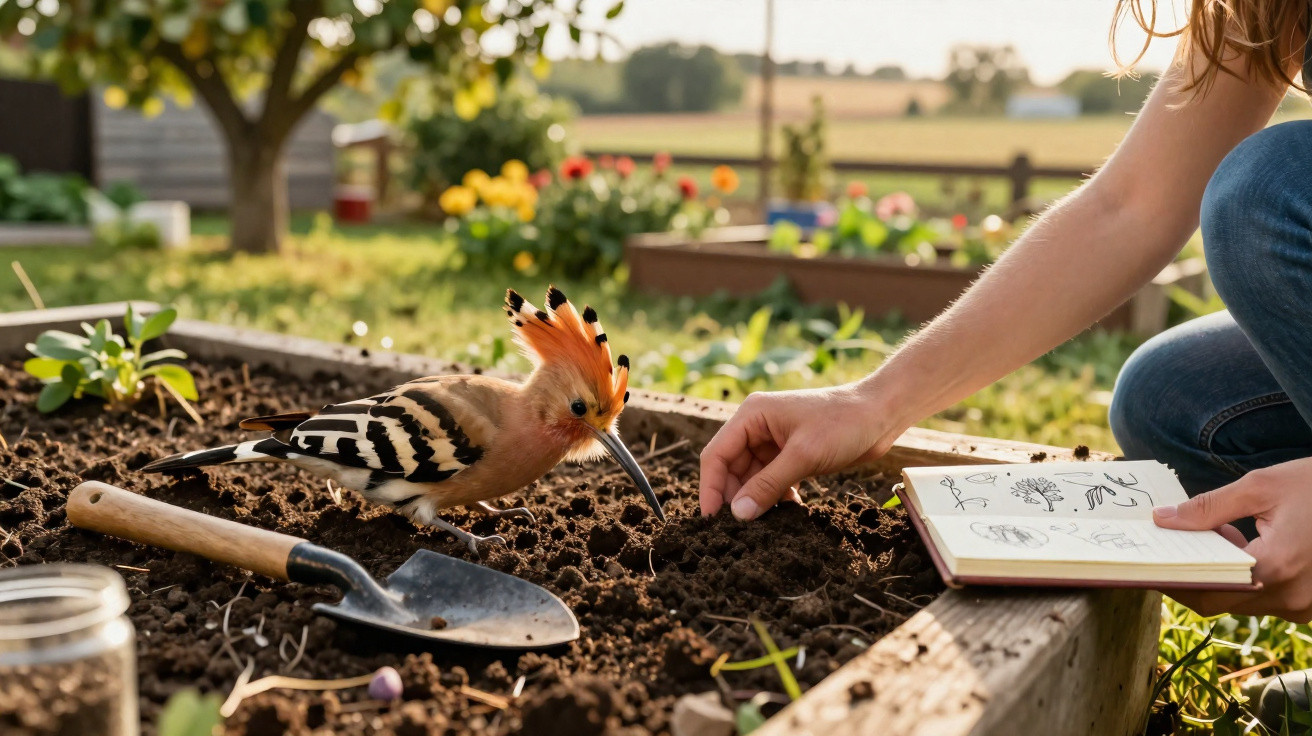
Anyone who spots a Hoopoe in their own garden is unlikely to forget it. Its black-and-white striped wings, long curved bill and raisable feather crest give it an almost tropical appearance. Many amateur gardeners are surprised to ask: is it simply chance, or does it mean something more when this remarkable bird chooses to land in their garden?
How the Hoopoe ‘reads’ your soil
Biologists regard the Hoopoe as a highly specialised insect-eater. Using its curved bill, it probes loose ground to extract a wide range of crawling creatures, including:
- chafer grubs and cockchafer larvae
- mole crickets
- caterpillars, including some processionary moth caterpillars
- beetles and their larvae
- crickets and other ground-dwelling animals
For this diet to be available, the bird needs soil teeming with life. A place dominated by gravel, concrete and chemical poisons offers the Hoopoe no real prospect of survival. Its presence therefore provides a fairly clear indication: insects are still plentiful, the soil is active and the garden ecosystem is functioning.
“A garden visited regularly by a Hoopoe generally indicates living soil, few poisons and plenty of insects.”
If you see the bird returning to the same area for several consecutive days, you can assume it is finding enough food there. This points to:
- gardening with few pesticides, or without poisons altogether
- patches of open soil
- lawn that is neither cut too short nor allowed to become completely overgrown
- limited disturbance from noise and bustle
The preferred landscapes of the ‘crown bird’
The Hoopoe favours sunny, open terrain. In the wild, it is found particularly in:
- traditional orchards
- vineyards
- lightly planted fruit gardens
- parks with mature trees
- loosely built village settings with gardens and meadows
Its ideal garden is more natural and slightly untidy than a sterile designer lawn. A mix of closely cut grass and small areas of bare soil suits it perfectly. Such conditions allow it to land, walk around and probe comfortably for prey. Dense ground cover, thick layers of bark mulch and continuous paved surfaces make hunting much more difficult.
Peace and quiet matter too. A garden constantly filled with lawnmowers, trampolines and loud music will deter this sensitive bird. Anyone pleased by its visit also benefits from a calmer, more relaxing outdoor space.
Where the Hoopoe comes from – and why its visit is not random
The Hoopoe spends most of the winter south of the Sahara, in warm savannahs and open country. From late winter into spring, it begins its journey to Europe. Across central Europe, it can broadly be encountered from April to September, and occasionally a little earlier in the warmer south.
Its population has declined noticeably over recent decades. The principal reasons have been:
- more intensive farming across large, uniform areas
- extensive use of insecticides
- the loss of mature trees and suitable nesting places
Numbers are recovering in some regions, partly because farming practices have changed to an extent and climate effects favour the species. Even so, it remains rare in many places. Some large urban areas have only a handful of breeding pairs.
“Anyone who sees a Hoopoe in their garden belongs to a small minority of lucky people – its appearance is more an honour than a coincidence.”
When the bird appears in more northerly or heavily built-up areas, this suggests that your plot stands out from its surroundings: it has more greenery, more insects and more natural corners than many neighbouring gardens.
What the Hoopoe may suggest about your garden’s future
In practical terms, the Hoopoe represents a degree of future resilience: a garden capable of feeding such sensitive species is usually better able to withstand challenges such as drought, pest outbreaks and biodiversity loss. Where insects and birds are abundant, the ecological web remains more stable – an advantage in an era of climate change and extreme weather.
Symbolism also has a part to play. The Hoopoe appears as a guide and companion in ancient writings and legends. In Persian poetry, it leads other birds in their search for truth, while in ancient Egyptian symbols it represents gratitude and family bonds. Many folk beliefs see its crest as a sign of dignity and renewed beginnings.
Whether or not you believe such things, many people experience the moment this striking bird lands on their lawn as a small turning point. They suddenly pay closer attention to the nature outside their front door, reconsider the use of garden chemicals and take greater interest in animals they had barely noticed before.
What its behaviour can tell you
Its arrival is not the only revealing feature; the Hoopoe’s behaviour can also offer clues:
| Observation | Possible meaning |
|---|---|
| Hoopoe walks across the lawn while searching | The soil provides abundant insects, and its structure suits foraging |
| Bird returns repeatedly over several days | The garden is considered a regular hunting ground with a reliable food supply |
| Calls heard early in the morning, but the bird is rarely seen | There may be a nesting site nearby, for example in a tree hollow or opening in a wall |
| Only a brief stop before flying on | Probably a resting point during migration; the site is usable, but not a core territory |
By watching carefully, you can almost interpret your own garden as a ‘health check’. If the bird disappears again after only a short time, it is worth considering possible disruptive factors: too much sealed ground, a lack of structure or continual activity.
How to turn your garden into a Hoopoe haven
No one can ‘order’ a Hoopoe. However, you can create conditions that appeal to it – and many other species will benefit as well. Useful measures include:
- avoiding chemical insecticides
- retaining a few open patches of soil instead of mulching everything
- not cutting every part of the lawn extremely short
- keeping mature trees and not immediately removing tree hollows
- planning quiet areas free from constant noise
- leaving piles of leaves and areas of dead wood in place
Those with enough space can install artificial nesting cavities that resemble tree hollows. Special nest boxes with a side entrance and sufficient depth suit the bird’s breeding behaviour. One factor remains essential: the location must be quiet, sunny and not regularly used by people.
Unpleasant side effects – and why they are worthwhile
As elegant as the Hoopoe may seem, its nest cavity can have a strong smell. The young produce a powerful secretion intended to repel predators. This is why folk names for the species have referred to its odour. Anyone who tolerates nest sites close to the house must accept this distinctive scent.
The benefit is considerable: during the breeding season, a Hoopoe family consumes vast quantities of insect larvae, including species that could cause serious garden damage. Rather than using poison, you allow a feathered professional to do the work – sustainably, quietly and free of charge.
What else you should know about the Hoopoe
Many garden owners are unsure how to behave when the bird appears. The basic rules are straightforward:
- do not chase after it or try to touch it
- keep dogs and cats away where possible
- do not start noisy equipment while it is hunting
- watch from a distance, perhaps using binoculars
The Hoopoe is legally protected. Nesting sites must not be destroyed or deliberately disturbed. If you find a nest in a shed, wall or tree, the best approach is to leave it alone and postpone building work until the young have fledged.
For children, such a visit can be an ideal introduction to genuine nature observation. Instead of watching wildlife films on a screen, they can see a living, rare animal just beyond the patio door. Parents can use the opportunity to discuss soil life, insects, migratory birds and the value of avoiding poisons. In this way, one bird can become the starting signal for a more conscious relationship between people and their gardens – with very real consequences for soil quality, biodiversity and the future of their own patch of green space.














Comments
No comments yet. Be the first to comment!
Leave a Comment