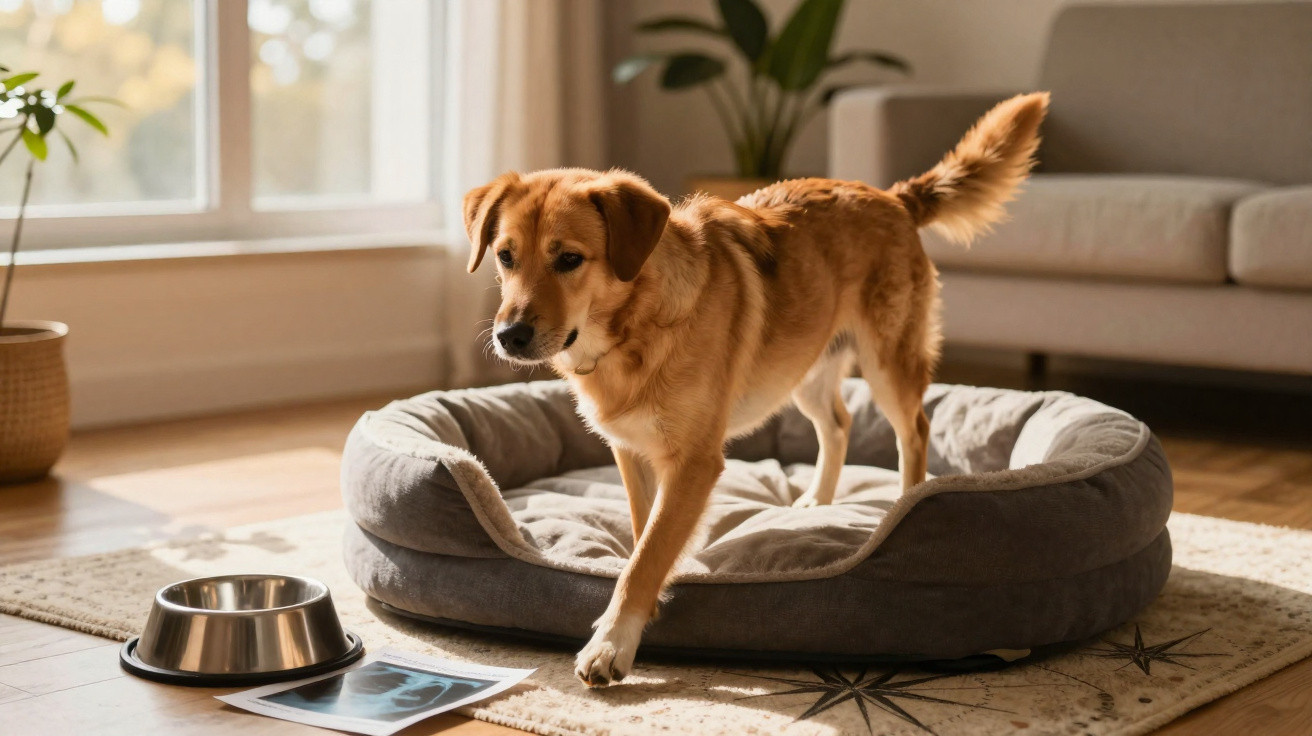
Anyone who lives with a dog will know the scene: the animal paws at the surface, sniffs around, circles the cushion several times – then finally flops down. It is amusing to watch, of course. Yet this “sleep dance” is far from pointless theatre. A combination of primal instinct, an internal navigation system and, at times, even a quiet physical cry for help lies behind the circling.
An ancient survival routine: why dogs prepare their sleeping spot
Inherited from wolves: making a bed rather than scrunching a sofa cushion
Long before dogs slept on sofas and in orthopaedic beds, their ancestors rested outdoors – on soil, leaves, snow or grass. Turning in circles was simply a survival tactic for them.
Repeatedly walking around the area achieved several things at once:
- It flattened the vegetation, creating a more level place to lie.
- Stones, twigs and thorns were pushed aside.
- It allowed them to “check” the ground for dampness or cold.
Although the floor in a modern living room is already smooth, dry and warm, this behavioural programme remains deeply embedded in their genes. Your dog is still “preparing” its bed, even when it objectively looks perfectly ready.
Circling before lying down is a visible remnant of genuine wild-animal behaviour – simply continued indoors.
A safety inspection: driving away pests and hazards
Grass and cracks in the ground could conceal all sorts of creatures outdoors: snakes, spiders, insects and rodents. Prey animals are vulnerable when they sleep without moving, so their chosen spot needed to be as safe as possible.
By turning in circles and repeatedly treading the ground, the ancestors of today’s dogs could:
- startle or drive away small animals,
- detect unusual movement or sounds,
- assess scents more effectively and check whether an enemy was nearby.
Once no disturbance is detected, the dog lies down, often curling into a ball to protect its abdomen and organs. Its back faces outwards, while the sensitive part of its body is concealed within its posture. This is a classic protective mechanism that still operates in the living room.
The dog's built-in compass: alignment with the magnetic field
Research suggests dogs often align themselves north to south
In recent years, animal behaviour researchers have made a remarkable observation: many dogs orient themselves along the north–south axis of the Earth’s magnetic field during certain activities – including sleeping and relieving themselves.
Circling appears to function as a form of fine adjustment. The dog searches for the position in which it feels most “right”. While humans cannot perceive the magnetic field, dogs seem able to sense it and use it for orientation.
A dog may look as though it is merely walking around aimlessly – but it is often “calibrating” itself to invisible environmental stimuli.
Why this alignment may soothe a dog
Many owners report that, once their dog has found its ideal position, it audibly exhales, its muscles relax and its eyes narrow. Orienting itself to the magnetic field may contribute to this sense of inner calm.
The circling then serves as a searching movement: the dog tests different angles until its body and nervous system reach a kind of resting state. As a result, the animal seems more settled and sleeps more deeply.
For you as an owner, this means that there is no need to stop the turning if it does not bother you. It is simply part of a ritual that provides the dog with security and orientation.
When circling can be a warning sign of pain
When you should take notice
A few ritualised turns, lying down and that is that – this is considered normal. It becomes problematic when the dog seemingly cannot stop. Caution is needed if it makes significantly more than three or four turns, gives up, tries again, lies down then jumps back up, or cannot settle on a position at all.
This behaviour may indicate that no position feels genuinely comfortable because the joints, muscles or spine are painful. Common underlying causes include:
- early joint wear (osteoarthritis),
- inflammation following injuries,
- back problems, such as issues in the lumbar area,
- the effects of excess weight placing pressure on the joints.
Typical accompanying symptoms that should be taken seriously
It becomes more than mere “comedy” if other signs appear too. Watch for the following around the time your dog lies down:
- heavy panting despite no heat or recent exertion,
- quiet whining or growling when lying down or getting up,
- lowering its hindquarters hesitantly, as though it does not dare to do so,
- noticeable stiffness after resting, particularly in the morning,
- suddenly refusing certain places to lie, such as surfaces that are too hard.
The longer your dog unsuccessfully tries to find a pain-free position, the more urgently it needs to be seen by a veterinary surgeon.
Many owners tend to dismiss such changes for a long time as an “old-age quirk”. Yet a large proportion of these problems can be treated or at least eased – through pain management, physiotherapy, muscle strengthening and a suitable sleeping area.
How to make lying down easier for your dog
Choosing the right sleeping place
If you feel that your dog is turning far more often than it used to, it is worth looking at its surroundings. A few practical points can help:
- Surface: Very hard floors encourage pressure sores. A well-padded, non-slip dog bed reduces strain on the joints.
- Size: Beds that are too small force a dog into a tense posture. It needs enough room to stretch out.
- Temperature: Draughty corners or places close to radiators can worsen discomfort. A moderately warm, quiet location is more comfortable.
- Peace and quiet: Constant interruptions from children, the television or people passing through doorways prevent a dog from truly relaxing.
Exercise, weight and preparing for old age
Reducing strain on your dog’s joints usually means adjusting several factors:
- Weight control: Every extra kilogram increases pressure on the hips, knees and spine.
- Regular, suitable exercise: Shorter walks more frequently are preferable to infrequent forced marches.
- Muscle strengthening: Gentle exercises, mild inclines or swimming, where possible, stabilise the musculoskeletal system.
- Veterinary checks: Especially for older dogs, having the joints and back checked once a year is worthwhile.
How to tell a normal ritual from problem behaviour
| Normal circling | Suspicious circling |
|---|---|
| 3–4 turns, followed by lying down calmly | many turns, repeatedly stopping, restlessness |
| relaxed gait, calm expression | stiff gait, tense muscles |
| no whining, normal breathing | panting, whining or growling when lying down |
| dog falls asleep quickly | dog takes ages to settle |
Look at the overall picture rather than relying on a fixed number of turns. Every dog is different. Some make two turns, while others are more likely to make four. It becomes noticeable when this pattern suddenly changes significantly or when new discomfort appears.
What this behaviour reveals about your dog’s emotional life
Alongside instinct and physical condition, a dog’s mental state also matters. Dogs use rituals to reduce stress and create predictability. Turning before lying down can therefore be a kind of “winding-down programme” – much like people who follow the same evening sequence of switching off the light, putting away their phone and opening a book.
When everyday life changes considerably – a house move, a new family member or noise in the home – some dogs circle more often or more restlessly until they feel their spot is safe. During such phases, a clear routine helps: set feeding times, dependable walks and a quiet retreat reserved solely for the dog.
Anyone who watches this seemingly ordinary circling more closely will get to know their own four-legged companion better. These one or two minutes before lying down contain a surprising amount of information, from normal primal instinct and an internal compass to possible pain signals – you simply need to be willing to read them.







Comments
No comments yet. Be the first to comment!
Leave a Comment