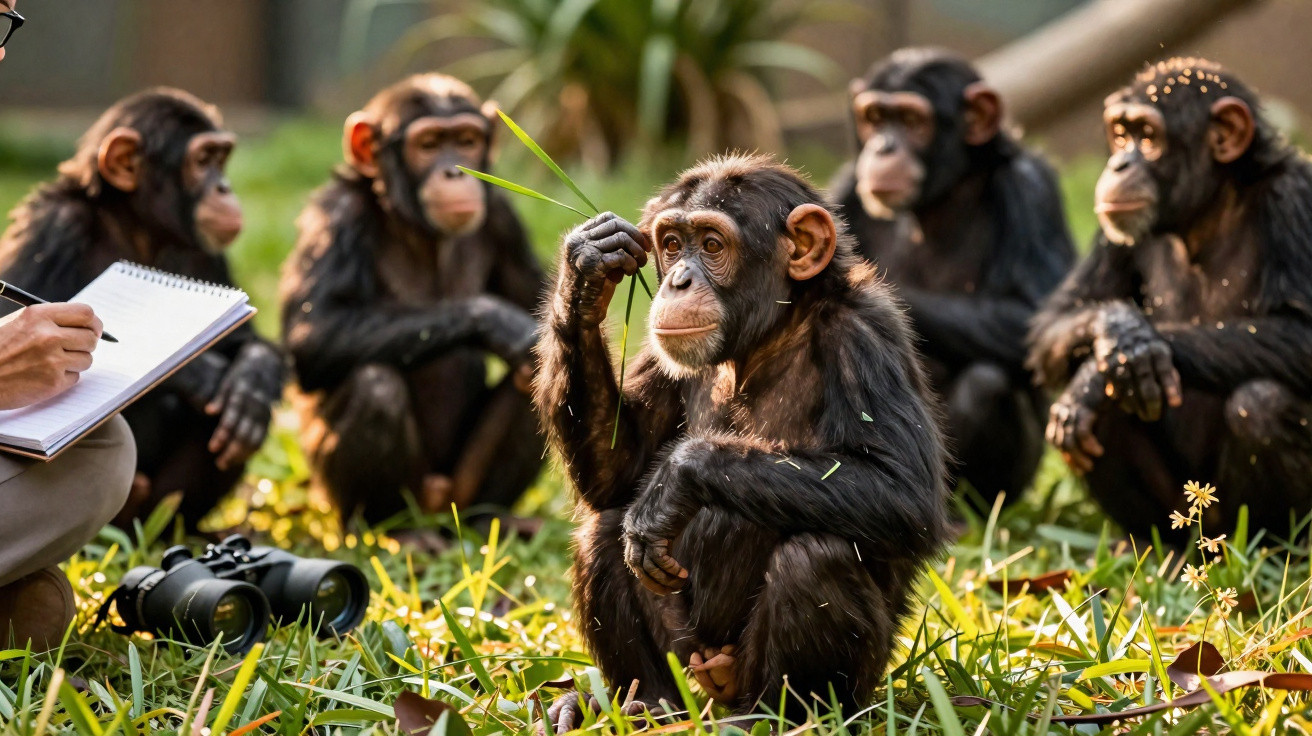
The scene might be mistaken for an unusual fashion photograph: young chimpanzees relaxing in the shade and grooming each other, with slender green straws poking from some ears and, in others, from their bottoms. Beneath the amusement, researchers have identified a meaningful insight into how culture, fads and even “style” can circulate among our nearest animal relatives.
From ear decoration to a back-end statement
The account starts at Chimfunshi Wildlife Orphanage in northern Zambia, among Africa’s biggest chimpanzee sanctuaries. Behavioural scientists had previously recorded an unusual practice there around a decade ago: chimpanzees would place a grass blade in an ear and leave it protruding, rather like a pared-back earring.
This initial example, described in a scientific paper in 2014, appeared to be an amusing isolated oddity. However, research published in the journal Behaviour on 4 July 2025 indicates that the “look” reappeared in a different group - and developed further.
In the latest observations, a central group of chimpanzees at Chimfunshi continued to wear the familiar grass-in-the-ear accessory. Some, however, introduced a striking addition: they put grass between their buttocks too, leaving it jutting out like a small green tail.
What started as a single chimp’s odd habit turned into a short-lived craze, spreading through the group in just days.
The researchers followed the behaviour’s spread and concluded that a high-ranking male seemed to have started it. Over roughly a week, several group members began imitating him. Although the habit did not catch on with every chimpanzee, enough adopted it for it to be considered more than chance behaviour.
Did humans accidentally inspire chimp fashion?
The peculiar practice prompted an obvious question: what was its source? The newer trend began in a group that had no contact with the chimpanzees examined a decade earlier, making direct imitation between the two groups improbable.
The researchers considered whether it was simply coincidence, but the similarities seemed too precise. Could two separate communities in the same sanctuary both independently play with grass in their ears? This question led the team to consider influences beyond the chimpanzees.
Sanctuary employees provided the missing link. Some keepers said they occasionally put grass - or even a matchstick - into their own ear while at work, using it to scratch or clean the ear. Keepers working in other enclosures reported that they never did this.
Where keepers routinely fiddled with grass in their ears, chimpanzees were more likely to copy the gesture and turn it into a group habit.
The scientists’ proposed explanation is straightforward: chimpanzees spend all day observing people. A curious animal sees a familiar keeper place grass in an ear, tries the action itself, and finds it interesting or at least harmless. It repeats the behaviour, while other attentive chimpanzees subsequently copy it.
Putting grass at the rear seems to be an inventive, playful variation created by the chimpanzees themselves. After the general concept of “body plus grass” had taken hold, one animal tested a different placement. It attracted attention, likely triggered social responses, and spread quickly as an apparent in-joke within the group.
Is it fashion, tool use or just a joke?
For researchers, this grass fad falls into an uncomfortable middle ground. It does not operate as a tool: the chimpanzees are not using grass to access food, extract insects or treat wounds. It also has no apparent health benefit.
Instead, it resembles what people might describe as a style decision or playful display, concerned more with communication than survival. A chimpanzee passing by with grass in its ear is doing something conspicuous, unnecessary and socially noticeable. This is similar to the human rationale behind wearing an unusual hat or a piercing.
- Tool? No obvious functional purpose.
- Play? Probably connected to social play and experimentation.
- Signal? It may communicate “I’m part of this group” or “I’m paying attention to you”.
- Fashion? Broadly speaking, yes: an arbitrary shared style transmitted through imitation.
Why captive chimpanzees have time for trends
Life in a sanctuary gives chimpanzees something that is scarce in the forest: free time. Their food is supplied and predators are not a threat. Conflicts still happen and social hierarchies remain important, but surviving each day requires less work.
Lead researcher Edwin van Leeuwen of Utrecht University argues that this extra breathing space allows new traditions to emerge. With more energy available, chimpanzees can devote greater time to watching one another, grooming, experimenting and copying unusual gestures that draw their attention.
More free time means more room for culture-like behaviours: local quirks, traditions and seemingly pointless but socially meaningful habits.
Inserting grass into an ear or buttock can act as a low-risk signal of social interest. When a lower-ranking chimpanzee replicates a dominant male’s strange new action, it may be expressing “I see you, I respect you, and I want to be associated with you.” A shared practice can then strengthen social ties.
The researchers point out that, for chimpanzees as for humans, imitation is seldom neutral. The person copied, and the timing and setting of the copying, all have social significance. By mirroring a well-liked individual’s behaviour, chimpanzees may be subtly negotiating their own position in the group.
Could wild chimpanzees do the same thing?
Scientists studying wild chimpanzees have already documented cultural variation between communities. Some groups crack nuts using stones, while others do not. Others use particular leaf gestures in grooming or courtship. Such practices are local traditions acquired socially and handed down across generations.
Even so, nobody anticipates wild chimpanzees parading through the forest with ornamental grass in their backsides. Forest life creates less opportunity for this sort of pure play, as finding food, defending territory and staying alert take precedence.
Sanctuaries function as a form of behavioural laboratory. Without continual danger, chimpanzees can direct their curiosity towards quirky behaviours that may never appear in tougher environments. The same mental capacities that enable sophisticated tool use in the wild can, under safer conditions, also produce apparently frivolous fads.
How scientists distinguish a ‘trend’ from a fluke
A central difficulty is telling apart an individual eccentricity and a true group-level pattern. Behavioural researchers generally assess several factors:
| Criterion | What researchers look for |
|---|---|
| Spread | Does the behaviour pass from one chimpanzee to several others? |
| Longevity | Does it continue for weeks or months, rather than only one day? |
| Learning path | Do younger or lower-ranking chimpanzees copy older or higher-ranking individuals? |
| Lack of function | Is there no clear survival benefit, indicating a possible social purpose? |
The grass-in-ears and grass-in-bottoms practices meet several of these criteria. They moved through part of the group, continued for a time, and appeared to offer neither extra food nor greater safety.
What ‘culture’ means when talking about chimpanzees
When researchers apply the word “culture” to animals, they are not referring to art galleries or literature. Instead, they mean traditions and behaviours that:
- are shared by members of a group
- differ between groups within the same species
- are socially learned rather than genetically determined
By this definition, chimpanzees plainly possess culture. Different communities display distinctive handshakes, grooming customs, toolkits and food-finding techniques. The Chimfunshi grass trend fits comfortably within this pattern as a lightweight visual tradition.
This is significant for people because it reduces the distinction we often make between “our” symbolic behaviours and those of other animals. Chimpanzees do not hold catwalks or create designer labels, yet they demonstrate an interest in arbitrary signals that have meaning only within their own social community.
What this means for anyone visiting or working with great apes
For sanctuary workers, zoo keepers and field scientists, the study offers a practical lesson: apes observe everything people do. An offhand habit - cleaning an ear with grass, wearing a brightly coloured bandana or tapping on glass - may provide the basis for a new ape behaviour.
This creates ethical considerations. Should humans intentionally demonstrate particular actions to enrich the lives of apes? Certain programmes already teach apes basic gestures or ways of using objects to engage their minds. Yet nobody wants to introduce practices that might lead to distress, injury or conflict.
A sensible strategy is structured enrichment: provide safe materials, change the available objects regularly, and monitor how apes decide to use them. Grass fashions are fairly harmless, whereas imitated behaviours such as tampering with enclosure locks or placing objects in wounds would require rapid action.
If you ever see a grass-wearing chimp
Visitors who spot strange chimpanzee adornments can regard them as small glimpses into complex minds. Grass protruding from an ear is not simply an accidental occurrence: it reflects observation, curiosity and subtle imitation.
Behind one grass blade may lie a keeper’s unconscious action, an adventurous chimpanzee’s experiment, and a shifting network of alliances as other individuals choose whether to embrace the fad or disregard it. In a species so closely related to ours, even a humorous accessory can reveal much about the way culture develops.












Comments
No comments yet. Be the first to comment!
Leave a Comment