The sudden silence in the house feels heavy, the bowl remains full, and there is no meow in response to the familiar call.
Within minutes, what first seemed merely unusual becomes a lump in your throat: your cat has gone missing. It is January, the nights are freezing, the streets are busy and a gate has been left ajar. At this point, panic will not help. What matters is responding promptly and methodically, treating the situation like an emergency operation with clear stages and tight deadlines.
The first hours: treat every minute as precious
The initial hours after a disappearance can shape the entire search. Your cat may be frightened, injured or trapped somewhere very close to home. In cold weather, the danger is greater because it may seek shelter away from its usual surroundings.
The sooner you organise a “task force” with practical actions, the better the chances of being reunited within the first few days.
Check the house and immediate area straight away
Before assuming your cat has travelled far, carry out a thorough search. Many “missing” cats are actually shut in or hiding nearby.
- Search bedrooms, cupboards, the loft, cellar and utility areas.
- Look behind appliances and heavy furniture.
- Make sure it has not been locked in the garage, pantry or guest room.
- Speak to neighbours and ask them to check their garages, sheds and gardens.
Use a powerful torch, even in daylight. Its beam can catch the reflection of eyes beneath cars, under wooden decking, on low roofs or inside ventilation gaps.
Update the register and notify official services
If your cat is microchipped or otherwise identified, immediately notify the relevant registration service. In France, the I-CAD register changes the animal’s status to “lost” and creates an alert when the chip is scanned at a veterinary practice or shelter. Procedures differ elsewhere, but the principle is identical: update the record so that any professional who finds the cat knows that an owner is looking for it.
At the same time, make a quick list of key places within a radius of up to 20 km:
- veterinary practices and veterinary hospitals
- council services and municipal bodies that collect stray animals
- shelters, charities and independent animal rescuers known locally
- companies that carry out rescues on nearby motorways
Telephone each one, provide a detailed physical description and any distinctive features, and make sure your contact numbers are always available. This stage establishes an alert network that acts like a “safety belt” around the disappearance.
Field search: create your own patrol
Once you have searched the home and contacted official services, it is time for the more physical part of the search: going out into the streets. Frightened cats often remain silent and concealed within 500 metres of their home address.
Patrol at the most useful times
Quieter periods make a response to your calls more likely. Late at night and very early in the morning are particularly valuable times. Walk slowly and call your cat using a nickname it knows, without shouting.
Slow, repeated and quiet walks, using a torch and complete attention, often uncover faint meows or slight movements that would otherwise go unnoticed.
Take a container of dry food or a strongly scented pouch of wet food. Both the sound and smell can act as lures. If your neighbourhood has many houses with gardens, arrange with neighbours to leave gates open for a few minutes while you search, making it easier for the cat to find a possible route home.
Mass communication: make everyone remember your cat
Once the first searches and essential calls have been completed, it is time for wider communication. The aim is straightforward: turn neighbours and local internet users into extra eyes on the streets.
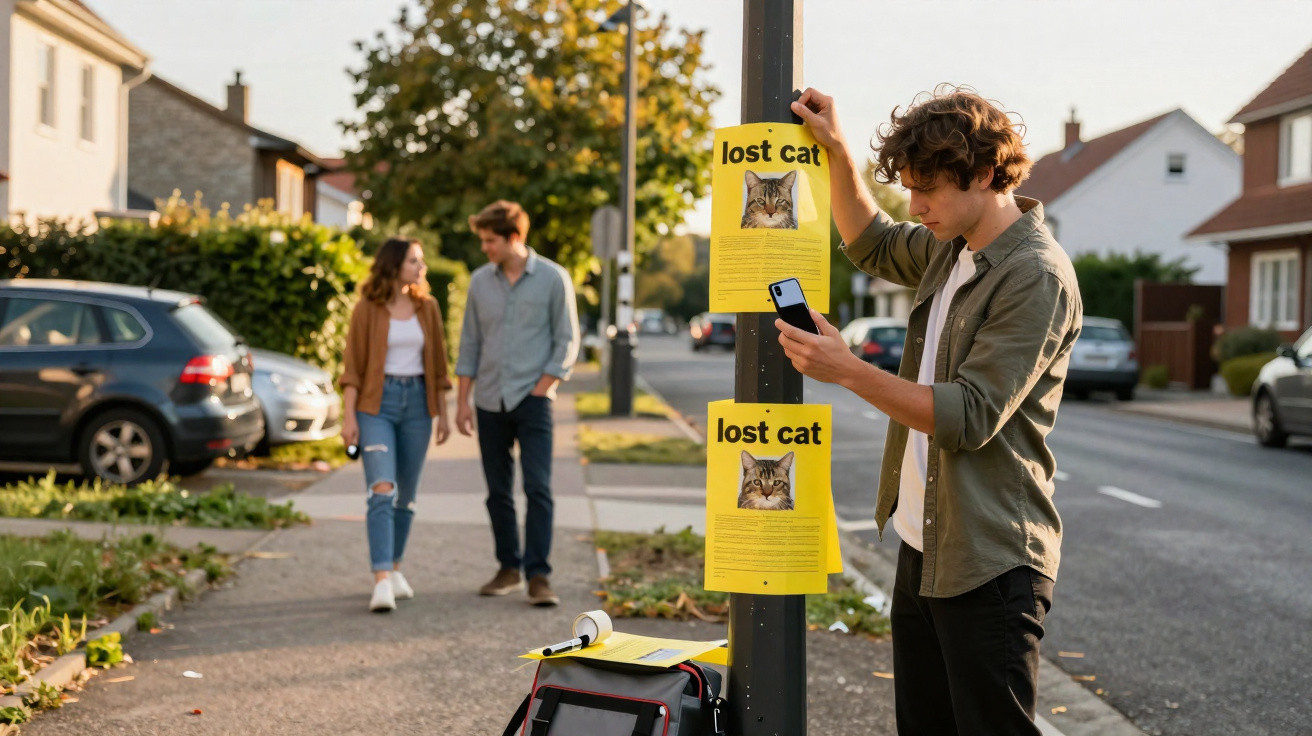
How to create a poster nobody overlooks
A useful poster must be understandable within seconds, including from a distance. Too much information gets in the way.
| Element | Why it matters |
|---|---|
| Clear colour photograph | Helps people remember the cat’s face and coat details. |
| Prominent “LOST CAT” wording | Immediately identifies the nature of the notice. |
| Date and neighbourhood where it went missing | Lets people judge how recent the case is and where to look. |
| Distinctive features | A white patch, torn ear or particular collar make recognition easier. |
| Two contact telephone numbers | Makes it more likely that someone will be able to reach you. |
Print the notices on durable paper and place them in clear plastic sleeves so they withstand rain and dew. Focus on busy locations, including bakeries, supermarkets, schools, bus stops, blocks of flats, and veterinary practices.
Social media and local groups as a constant radar
Online, concentrate your reach on the area where the cat is most likely to be. Post in neighbourhood groups, town pet pages, residents’ mailing lists and community apps.
Include:
- a clear photograph
- the street or neighbourhood where the cat was last seen
- its behaviour around people, such as nervous, sociable or aggressive towards strangers
- guidance asking anyone who sees it not to chase it, but simply take a photo and telephone
Repost the notice during busier online periods, such as between 18:00 and 21:00, when people arrive home from work and check their phones. Repeating the post every few days keeps the case visible in people’s feeds.
Managing the search: organise, record and persist
When a cat has been missing for more than one or two days, the search begins to resemble a marathon. How you handle this stage affects not only the likelihood of a reunion but also the emotional strain on the household.
Write everything down to identify patterns in the clues
Use a notebook or notes app to log every telephone call and every possible sighting, including vague ones. Record the time, street, description of the animal seen and the name of the caller.
By recording every clue, you create a map of probabilities and avoid losing details that may prove decisive after days of exhaustion.
If reports repeatedly point to the same area, patrol it more often, put up additional posters and talk to local shopkeepers. Whenever a new sighting is reported, try to reach the location as quickly as possible. Frightened cats frequently move from one hiding place to another.
Revisit routes and adapt your approach
One common mistake is giving up on places that have already been checked. Many cats emerge from hiding only after several days, when hunger begins to outweigh fear. Returning to the same alleyways, empty plots and garages at different times creates fresh opportunities.
Some families set out food and water at strategic points. In certain cases, it can be worthwhile using simple security cameras aimed at the food bowl to see whether the cat appears overnight. This approach is especially helpful for very timid cats.
Less discussed factors: emotions, risks and possible scenarios
Searching for a missing pet affects routines, work and mental wellbeing. Feelings of guilt and catastrophic thoughts can arise easily. Having even a basic action plan reduces helplessness and helps prevent impulsive decisions, such as going alone into dangerous places in the middle of the night.
Some situations require particular attention. Cats that have never been outdoors usually behave very differently from those already used to roaming outside. The former is more likely to stay still, hidden within a smaller radius, unable to work out how to “get back”. The latter may travel through more streets, but will also tend to seek familiar routes and known smells. Tailoring the search to this profile makes it more effective.
Traps, building works and fast roads are another sensitive issue. Speaking with construction managers, building caretakers and refuse collection workers can help identify places where the animal may be trapped without anyone noticing. In areas crossed by major roads, it is worth monitoring footbridges, central reservations and nearby parks.
Finally, professional help may be appropriate in complex cases. There are trainers and feline behaviour consultants who can advise on lures, humane traps and ways to approach a highly frightened cat. In some towns and cities, experienced volunteers organise search groups, especially where weather conditions are risky or there are many vacant plots.
Combining official action, neighbourhood involvement, a digital strategy and daily persistence does not guarantee an immediate outcome, but it creates a genuine “protective belt” around the disappearance. Each coordinated step slightly reduces the role of chance and increases the likelihood of hearing that familiar meow at the front door once again.














Comments
No comments yet. Be the first to comment!
Leave a Comment