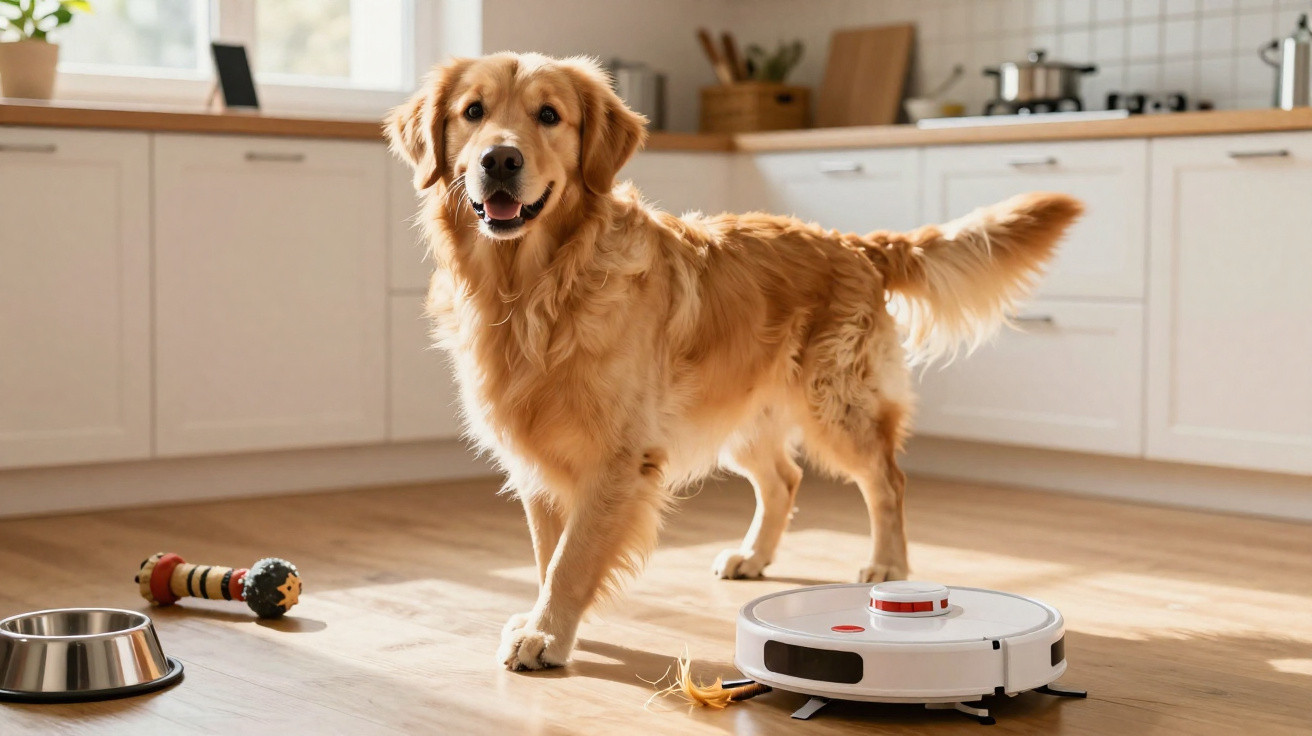
A peaceful afternoon in a family kitchen took an unexpectedly stressful turn when a soft hum beneath the cupboards alarmed its fluffiest occupant.
What was normally little more than background noise during the daily clean abruptly became the focus of everyone’s attention - particularly for Hank, a golden retriever whose tail happened to be resting on the floor at precisely the wrong moment.
A quiet kitchen, a robot vacuum and one unfortunate tail
Shortly before 5 pm, the robot vacuum left its charging base and made its way into the kitchen. Following its familiar programmed path, the small machine tracked along the cupboard edges at barely 1 km/h. That may be a gentle pace for people, but it was quite quick enough for Hank’s tail.
Hank, a usually relaxed golden retriever, was lying in his regular place, somewhere between dozing and keeping watch for potential snacks. His generously feathered tail, typical of the breed, lay stretched over the tiles like an unsuspecting plume.
Unconcerned with emotions, fur or personal boundaries, the vacuum rolled directly over it.
The fur on Hank’s tail became tangled in the rotating brush, turning a routine cleaning cycle into a minor household drama.
Relatives hurried over after hearing a startled bark and chair legs scraping sharply across the floor. Hank stood almost motionless, visibly shocked, his tail caught by the machine. The footage, which was later posted online, sits somewhere between physical comedy and genuine concern.
An ordinary clean becomes a viral moment
Video shared by the family captures Hank glancing back over his shoulder, looking both worried and baffled as the robot vacuum grips his tail. He neither snaps nor spirals into panic. Instead, with his ears pinned back, he waits for somebody to solve this distinctly modern predicament.
In the footage, a family member crouches beside him, gently works the golden fur free from the brushes and switches off the appliance. Hank remains remarkably still, seemingly aware that a sudden movement could worsen the situation. After he is released, he walks off with the composure of a dog determined to act as though nothing humiliating has occurred.
Online commenters reacted with a mix of laughter and sympathy, calling Hank “braver than all of us” and the vacuum “a furry snack hunter”.
A purported family “review” of the robot vacuum also began making the rounds on social media. Deliberately misspelt, it gave the device only one star and delivered the savage verdict: “Tried to eat my tail.” It is unclear whether the post was sincere or an inside joke, but it added to a broader stream of memes about robot vacuums “attacking” pets’ paws, toys and dignity.
The aftermath for a golden retriever with trust issues
For Hank, the episode resulted in more than a clump of tangled fur. His owners said that his behaviour shifted over the following days and weeks. The kitchen, formerly his preferred area of the house, became somewhere he avoided.
They observed several unfamiliar habits:
- He spends extended stretches looking at the kitchen wall, seemingly following noises that nobody else notices.
- He occasionally sleeps while standing, especially around doorways where he can remain watchful.
- He will not go into the kitchen by himself, particularly if the vacuum is operating or merely parked in its base.
The robot vacuum’s low hum - roughly 70 decibels, similar to a noisy street or raised conversation - has become a firm emotional limit for Hank. Once the machine starts, he quietly withdraws to the security of a different room.
When something cute becomes worrying
Clips featuring pets and robot vacuums regularly attract millions of views: cats travelling on top of them, dogs barking at them and puppies pursuing them through living rooms. At first sight, Hank’s experience appears to belong in the same category, yet it also prompts questions about the way animals experience these machines.
For a dog, particularly a sensitive, family-oriented breed such as a golden retriever, an abrupt sound followed by a tug on the tail may feel like a real danger. Behaviour experts note that an incident people regard as slapstick may be experienced by a pet as a significant fright.
Once an animal links a room, a sound or an object with fear, that association can linger far beyond the original incident.
Why robot vacuums unsettle pets
Robot vacuums are built to travel independently and alter their route when they encounter obstacles. To a pet, this can resemble an object that produces unfamiliar sounds while apparently “following” them around a room.
Several features can disturb many animals:
- Unpredictable movement: The machine can change course without warning, often moving directly towards tails or paws.
- Continuous noise: A persistent hum or whirr may be stressful for animals with acute hearing.
- Low height: It comes towards them from ground level, where many animals feel exposed.
- Contact with fur: If the device gets too close, its brushes and wheels may pull at hair or whiskers.
Golden retrievers, recognised for their long feathered tails and typically placid temperament, can be particularly vulnerable. Their tails brush close to the floor, exactly at the height of a robot vacuum.
Keeping pets and robot vacuums safe together
Incidents such as Hank’s have led more owners to reconsider the timing of automated cleaning. Pet trainers and vets commonly advise handling a robot vacuum like any other noisy household appliance around animals: introduce it slowly and carefully.
Useful measures include:
- Running the vacuum in brief sessions initially, while remaining in the room with your pet.
- Giving pets a clear route out, such as an open doorway to another room.
- Keeping long fur, tails and loose toys away from areas being actively cleaned.
- Setting full cleaning programmes for times when pets are outside or elsewhere in the home.
- Reducing the suction setting or selecting “quiet mode” where the appliance offers that feature.
Where an animal is already anxious, some owners use baby gates at doorways while the vacuum is on, allowing the pet and the machine to have separate spaces.
When a fright becomes a long-term memory
Hank’s unwillingness to enter the kitchen alone suggests more than a passing scare. Dogs can create powerful links between particular places and their feelings. A negative experience in one room may shape how they use it for months afterwards.
Behaviour specialists occasionally refer to this as a form of “micro-trauma”. While it is not equivalent to a severe phobia, it can still genuinely change everyday patterns. A dog that previously waited beside the fridge for dropped food might instead linger by the hallway, observing from afar.
Straightforward approaches may restore confidence:
- Offering treats or complete meals in the room that feels frightening while the vacuum remains switched off.
- Playing brief, gentle games there, such as fetch or tug, to reconnect the area with pleasant experiences.
- Removing the robot vacuum from view altogether for a period, keeping it in a cupboard rather than on its charging base.
Improvement can be gradual and inconsistent. A dog may enter the kitchen on one day, then retreat the next after hearing a faint mechanical noise such as the refrigerator motor switching on.
Understanding pet anxiety around household gadgets
Hank’s “I’m speechless” experience reflects an increasingly common feature of modern homes: pets now live alongside not only people and furniture, but also independent machines. Some animals adjust easily and see robots as harmless parts of the background. Others, including Hank, require additional time and reassurance.
Expressions including “noise sensitivity” and “startle response” are appearing more frequently in veterinary clinics, particularly as household devices increasingly connect, beep and whirr independently. A dog startled by a vacuum’s hum may also respond to a dishwasher, air fryer or washing machine beginning its cycle.
Owners who identify patterns - a tucked tail in response to certain noises, pacing or repeated avoidance of particular rooms - can adapt the household routine. Altering cleaning schedules, lowering noise where feasible and pairing frightening sounds with rewards can have a noticeable effect.
A golden retriever caught by a robot vacuum may appear amusing on screen, and plenty of viewers will share the scene with a grin. Yet beneath the funny moment is a straightforward reminder: as our homes become smarter, pets still need patience, understanding and the opportunity to feel secure on their own floors.







Comments
No comments yet. Be the first to comment!
Leave a Comment