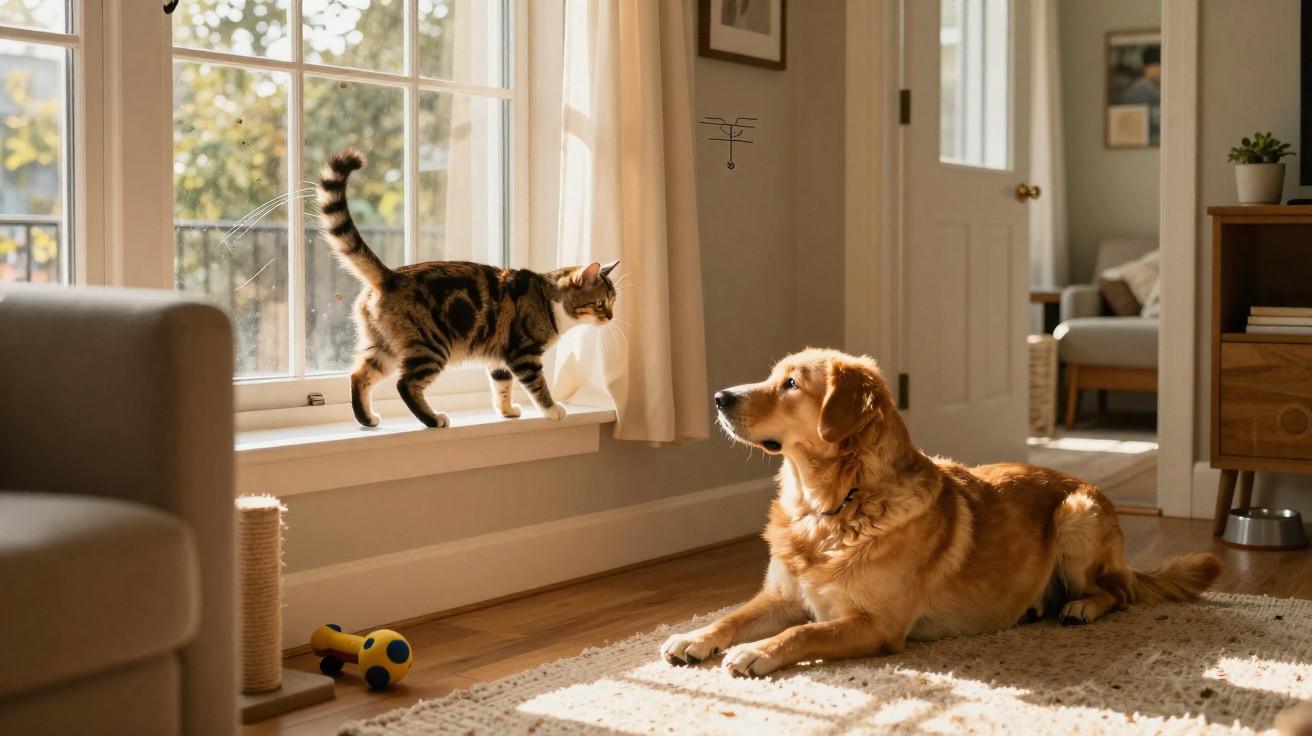
You pass the bedroom: nobody there. You check the kitchen: also empty. Then you arrive at the smallest, most unusual room in the house – and find your pet curled up as though it is the only secure place in the world. The temperature is the same throughout, the roof is shared and the family is nearby. Still, your cat chooses the hallway rug every time, while your dog sleeps partly beneath the coffee table as though protecting something hidden.
You may have attempted to tempt them elsewhere with treats, cosy beds and fresh blankets that cost more than your own pillow. They inspect them, seem to think it over, then return straight to “their” room.
There is a subtle reasoning behind these decisions. It is less about the number on the thermostat and more about how a space feels against their fur, sounds to their ears and responds to their deepest instincts.
More than temperature: how pets “read” a room
Watch a cat carefully as it enters a room and it can seem as if an internal checklist is underway. It stops at the doorway, its ears flick, whiskers point forwards and tail makes tiny adjustments. Dogs conduct a similar inspection more obviously: circling the coffee table, sniffing by the window and perhaps briefly flopping in the doorway before settling on a place.
To us, rooms seem “more or less the same” when the thermostat shows the same reading. To pets, however, every area is its own world. Light, shade, echoes, scents, draughts and the surface beneath their paws all influence whether somewhere feels comforting, secure or stressful. Temperature is only one small part of that picture.
When a pet selects one room instead of another, then, it is not acting unpredictably or being “difficult”. It is making a whole-body, all-senses assessment that people rarely register.
Think back to the latest heatwave or cold spell. Many owners see their pets suddenly relocate to a particular place, as if an unseen instruction has arrived. A cat living in a 24°C flat might spend summer afternoons on the bathroom tiles, before pressing itself behind the sofa in winter evenings where the radiator pipes run.
Dogs frequently establish their own “micro-climate routes” around the home. They may spend the morning in a sunny patch beside the balcony door, midday beneath the table where crumbs land, and late evening in the cooler hallway where street noise is softened. A typical house contains a network of miniature climates, shaped by imperfect insulation, window direction, draughts beneath doors and the way warm air gathers near ceilings and in corners.
A UK survey of dog owners found that nearly 60% reported their dog having a “favorite room” that varied by season. The heating remained broadly unchanged, but the direction of light, patterns of noise and the rooms where the family gathered all altered. Your pet tracks these details quietly, day after day.
The scientific term for this is rather unexciting: thermal comfort. Pets are not concerned with what the thermostat says; they respond to what their skin, coat and senses tell them at that precise time. Identical air temperatures can feel dramatically different because of sunlight, moving air and surrounding surfaces.
Hard flooring draws heat away from small animals much faster than a thick carpet does. A draught that barely registers to you may feel like an unending cold stream across a dog’s nose. Some cats seek out a room where sunshine appears for only twenty minutes, as that brief period makes an ideal warm patch on an armchair. They remember these short-lived moments of comfort just as we remember when to have our morning coffee.
There is an emotional dimension, too. A room carrying the faint smell of your worn T-shirt and the echo of your voice can feel much safer than an immaculate guest bedroom that is rarely lived in. Pets combine physical ease with emotional security, turning an apparently simple room preference into a quiet display of survival wisdom.
Reading your pet’s secret room map
To work out why your pet prefers a particular room, begin with something that sounds simple: follow them. Do this over several days rather than only once. Record the time, weather and what everyone else in the household is doing when they choose “their” place.
Stand where they usually lie. Feel the floor under your bare feet. Pay attention to sounds you would normally tune out, such as the refrigerator motor, traffic through a thin wall or a neighbour’s dog downstairs. Touch the nearby surfaces. Is a wall warmer than the air? Does the window admit a slight draught that might actually be pleasant through a dense coat?
In effect, you are trying to experience the room through their senses for a moment. Squatting in the hallway at 10 p.m. may feel rather foolish, but it is often how you discover why that supposedly “random” corner matters so much to them.
Owners often think that a pet avoiding a room is being fussy or stubborn. In many cases, the explanation is more practical. Flooring may be too slippery, particularly for older dogs or overweight cats. Strong ceiling lighting may be uncomfortable for light-sensitive eyes. A patterned carpet or loud television can unsettle an anxious animal.
Emotionally, pets often favour rooms that fit the household’s “heartbeat”. It might be the room where you work all day, the sofa where everyone gathers on a Sunday afternoon or the place by the door where all hell breaks loose when somebody gets home. They are drawn to spaces that work for their social instincts.
Most people have seen a cat that demands to sit in the bathroom while you shower, or a dog positioned half in the corridor and half in the living room like a living checkpoint. This is comfort combined with strategy: remaining sufficiently warm or cool while quietly monitoring you and the home.
Let’s be honest: nobody really does this every day. Most of us do not routinely assess our homes through our pet’s eyes. We alter the heating, plump up a bed and hope that will do. That makes it easy to overlook the subtle indications that a room feels wrong to them, not because of its temperature but because of its atmosphere.
Owners commonly make two familiar errors. The first is putting beds where they “look nice”, rather than where the animal already chooses to nap. That lavish new bed in an unused living-room corner is, to your cat, merely a cold and echoing area with no strategic purpose. The second is rearranging furniture or shutting doors without allowing the pet time to redraw its comfort map. For a territorial species, that gradual process matters.
Guilt can play a part as well. People may fear that a dog sleeping in the hallway instead of the bedroom is unhappy or “left out”. Often, though, the dog has simply located a spot with better airflow, gentler sounds and a more restful place to breathe.
“My lab stopped sleeping by my bed and moved to the landing,” one behaviorist told me. “The owners were heartbroken. But when we checked, that landing got a cool, steady airflow at night. He wasn’t rejecting them. He was choosing better sleep.”
How can you reconcile what looks attractive to you with what feels right to them?
- Observe where your pet naturally naps for a week. Rather than resisting that instinct, place their bed nearer those locations.
- Check draughts and noise at their height by sitting or lying on the floor for a minute in their preferred rooms.
- Provide several surface options: a soft bed, a cooler mat and a slightly elevated perch or step.
- Keep at least one door open towards the route they enjoy patrolling, so they do not feel shut off.
- Accept their “weird” preferences. If they consistently select one unexpected corner, there is a reason, even when you have not identified it yet.
Living with their choices – and what they tell you
Once you begin looking, a pet’s room preferences can become a silent form of communication. A cat that leaves its sunny windowsill for a dark wardrobe may be signalling that traffic noise has become overwhelming, or that arthritis has made jumping harder than it was last year. A dog swapping the sofa for the bathroom floor may be indicating that it feels hotter than usual.
Their preferences also change alongside your life. A new baby, partner or working pattern changes the emotional climate of every room. Some animals stay close to the disruption, remaining attached to the nursery or home office. Others withdraw discreetly to the one unchanged space where scents and sounds remain familiar and predictable. Their “favorite room” can become the last stable island amid human upheaval.
Once you recognise this, you cannot easily stop seeing it. You start to appreciate how actively they manage their own wellbeing, moving between rooms as we move between moods. Their route through the home forms a daily map of comfort, safety, routine and affection. Whenever they settle into that same peculiar corner, they are doing more than choosing a room: they are choosing the version of home that feels most like their own.
| Key point | Detail | Why it matters to the reader |
|---|---|---|
| Hidden senses | Animals assess light, sounds, scents and textures as much as they assess temperature. | Understand why an animal rejects or loves a particular room. |
| Micro-climates | Even at 21°C, draughts, surfaces and sunlight produce very different zones. | Helps you position beds, litter trays and food bowls in suitable places. |
| Warning sign | A sudden change in a favourite room may reflect pain, stress or a change in routine. | Helps you know when to watch more closely or speak to a vet or behaviourist. |








Comments
No comments yet. Be the first to comment!
Leave a Comment