The dog made no sound as they walked away.
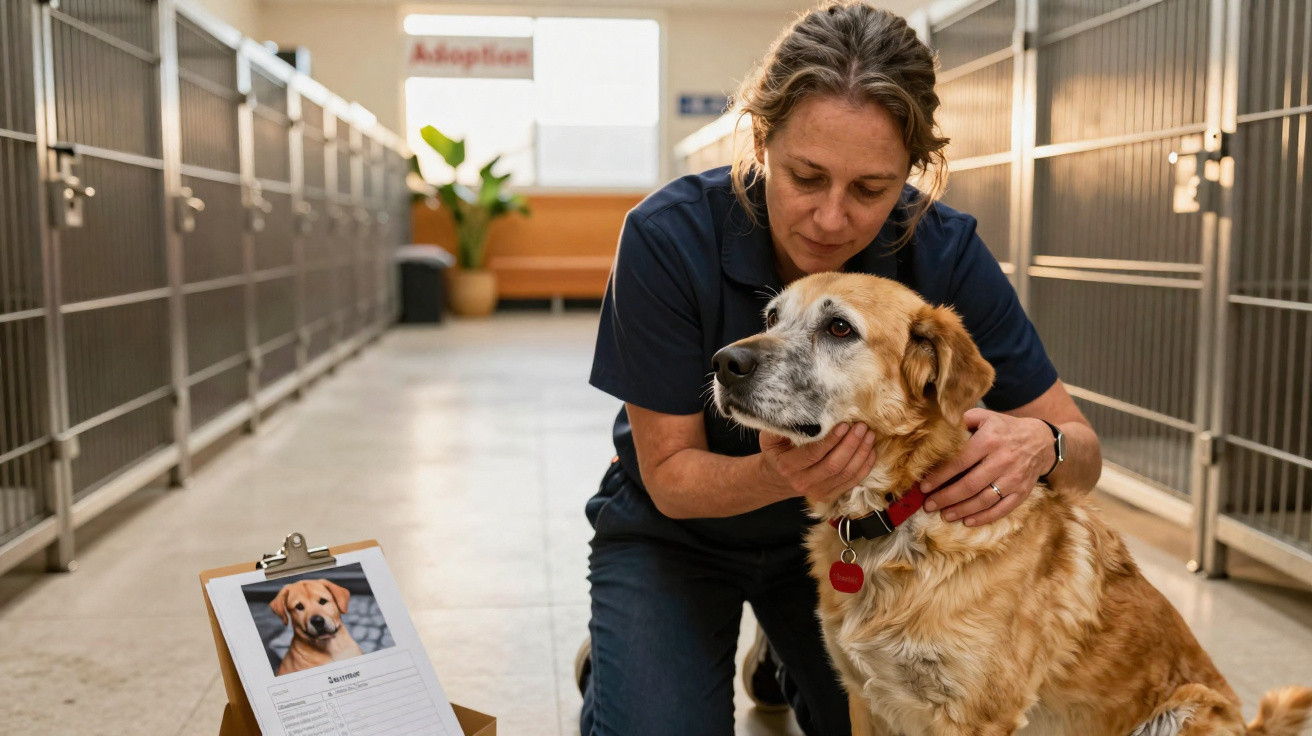
Instead, he remained still, his white muzzle against the wire door of the intake kennel and his gaze locked on the exit, as though his family might suddenly realise they had left somebody behind. Jenna, a shelter worker, knew that expression well: bewilderment threaded with a muted panic. This time, though, it affected her differently.
As she did with every animal arriving at the shelter, she crouched down to scan his microchip. The number appeared on the screen and his record opened. It was the same shelter, the same building. Eleven years earlier, he had been adopted from this very place as an energetic golden puppy with enormous paws and an optimistic name: Buddy.
She looked from the file to the grey-faced dog before her.
All at once, the room seemed far too small.
When a “surrender” becomes something far more painful
The explanation on the intake form was neat and practical: “Owner moving. Can’t take dog.” The handwriting was hurried, the sort used by someone keen to finish quickly. Buddy’s previous owner had already gone, leaving only a faint trace of cologne in the corridor. Meanwhile, the elderly dog paced from one end of the kennel to the other, his claws ticking across the concrete.
Jenna watched him make another circuit, stop by the door and give a quiet whine. He did not understand the word “surrender”. He only knew that he had arrived on a lead and was now alone behind a metal gate. Fluorescent lights buzzed overhead. Further along the row, a young dog barked frantically, yet Buddy merely sighed and settled with his head between his paws, as if he had waited like this before.
He had.
The shelter database contained a photograph from Buddy’s adoption day years before. In the picture, a child held him in both arms as though he were the centre of their world. The date stamp at the bottom read: spring of 2013. At the time, the shelter had marked his adoption as a success: one fewer dog in a kennel, one more happy ending for social media.
Now, however, his file included another note: “Owner surrender. Senior. Possible arthritis. Slight clouding in eyes.” The difference between those entries was crushing. The old image showed floppy ears, bright eyes and a streak of golden energy. The Buddy standing there now moved more slowly, breathed more heavily and wore grey through his coat.
The word nobody had written, but everyone could feel, was “back.”
Shelter workers learn to make a silent calculation in their minds. A puppy? Usually easy to rehome. A young adult? The prospects are strong. A senior dog with misty eyes and painful joints? That is another matter entirely. Nobody says it aloud, but the figures are there, hovering around each kennel like labels no one can see.
For Jenna, discovering that Buddy had already been through this place changed everything. He was no longer simply another older dog. He was a full-circle story returning to the same building, bringing eleven years of loyalty with him and suddenly having nowhere to put it. Her throat tightened as the reality struck: this was not only about an animal growing old. It was about the delicate bargain people make with pets, promising “forever” while quietly wishing that life will not make that promise inconvenient.
She shut his file, feeling as though she had read an entire biography in three lines.
What happens behind the scenes when a senior dog is abandoned
The staff’s first gesture for Buddy was straightforward: they gave him a blanket carrying the scent of other dogs. It was not the smell of his own dogs or his own home, but it offered warmth and a kind of familiarity in worn fleece. After that came an unhurried walk in the small grassed yard at the back, where he investigated each corner as though he might find the scent of the life that was no longer his.
They transferred him to a calmer kennel, away from the feverish energy of the younger dogs. Somebody fixed a handwritten message to his door: “Very sweet. Senior. Loves gentle scratches behind ears.” A note like that can make all the difference. A visitor looking along the kennel row may stop, crouch down and truly notice him rather than seeing only his age.
It is a small refusal to accept that “old” means “over.”
Later that afternoon, a volunteer called Marcus sat cross-legged outside Buddy’s kennel and read the intake notes aloud in a warm, conversational tone. “Adopted as a puppy… lived with one family… likes car rides… scared of fireworks.” Hearing his own story made Buddy wag his tail, like someone hearing their name across a crowded room.
Marcus and Jenna each spent time sitting with him between cleaning and feeding rounds. At one point, Jenna went into the storeroom and cried quietly and quickly for three minutes. She dried her face, then returned to her work. Most people know that feeling: pretending to be all right until one tiny detail-an elderly dog’s empty lead or an abandoned toy-shatters the mask held in place all day.
In the corridor, Buddy continued to wait, hopeful whenever footsteps went by.
From the outside, a shelter can appear orderly, even bureaucratic: forms, microchips and charts pinned to walls. Within it, the work depends on small emotional bargains-how deeply to let each story affect you, and how much distance you need to survive the week. When a senior dog such as Buddy comes back, it touches a particular raw nerve for the staff.
They understand what older dogs are up against: longer periods in kennels, aching joints against cold concrete and visitors passing by while saying, “He’s beautiful, but we’re looking for someone younger for the kids.” They also know that senior dogs often come with something priceless: they are usually house-trained, slower-moving and often calmer companions in real, untidy households.
The challenge is persuading a rushed world to slow down long enough to see them.
How Buddy changed the way people moved along the kennel row
The following day, Jenna printed Buddy’s puppy photograph and attached it beside his kennel card. There were two Buddys next to each other: the fluffy, sparkling-eyed youngster and the grey-muzzled, dignified older dog. Underneath, she wrote in bold marker: “Adopted from this shelter 11 years ago. Back through no fault of his own.” The words read like a quiet plea-not furious, simply honest.
Visitors began lingering at his kennel for a little longer. Some looked at the photograph, then knelt to examine his face, trying to find the puppy he had once been. One woman murmured, “Oh my God,” before reaching through so that he could lick her fingers. Others read the sign, frowned and carried on, clearly uneasy, as though it had made them consider a promise they too were unsure they could keep.
Buddy wagged his tail for every pair of shoes that stopped.
The truth is that when people fall for a puppy, few of them plan for a dog’s final years. They do not imagine tablets, veterinary bills or stairs that abruptly become mountains for a 14-year-old body. Instead, they picture walks, dog parks, children playing in the garden and the familiar image of a family with a dog. Many dogs are lost in the distance between those dreams and the gradual, everyday reality of ageing.
That distance was what affected Jenna so profoundly. Buddy had plainly been cherished once: his coat was brushed, his weight was healthy and his eyes remained bright beneath their cloudiness. At some point, life had shifted-perhaps money, housing, divorce or a move-and the dog had become the part that no longer fitted the new picture. That does not excuse it. It only makes the sorrow more complicated and, somehow, more human.
After all, walking away is rarely a single choice. It is a collection of smaller ones.
One afternoon, a father arrived with his teenage daughter. They said they were “just looking”, the familiar phrase shelters hear daily. The daughter stopped at Buddy’s kennel and did not continue on. She read his story, then read it once more. Her father saw Buddy’s age and instinctively tugged at her arm. “He’s old,” he said softly. “We should find one who’ll be with us longer.”
She kept hold of the bars.
After a long pause, she said something that made Jenna’s throat tighten all over again:
“Maybe we don’t need ‘longer’. Maybe we just need to be the ones who don’t give up on him this time.”
They asked to meet him in the exercise yard. Buddy headed towards them with the awkward, stiff-legged trot of an old dog trying to convince everyone that he was still young.
Inside the small adoption office, a new note appeared beneath his name on the whiteboard:
- Reserved for meet-and-greet
- Senior-friendly family
- Possibility of hospice-style adoption
- Teen daughter very attached
Sometimes, one person only needs to recognise the dog in front of them, rather than the dog he used to be.
What Buddy’s story asks of all of us
When Buddy eventually left the shelter again, he wore a different sort of lead. It was not a brand-new one that suggested a “fresh start”, but a gently worn lead that said “we know what we’re signing up for.” His new family went home with a folder containing information about arthritis medication and senior care. They also took home a dog who fell asleep with his head on the teenager’s lap in the back seat before they had even driven out of the car park.
Stories like Buddy’s do not remove the harsher reality facing shelters. Not every senior dog receives a second second chance. Some spend their final months beneath fluorescent lighting, looked after by people who love them deeply but cannot take them home. Even so, a dog such as Buddy alters the atmosphere of a building. He makes people walk more slowly, study kennel cards more carefully and ask different questions.
He makes us look beyond the “forever home” slogan and confront what commitment genuinely requires.
| Key point | Detail | Value for the reader |
|---|---|---|
| Senior dogs are often overlooked | Many adopters concentrate on puppies and young dogs, leaving older animals behind | Encourages readers to consider age realistically and compassionately |
| Emotion matters in adoption choices | Personal stories, photographs and handwritten notes can alter the way people view a dog | Shows readers that their attention and empathy can literally save a life |
| Commitment outlasts the “cute phase” | Dogs like Buddy show that loyalty works both ways, particularly during difficult years | Invites readers to think carefully before adopting and to honour the full life of a pet |
FAQ:
- Question 1 Why are senior dogs more likely to be surrendered?
Answer 1 It is often a combination of increasing veterinary costs, changes to housing or family circumstances, and the greater care older dogs require. People who managed well with a young, healthy pet can become overwhelmed when age brings mobility problems, medication and accidents indoors.
- Question 2 Are senior dogs harder to care for than younger dogs?
Answer 2 They may need additional medical care and gentler routines, but they are generally calmer, less destructive and already trained. Many adopters describe life with a senior dog as slower but deeply fulfilling, like sharing a home with an old friend who already understands the house rules.
- Question 3 How long do senior shelter dogs typically wait for adoption?
Answer 3 It differs from shelter to shelter, but older dogs often wait two to four times longer than younger ones. Some spend months watching other animals leave. That’s why any extra attention-sharing their photo, stopping to meet them-can be a turning point.
- Question 4 What should I think about before adopting a senior dog?
Answer 4 Consider your budget for veterinary treatment, the layout of your home (stairs and slippery floors), and whether your schedule allows for shorter, more frequent walks. Think about the emotional aspect too: you may have fewer years together, but those years can be exceptionally close and meaningful.
- Question 5 How can I help senior dogs if I can’t adopt one?
Answer 5 You can sponsor their shelter care, share their profiles online, volunteer to walk or cuddle them, or donate orthopaedic beds and joint supplements. Small, practical actions can add real comfort to a dog’s final chapters.







Comments
No comments yet. Be the first to comment!
Leave a Comment