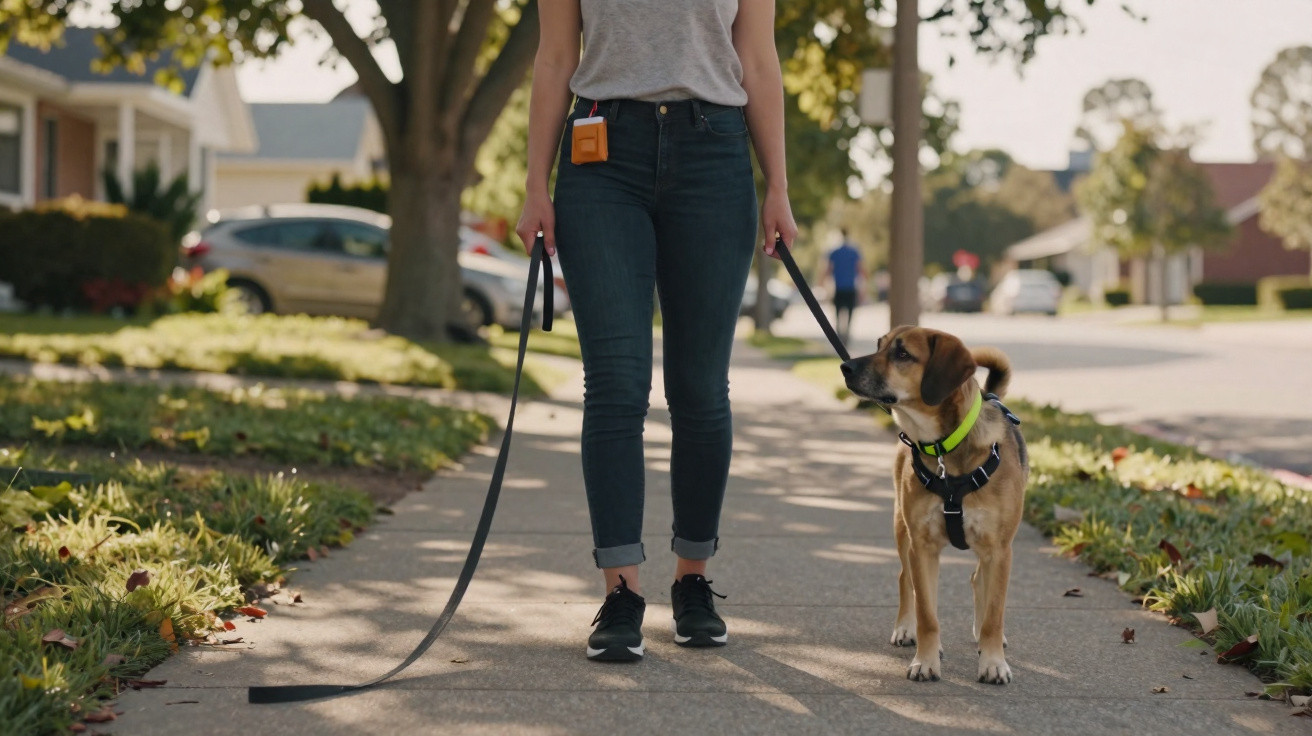
The dog was panting before they had even reached the corner. Its lead was stretched out like a fishing line, while the person at the other end stumbled along behind, wearing the half-apologetic, half-irritated smile reserved for strangers they pass on the pavement. From ten metres away, the routine was obvious: the dog pulls, the human hurries to catch up, and both are caught in an awkward dance that bears no resemblance to the relaxed walks people picture when they bring home a dog.
The amusing part was that the owner believed they were “working on leash manners.”
In reality, they were practising the pulling.
The everyday walking habit that teaches dogs to pull even harder
Most owners do not notice they are doing it. The lead tightens, the dog moves ahead, and rather than stopping or turning around, you respond in the most instinctive human way: you speed up. You allow yourself to be hauled along for a few paces “just to get past this part” or “just to reach the park.”
Repeated on walk after walk, that small choice is the easily missed habit that supercharges leash pulling.
Your dog discovers that pressure means forward movement. Tight lead means we keep going; a loose lead means we slow down or stop. From the dog’s point of view, it is easy to see which option is worth repeating.
Imagine a young Labrador that has spotted the park entrance. Every part of him leans into the harness as his paws tap excitedly across the pavement. His owner, worn out after work, lets him pull them for the final 20 metres. It seems insignificant at the time. It takes only seconds, and it feels easier than stopping and starting again.
The following day, the same pair takes the same route and reaches the same place. The Labrador remembers. He starts pulling sooner, and with more force. His owner gives a nervous laugh as the dog drags them towards the gate like a water-skier. Within a week, the dog is pulling for much of the walk rather than only near the park entrance. One “little exception” has become the standard routine.
Training logic explains why. Dogs repeat outcomes that benefit them. If pressing into the lead brings them closer to a tree, a scent, another dog or the park, their brain records that behaviour as successful. Your hurried steps behind them are not neutral; they reward the exact behaviour you would prefer to see less often.
This is the point at which many people become stuck. They purchase another collar, a new harness or even a specialist lead. The equipment is different, yet the walking pattern is unchanged. The dog pulls, the person follows, and the habit becomes stronger. A lead may appear to be a tool of control, but it can often be a direct line to your own habits.
How to stop reward-walking leash pulling
The change is remarkably straightforward: moving forwards must happen only when the leash is loose. Not when it is tight, not when it is “nearly loose”, and not “just for a second until we cross the road”. Forward movement is the reward. No loose leash means no progress.
In practical terms, stop when the lead tightens. You can also turn away or take a small step backwards. The moment your dog eases the pressure, even slightly, begin moving forwards again. Your walking pace becomes clear feedback, and your dog starts to understand that dragging does not make the world arrive any sooner.
This is not about using force. It is about applying one small rule consistently.
For many owners, this creates a quiet sense of panic. “If I stop every time my dog pulls, I’ll never get anywhere.” At the beginning, that may genuinely seem true. The first few walks can be slow and disorderly, with repeated false starts. You might travel half your normal distance and end up feeling twice as tired.
However, this is also the moment the pattern begins to shift. A dog that previously powered you along the street now has to think. Each stop and slight change of direction interrupts the automatic pulling habit. Gradually, your dog may try a gentler lead, look back at you or offer a step alongside you. That is when a walk begins to feel like a conversation rather than a tug-of-war.
The principle behind it is almost dull in its simplicity. Pulling continued because it had a worthwhile payoff. Your companion pulled, you followed and you both continued forwards. Once that reward is removed, the behaviour produces nothing. Dogs generally do not keep spending energy on actions that do not “work”.
Your role, then, is not to become harsher, stronger or louder. It is to stop paying for pulling with forward movement. Being dragged along “just this once” is like feeding coins into a slot machine you claim to dislike. Stop the payout, and the game changes.
Practical ways to walk without rewarding pulling
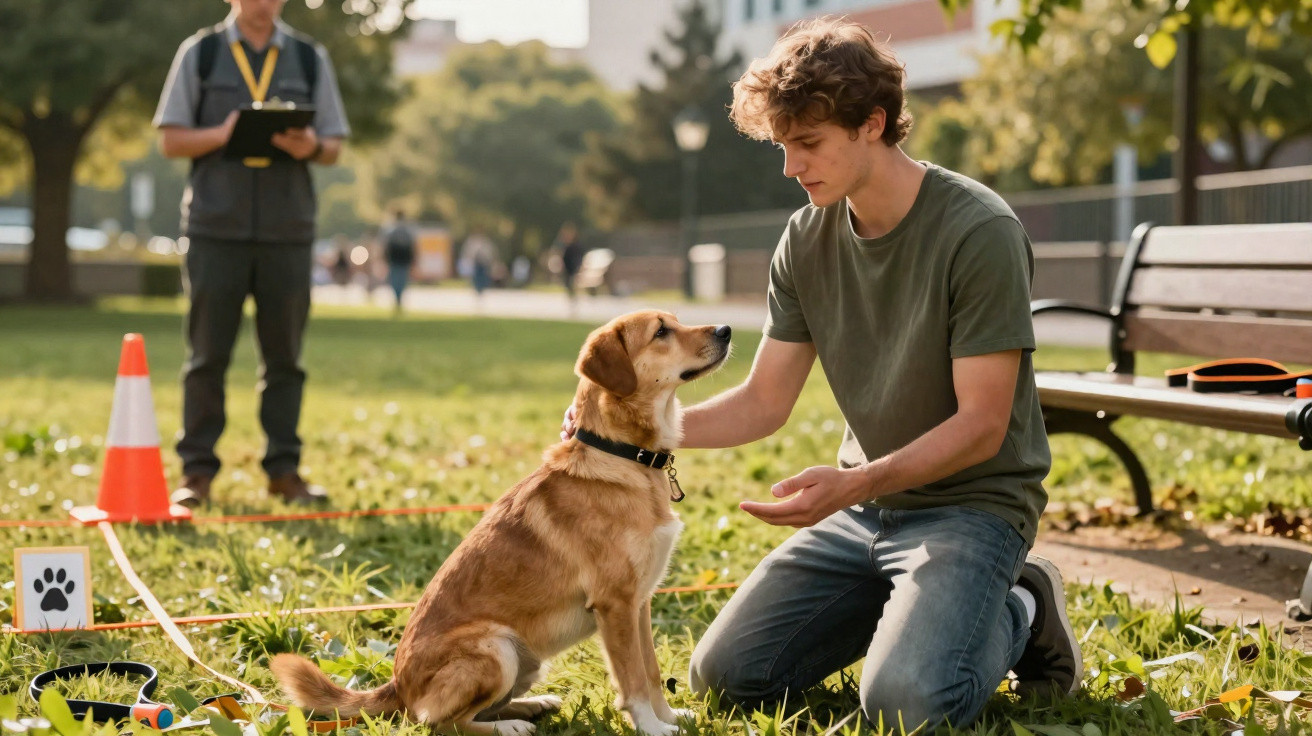
Begin in the easiest possible setting, where your dog has a realistic chance to get it right. Choose a quiet street, a car park during a quiet period or even your own drive. Attach the lead, hold it with visible slack and stand still briefly. Give your dog time to understand that the walk begins calmly rather than at full speed.
Take one step. If the lead remains loose, take another. If your dog rushes ahead and the line becomes tight, stand still like a statue. When your dog looks back or takes a step that eases the tension, offer calm praise and start walking again. You are establishing a fresh rhythm: loose means go, tight means pause. After several sessions, that rhythm can begin to feel surprisingly satisfying.
A major mistake is assuming this approach has to be flawless from the first day. It does not. On some days, you will be calm, patient and consistent. On others, you may be late for work, or rain may be blowing sideways, and you will allow your dog to drag you to the nearest patch of grass.
Let’s be honest: nobody really does this every single day.
That does not undo all your work. Improvement comes from the wider pattern, not one difficult walk. When pulling usually does not succeed, your dog will adjust. Both of you are allowed to be human and canine rather than robots following a perfect training plan.
“Leash walking isn’t about dominating the dog,” says one positive trainer I spoke to. “It’s about creating a predictable rule: when the leash feels easy, the world opens up. When it feels tight, nothing interesting happens. Dogs are experts at that kind of pattern.”
Create a “training walk” and a “toilet walk”
Use short, purposeful walks to practise the loose-leash rule. During quick toilet trips, accept less-than-perfect behaviour so that you are not battling against the clock every time.Use high-value rewards at the start
Give tiny treats, enthusiastic verbal praise or a brief sniffing break whenever your dog walks at your side. This is not bribery; it reinforces the alternative to pulling.Short sessions beat marathon frustration
Ten relaxed minutes of intentional walking are more useful than forty minutes spent being dragged around the block. Finish while you are slightly bored rather than completely exhausted.
Rethinking what a “good walk” really looks like
Many of us were given the same picture: a dog trotting politely at heel, a person strolling in a straight line, with both perfectly synchronised from the first house to the last. Everyday walks rarely look that way. They involve zigzags and pauses, carrying the mood of your day and your dog’s day together along one narrow strip of nylon.
Once you stop automatically increasing your speed when the lead is tight, your definition of success changes. A good walk becomes one in which you and your dog notice each other, even if the route is shorter or the pace is uneven. The conflict begins to leave the lead.
Small differences may appear first. Your shoulder may hurt less. Your dog may look up at you more often. The lead may hang in a gentle curve rather than forming a taut line. The street no longer feels like a battleground between “control” and “freedom”. It simply becomes somewhere you travel through together.
We have all experienced that moment of making eye contact with another owner being pulled past and thinking, “I hope that doesn’t become us.” The surprising reality is that avoiding that outcome does not depend on expensive equipment or viral tricks. It comes down to one repeated, small habit: refusing to let pulling be what takes your dog where they want to go.
| Key point | Detail | Value for the reader |
|---|---|---|
| Stop moving on a tight leash | Stand still or change direction whenever the lead becomes taut | Interrupts the pattern that teaches dogs that pulling equals progress |
| Reward a loose leash with movement | Walk forwards only when there is visible slack | Gives your dog a straightforward rule they can understand and follow |
| Train in short, easy sessions | Practise in quiet places and on brief walks where success can be repeated | Keeps training manageable in real life and lowers frustration |








Comments
No comments yet. Be the first to comment!
Leave a Comment