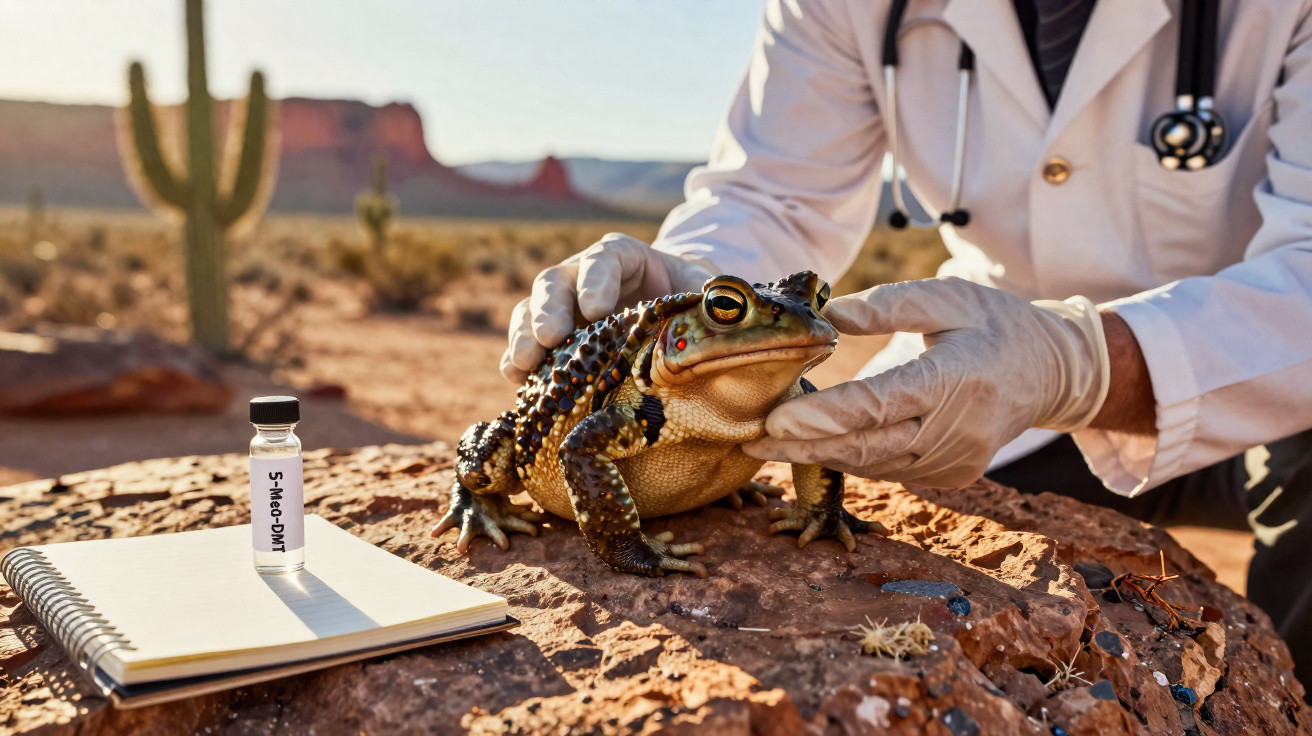
The legend that licking a toad causes hallucinations stems from a real fact, but it conceals a serious danger. The Colorado River toad produces a powerful psychoactive substance in its skin, yet contact with its secretions can lead to poisoning, dangerous cardiac changes and an urgent trip to hospital.
Is there really a toad with psychedelic properties?
The Colorado River toad, scientifically known as Incilius alvarius, lives in the south-western United States and north-western Mexico. Glands on its head release a secretion containing 5-MeO-DMT, a compound that acts on serotonin receptors in the brain and produces intense psychoactive effects.
David E. Nichols, emeritus professor of pharmacology at Purdue University and the researcher behind a synthetic analogue of the substance, describes it as one of the most potent psychedelics known. Its effects may involve disorientation, a temporary loss of one’s sense of identity and memory lapses.
Can licking the Colorado River toad cause hallucinations?
Despite its reputation, specialists say that licking the animal does not generally produce the psychedelic effects linked with 5-MeO-DMT. The substance does not have the same activity when swallowed, but this does not make the practice safe. The secretion contains other compounds that can cause severe poisoning.
Haley Dourron, a researcher at Linköping University, warns that even pets have required emergency treatment after licking these toads. Direct contact also exposes people to micro-organisms, irritation and unpredictable doses of toxins, with no medical supervision or assurance of safety.
What are the main health risks?
The toad’s defensive substances include cardiac glycosides, compounds that affect the strength and rhythm of heart contractions. Depending on the amount absorbed and a person’s health condition, the effects can worsen quickly and require immediate medical care. Risks include:
- Dangerous changes in heart rhythm;
- Nausea, confusion and loss of consciousness;
- Poisoning of unpredictable severity;
- The need for emergency medical treatment.
These compounds can trigger potentially fatal arrhythmias, which is why parks and specialists advise people not to touch, handle or lick wild animals. In the event of accidental exposure, the appropriate advice is to seek medical help and clearly state which animal was involved.
Watch the video shared by the YouTube channel CUMULUS TV for further details about the Colorado River toad and its psychedelic properties.
What is science researching about 5-MeO-DMT?
Researchers are studying synthetic versions of the compound to understand how it affects the brain and its potential therapeutic use. Preliminary studies are examining a possible rapid antidepressant effect, with some participants reporting improvement for at least one week, but the findings are still early and do not establish safety for use outside controlled research.
Dourron points out that there are few neuroimaging studies of 5-MeO-DMT, unlike LSD and psilocybin. Scientists are also assessing whether its unusual effects involve brain circuits associated with certain types of seizure. Any medical application therefore depends on further clinical trials and rigorous monitoring.
Protecting toads is also an urgent matter
Demand for the secretion threatens Colorado River toad populations, which are already affected by habitat loss, changing rainfall patterns, pollution and fungal diseases. Robert Villa, from the University of Arizona, says animals are being illegally removed from the wild to exploit their toxins, increasing pressure on the species.
Curiosity should never justify animal suffering or a risk to life. If you encounter a toad, keep your distance, protect children and pets, and allow it to continue on its way. Challenging this legend with information is an urgent step that can prevent poisoning and protect a species essential to environmental balance.
















Comments
No comments yet. Be the first to comment!
Leave a Comment