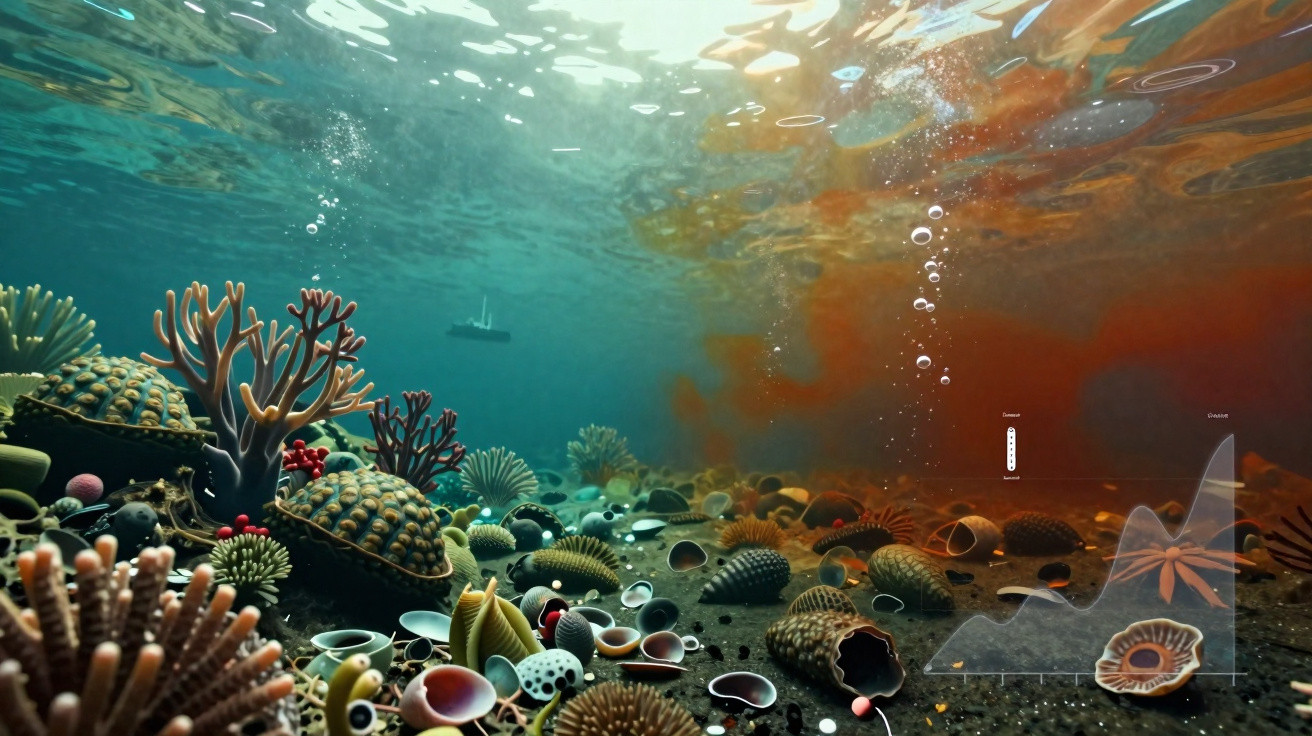
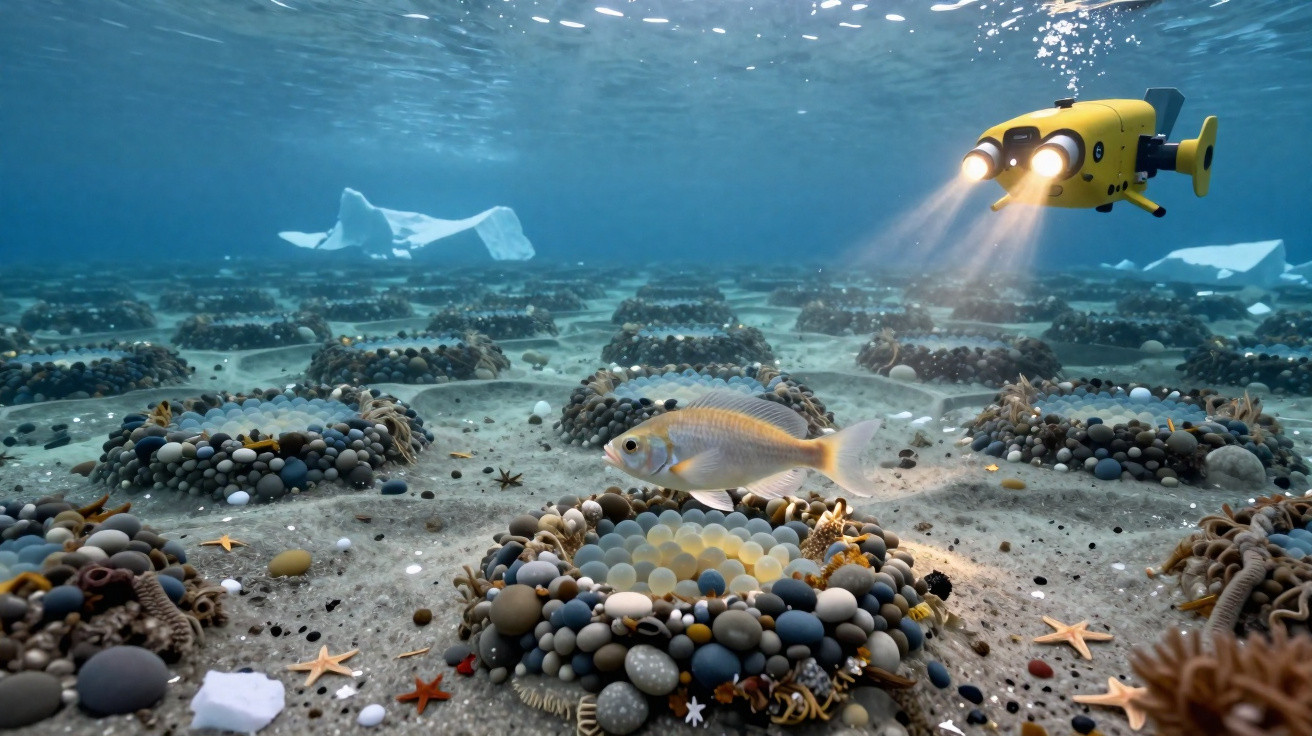
For the first 280 million years of animal life on Earth, seabed ecosystems were ruled by slow-moving organisms, including clam-like brachiopods and crinoid sea lilies.
Then the balance changed abruptly.
The Great Dying reshaped marine life
Huge volcanic eruptions released vast quantities of greenhouse gases into the atmosphere, warming the planet and setting off the Great Dying at the end of the Permian period.
This was the biggest mass extinction in Earth's history to date. In several respects, it closely resembles the climate change now unfolding: oceans warmed quickly and became depleted of oxygen.
New work headed by scientists at Stanford University has identified a strong connection between the disappearance of formerly dominant marine groups and the lethal heat and oxygen-poor conditions in end-Permian seas.
Before the Great Dying, the seafloor supported a wide range of organisms. Some persist today, while others are known solely through their fossils.
Earth scientist Jose Andres Marquez and colleagues have determined what separated the species that endured this catastrophic climate change event from those that perished.
"With this study, we essentially wanted to solve the mystery of why, when you go to the beach, you collect the shells of clams and snails rather than those of brachiopods," Marquez says.
"Our findings show that, across different organism groups, extinctions happened at much higher rates for those more vulnerable to increases in water temperature and decreases in oxygen availability."
Paleozoic fauna struggled with heat and low oxygen
The comparatively slow metabolisms of Paleozoic fauna appear to have left them especially susceptible to these severe changes. This contrasted with the surviving species, described by the researchers as 'modern' fauna, such as molluscs, fish, starfish and sea urchins.
To show this, the team compared how 38 species tolerated the hot, low-oxygen conditions associated with the Permian-Triassic extinction event.
The sample covered 9 species of Paleozoic fauna - including some of the few that survived the Great Dying - and 29 species of modern fauna.
For certain species, Marquez and his team carried out experiments to obtain fresh data on the boundaries of their tolerance. For the rest, they drew on findings from earlier studies. Combined, the evidence showed that Paleozoic fauna were generally much more sensitive to temperature and oxygen conditions than modern fauna.
"The aerobic metabolisms of the Paleozoic fauna are more rapidly limited by oxygen as water temperatures increase (or their biogeographic ranges are more rapidly limited by oxygen as temperatures increase) compared to their modern faunal counterparts," the authors explain in their paper.
Notably, Paleozoic fauna could withstand low oxygen, or hypoxia, more effectively while resting. Once active, however, that benefit vanished.
Warming projections and the modern climate change threat
By considering only oxygen and temperature, the scientists acknowledge that they cannot exclude the possibility that additional environmental pressures, including ocean acidification, also helped create the unbearable conditions of the Great Dying.
Even so, the results provide a fairly clear picture.
"The bad news is, we are on track for Permian-Triassic levels of warming in worst-case scenario projections," says Stanford earth scientist Erik Sperling.
"But the good news is, we're still at the point where we can change things and do something about it."
During the Great Dying, temperatures rose by 8–12 °C (46–54 °F) over thousands of years.
Today, after only a few centuries of emissions, temperatures are expected to increase by 1.5–4 °C above pre-industrial levels by 2100.
The crucial distinction is that humans are releasing these emissions into the atmosphere. Although volcanic eruptions cannot be prevented, the burning of fossil fuels can be stopped.
"The biggest mass extinction of all time started from a world that is very similar to today in having a relatively cool, relatively well-oxygenated ocean, and then there was a giant injection of carbon dioxide into the Earth system," Sperling says.
"Understanding how Earth and Earth's biota responded back then could inform us of what's to come."
The research appeared in Proceedings of the National Academy of Sciences.
Clare Watson fact-checked and edited this article. Although we take pride in our process, we are only human. If you notice an error, please tell us.









Comments
No comments yet. Be the first to comment!
Leave a Comment