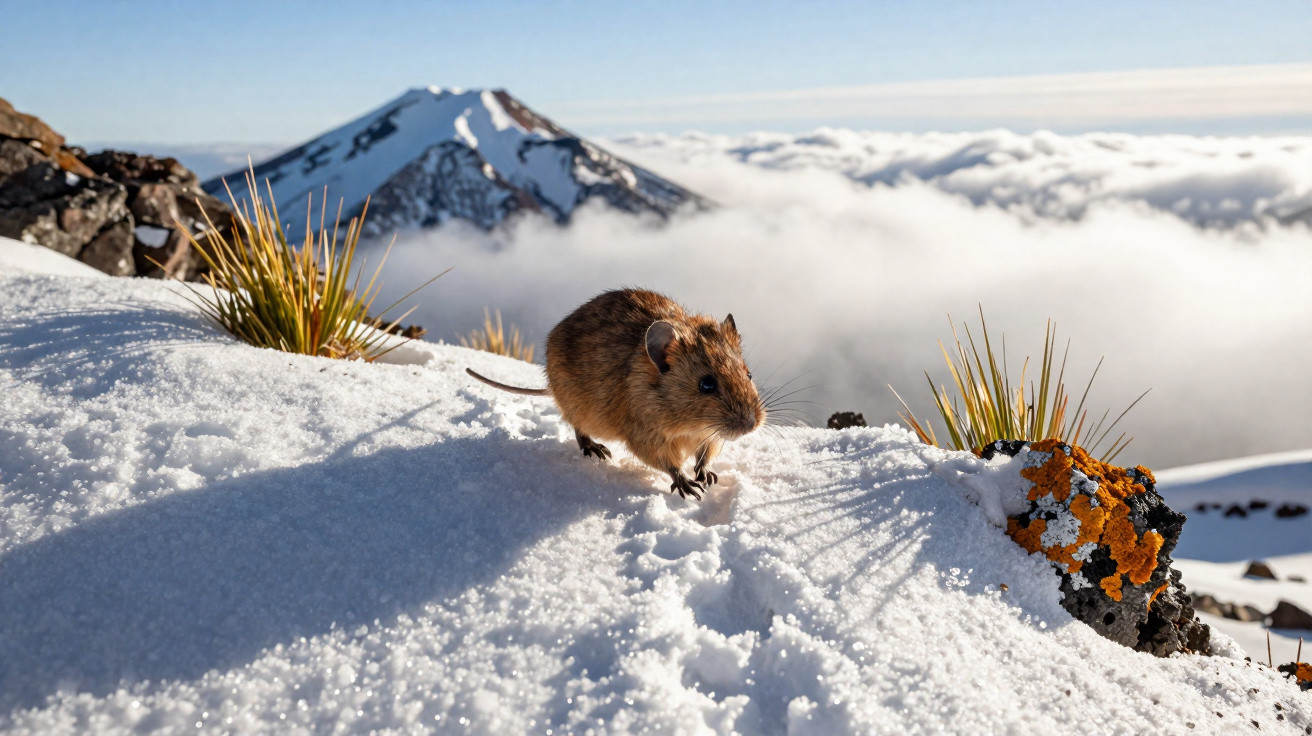
On the summit of frozen volcanoes, where a person could scarcely endure for more than a few hours, tiny mice dart among the rocks, survive brutal nights and find food where almost nothing grows. At an altitude of 6,739 metres, these animals are doing more than merely enduring. They have made one of Earth's harshest environments their home.
Mice live beyond the presumed limit
Andean leaf-eared mice have been discovered on the summit of Llullaillaco, a dormant volcano on the Chile–Argentina border. This site lies more than 1.6 kilometres above the world's highest permanent human settlement and is defined by extreme cold, thin air, limited water and almost no vegetation.
In 2020, a team headed by Jay Storz, a professor at the University of Nebraska–Lincoln, documented the animals at 6,739 metres. Until then, mammals were thought to be unable to live permanently above roughly 5,500 metres. The finding raised that limit to an altitude never previously recorded.
How do they cope with cold and scarce oxygen?
From 2020 to 2023, scientists examined populations ranging from sea level to Andean summits. Tests in Chile showed that mice from the highest elevations retain body heat and sustain their oxygen supply more effectively than relatives living at lower altitudes.
Research published in the journal Science uncovered changes connected to how the body operates in extreme settings. For Storz, who is also a mountaineer, the thought of small mammals living on these peaks is remarkable, as even a well-acclimatised person could not remain there for long.
Which adaptations secure their survival?
The mice had to overcome three challenges at once: breathing, retaining heat and finding food. The team found that the species combines several tactics to make use of the few resources available, even if this involves eating plants that would harm other animals.
- More effective maintenance of body temperature;
- Better use of the limited oxygen available;
- An ability to neutralise toxic substances in plants;
- Greater activity during the warmest hours of the day.
Researchers at McMaster University identified genetic changes that support digestion and the removal of toxic compounds. This advantage allows the mice to use the volcanoes' scarce vegetation. Venturing out in daylight may also mean less severe temperatures and a lower chance of encountering predators.
Life at such heights also brings benefits
Mountains may appear to offer nothing but hardship, yet they provide one significant reward: little competition. Graham Scott, a biology professor at McMaster University, believes the search for areas with fewer competitors may have driven the mice progressively higher, where they also encounter fewer animals capable of hunting them.
Although separated by thousands of metres in altitude, the groups remain genetically similar. This indicates contact between populations in low, middle and high-altitude areas. Rather than becoming an isolated species on the summits, the mice seem to move across an extraordinarily broad environmental range.
Mountain kings challenge the impossible
Scott says the discovery's key message is life's capacity to find solutions where survival appears unfeasible. These small rodents have overcome cold, hunger and oxygen deprivation without equipment, shelters or stored supplies, making them strong contenders for the title of land animals living at the greatest altitude.
Understanding these limits is urgent because extreme environments may hold answers about adaptation and resilience that we have not yet imagined. The Andean mice show that the impossible may be only a few metres higher. Protecting and studying these places now is the only way to discover how far life can truly go.













Comments
No comments yet. Be the first to comment!
Leave a Comment