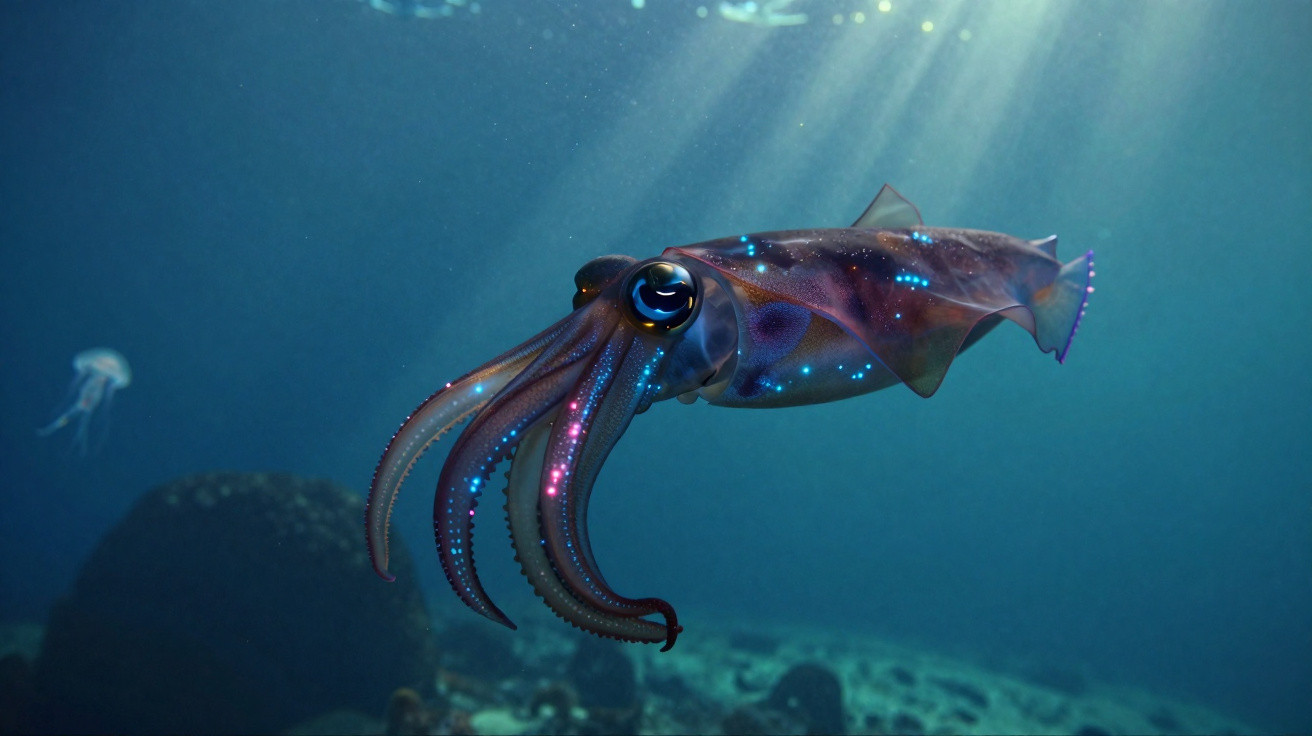
Its scientific name translates as “vampire squid from hell”, yet almost every part of that description is misleading. Vampyroteuthis infernalis does not drink blood, hunt like a monstrous creature or even belong to the group of true squids. In the ocean’s dark depths, it survives through energy-saving movement, decaying food and remarkable flashes of light.
Why is it not a true squid?
The vampire squid is a cephalopod, making it related to both squids and octopuses. However, it belongs to its own evolutionary lineage, placed within the order Vampyromorphida. It is the only known living member of this group, occupying an ancient branch of the evolutionary tree of these marine animals.
Its body combines traits associated with both relatives. The webbing between its eight arms resembles an octopus’s mantle, while its elongated shape is more squid-like. Two slender, retractable filaments complete its unusual anatomy and help it detect and gather food from the water.
Where did the frightening name come from?
Its appearance accounts for much of the nickname. Its skin ranges from dark red to black, its bluish eyes are proportionally large, and a membrane links the arms like a cloak. If it feels threatened, the animal can turn this structure inside out to cover part of its body.
Despite this dramatic display, it has no bloodthirsty habits. Research by the Monterey Bay Aquarium Research Institute has shown that its diet consists mainly of so-called marine snow: organic remains that slowly sink from the ocean’s upper layers.
- The animal inhabits deep waters in several of the world’s oceans.
- Its large eyes make use of the limited light available in its habitat.
- Its reddish colouring helps its body vanish into the darkness.
- The retractable filaments collect suspended organic particles from the water.
How does the vampire squid produce light for defence?
The vampire squid has light-producing organs called photophores. When faced with danger, the tips of its arms can release bluish pulses, creating a visual display that confuses predators and makes it harder to pinpoint the animal’s exact position in the dark environment.
Rather than using the dark ink released by many squids and octopuses, it can also emit a cloud of mucus containing bioluminescent particles. This glowing material lingers in the water briefly, acting as a distraction while the vampire squid slowly moves away.
Watch the video shared by the YouTube channel Coruj4 Curios4, featuring footage of the vampire squid in the oceans.
How does it live in an environment with little oxygen?
This cephalopod lives in deep zones where oxygen levels may be extremely low. Its slow metabolism, blood that transports oxygen efficiently and the large surface area of its gills allow it to remain in places where many active predators could not survive.
Instead of using energy to chase prey, it drifts and gathers detritus with its filaments. A study published in Proceedings of the Royal Society B described this feeding behaviour, revealing a strategy rare among cephalopods and perfectly suited to the scarcity of the deep sea.
What makes this creature so special?
The vampire squid shows that survival on the seabed does not always rely on strength or speed. Its success comes from conserving energy, tolerating low oxygen levels and using luminous defences that confuse threats without requiring direct confrontation.
Learning about this lineage turns an apparently frightening figure into a fascinating example of adaptation. The more science explores deep waters, the clearer it becomes that ominous names can conceal discreet, delicate creatures that are essential to understanding the history of life in the oceans.
















Comments
No comments yet. Be the first to comment!
Leave a Comment