In 2017, the enormous iceberg known as A-68 broke away from the Larsen C Ice Shelf, offering scientists a rare chance to investigate a vast stretch of seabed that had until then been concealed beneath the ice.
Scientists from UK institutions took advantage of that opening and made an unprecedented discovery, described in a study published in Frontiers in Marine Science.
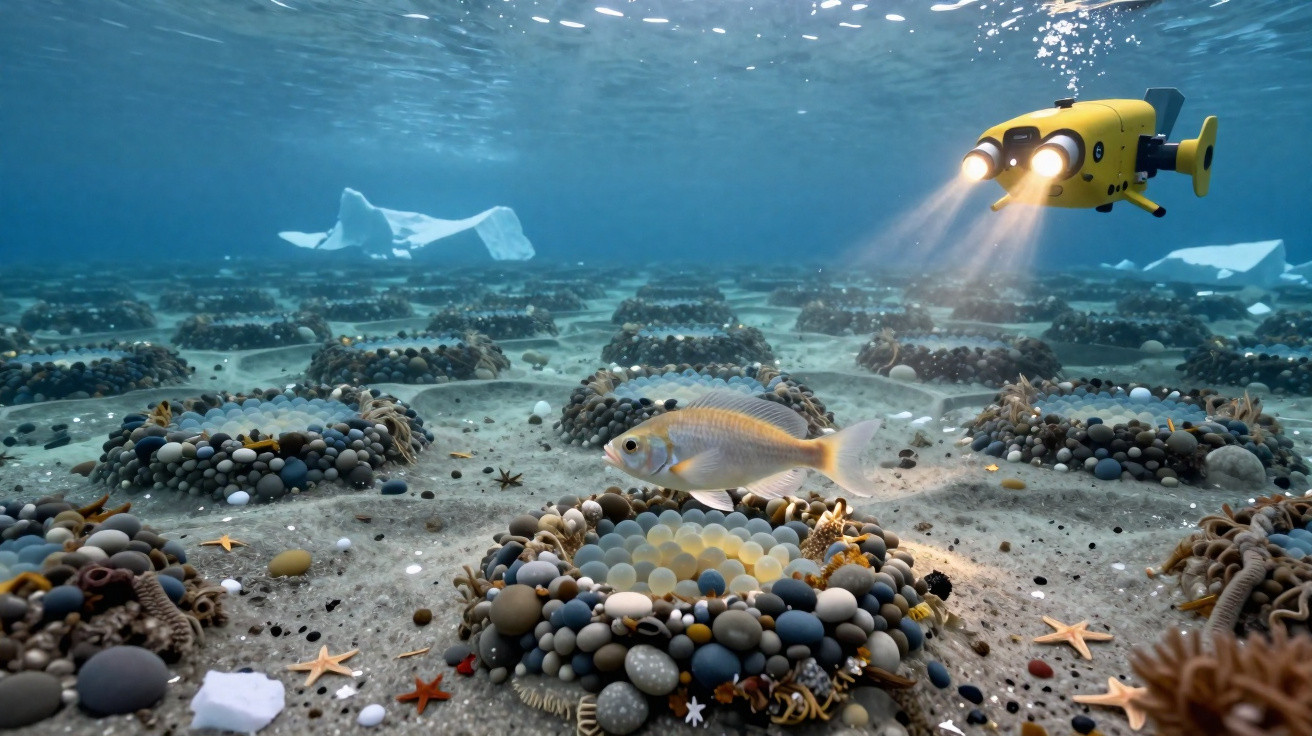
Using a remotely operated underwater camera, the team recorded more than a thousand fish nests: deliberately cleared areas within the plankton debris covering the ocean floor.
The nests themselves were not the only striking feature. Their arrangement revealed a highly organised ecosystem, adding weight to the proposal that this area of the Weddell Sea should become a Marine Protected Area.
"This study documents a large and widely dispersed nesting aggregation of the yellowfin notothenioid, Lindbergichthys nudifrons, in the western Weddell Sea, an area made accessible by the recent calving of the Larsen C Ice Shelf," write the researchers in their published paper.
"The most significant finding is the discovery of six distinct, geometric nesting patterns, which we propose are primarily driven by biotic interactions, namely predation pressure, rather than the abiotic factors observed in other large Antarctic fish breeding colonies."
Yellowfin notie nests in the Weddell Sea
The icefish L. nudifrons, or yellowfin notie, reaches lengths of up to 19.5 cm and was first recognised as a species in 1905. Each nest may contain several thousand eggs, with males protecting them for as long as four months.
As well as examining underwater ecosystems, the Antarctic expedition detailed in the study was searching for the wreck of Sir Ernest Shackleton's ship, Endurance, which went down in the same region in 1915.
Although the wreck was not located on that expedition-it was eventually found in 2022-the fish nests were widespread.
"Nesting sites were found at all locations surveyed during the Weddell Sea Expedition 2019 onboard the SA Agulhas II using the remotely operated vehicle," write the researchers.
Six geometric patterns of fish nests
The team distinguished six separate arrangements of nests across the seabed. The most frequent, representing 42 percent of every nest recorded, was classified as a cluster.
In these clusters, nests were densely grouped, at times touching or even overlapping. Unlike the nests of many fish colonies, however, they were not situated in warmer water, indicating that temperature did not explain the clustering.
Instead, the researchers believe the groups provide protection.
With several male fish guarding the edges of a cluster, there may be safety in numbers. The dense concentration of nests could also conceal the odour of the eggs from some predators, as the combined nests create a more confusing scent trail.
"This would offer a significantly reduced risk to the nests in the center of the cluster," write the researchers.
"Such defensive patterning, while novel for this species, is a well-documented phenomenon in fish nesting colonies in shallow tropical reef scenarios, where it is also attributed to increased predation protection."
Protection for the Weddell Sea ecosystem
The yellowfin notie's position in the food chain makes both the species and its nest clusters a vital component of the Antarctic ecosystem.
The Weddell Sea has long been difficult to explore, as Shackleton and others found. Yet life continues to flourish in its depths, reinforcing the need for the region to be designated a protected zone-not only for fish and other organisms beneath the waves, but also for the more conspicuous penguins and seals.
"These findings provide critical evidence of unique, structured breeding habitats, fulfilling key criteria for the designation of Vulnerable Marine Ecosystems and strengthening the case for the proposed Weddell Sea Marine Protected Area," write the researchers.
The research was published in Frontiers in Marine Science.
This article was fact-checked by Rachel Garner and edited by Rebecca Dyer. While we take pride in our process, we are only human. If you spot an error, please let us know.















Comments
No comments yet. Be the first to comment!
Leave a Comment