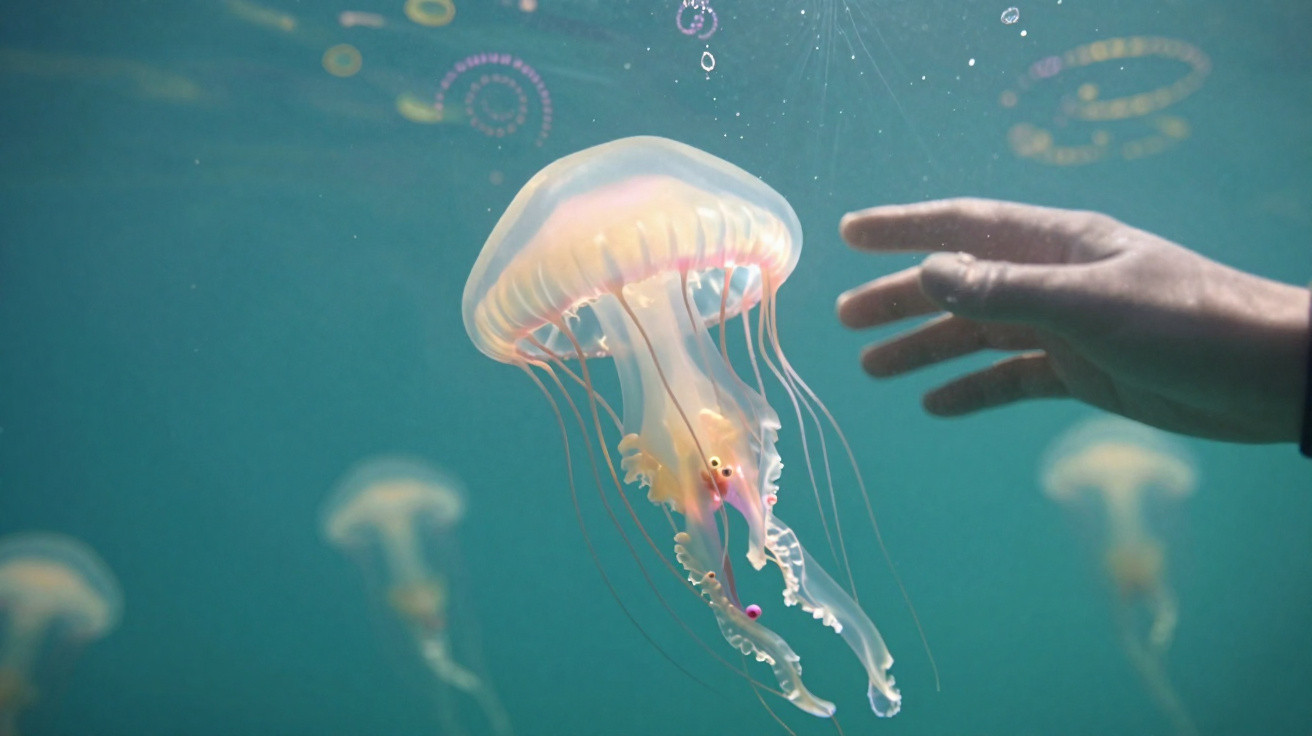
When it is injured, hungry or under threat, a tiny jellyfish does more than try to survive. It dismantles its adult body, rearranges its cells and returns to an earlier stage of life. Turritopsis dohrnii can carry out this process repeatedly, earning it the name immortal jellyfish and drawing the attention of ageing researchers.
How can a jellyfish become young again?
Its life cycle starts as a larva, which attaches itself to a surface and develops into a colony of polyps. The polyps produce tiny medusae: the free-swimming, tentacled form most people recognise as a jellyfish. In nearly every species, the adult animal reproduces, ages and dies, bringing the cycle to a permanent end.
For Turritopsis dohrnii, however, the process can run in reverse. When faced with injury, food shortages, temperature changes or ageing, the medusa shrinks into a cyst-like mass. It then attaches itself again and forms polyps, which can produce new medusae with the same genetic material.
What is cellular transdifferentiation?
This change depends on a process known as transdifferentiation, in which a specialised cell switches roles and takes on a different identity. It is as though a muscle cell left its usual role and were reprogrammed to help create another tissue, without the whole organism having to begin again from an embryo.
Gene-expression studies published in 2019 and 2021 identified alterations in networks linked to DNA repair, embryonic development, chromatin organisation and the control of mobile genome elements. As reversal takes place, the body undergoes extensive restructuring, switching off some adult functions and restoring cellular programmes associated with early stages of life.
What clues were found in the species' genome?
In 2022, researchers compared the genome of Turritopsis dohrnii with that of a closely related species that does not show the same rejuvenation ability. The comparison found differences and extra copies of genes connected with DNA replication and repair, telomere maintenance, cell renewal and protection against oxidative damage.
These findings do not identify a single immortality gene. Instead, they point to a combination of mechanisms that safeguards genetic material and makes it possible to reprogramme entire tissues. Areas under investigation include:
- Repairing accumulated DNA damage
- Regulating cell division and renewal
- Maintaining the ends of chromosomes
- Responding to stress within cells
- Activating development-related programmes
Watch the video shared by the YouTube channel Incredibly Animal, which shows how the immortal jellyfish life cycle works.
Can it teach humans to stop ageing?
In 2026, Texas A&M University highlighted the continuing work of marine biologist Maria Pia Miglietta, who studies the species and its ability to restart development. The current aim is to establish which cells take part in the transformation, which genes are activated, and how the animal retains its genetic identity during such radical changes.
That does not mean a treatment exists to rejuvenate people. The human body has far more complex organs, systems and cancer risks. Even so, understanding how mature cells regain plasticity could support research into tissue regeneration, wound healing, age-related diseases and safer ways to reprogramme cells.
Is the jellyfish truly immortal?
It is described as biologically immortal because it can evade ageing by restarting its life cycle, yet it remains vulnerable. It can be eaten, become ill, suffer irreversible damage or die before completing the transformation. Moreover, it has not yet been shown that a single individual can repeat the process indefinitely under natural conditions.
Despite these limits, the discovery challenges a rule that once seemed unavoidable: that an adult animal can only move towards old age. Following this research is not about expecting a fountain of youth, but about observing an extraordinary clue. Within a creature smaller than a fingernail may lie a new way to understand how cells age and begin again.











Comments
No comments yet. Be the first to comment!
Leave a Comment