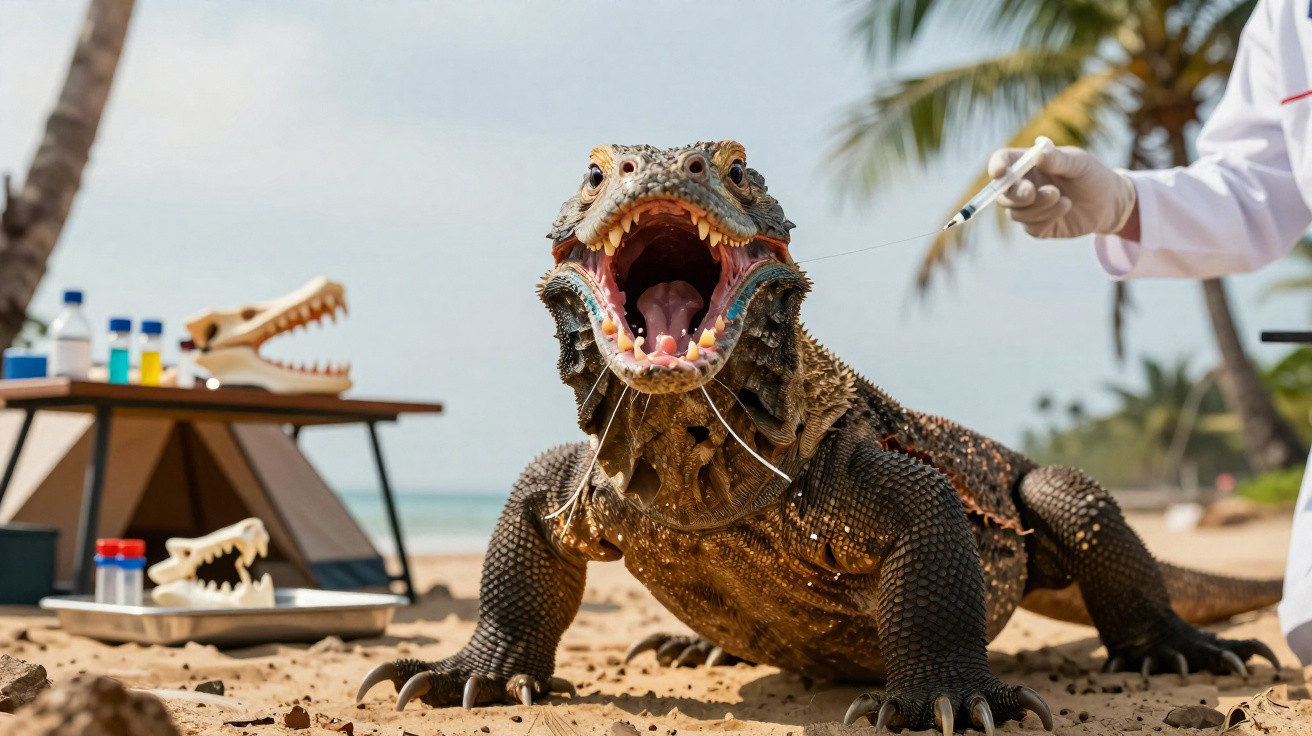
For decades, the explanation seemed settled: the Komodo dragon killed because its mouth contained an exceptionally dangerous mix of bacteria. Science has since revealed something more complex. Its bite combines blade-like teeth, deep wounds and venom glands that can promote bleeding, lower blood pressure and trigger shock.
The contaminated-mouth theory prevailed for decades
The bacterial reputation took hold after researchers identified various micro-organisms in the animal’s saliva and saw prey become weaker after escaping an attack. According to the hypothesis, the victim would be bitten, develop a severe infection and die gradually, allowing the reptile to follow its trail until it found the carcass.
Although plausible, this account mistook an association for a cause. Carnivorous animals naturally have bacteria in their mouths, and wounds can become infected. That does not mean, however, that the Komodo dragon maintains an especially lethal oral flora or relies primarily on a delayed infection to hunt.
How did the discovery of venom glands change the picture?
In 2009, a study led by researcher Bryan Fry described venom glands in the Komodo dragon’s jaw. The analysis identified substances with anticoagulant effects and effects associated with reduced blood pressure. This discovery shifted attention away from the supposedly dirty mouth and towards a predatory system involving anatomy, behaviour and chemistry.
Unlike some snakes, the venom is not injected through hollow fangs. Instead, it flows through channels between the teeth and enters the cuts made during the bite. As the animal bites and pulls its head back, its serrated teeth enlarge the injuries, increasing blood loss and helping the secretions enter the prey’s tissues.
The Komodo dragon bite is a combined attack
The danger does not come from one feature alone. The dragon uses its body to hold on, pull and tear open wounds, while venom components hinder clotting and contribute to circulatory collapse. Together, these factors explain why prey may rapidly lose strength, even if it gets away after the initial encounter.
The main elements of the attack show why describing the bite as merely infectious is an oversimplification:
- Serrated teeth create deep cuts
- Pulling movements widen the wounds
- Anticoagulant substances extend bleeding
- Venom components encourage a drop in blood pressure
- Blood loss and shock weaken the prey
Watch the video shared by the PeritoAnimal YouTube channel for more information about the Komodo dragon and its powerful, mysterious bite.
Bacteria have not vanished from the explanation
Later studies of the dragons’ oral flora found that the bacteria present were not as exceptional as the older narrative had implied. They may contribute to secondary infections, as happens with the bites of many animals, but there is insufficient evidence that they act as a biological poison evolved to kill prey.
Nor does this mean that every prey animal dies solely from chemical effects. The outcome depends on the severity of the cuts, the amount of blood lost, the location of the bite and exposure to venom. The current view is more comprehensive: mechanical trauma and toxic substances work together, while any infection has a secondary role.
The scientific correction makes the Komodo dragon even more impressive
The Komodo dragon’s story illustrates how a popular idea can persist even when new evidence calls for a different explanation. Science did not lose credibility by abandoning the old bacterial theory. On the contrary, it moved forward by comparing micro-organisms, examining glands and testing the effects of the substances involved in the bite.
The next time someone claims that the world’s largest lizard kills only with a mouth full of bacteria, the myth is worth correcting. The real mechanism brings together teeth, pulling force, haemorrhage and venom. Sharing this update is more than passing on a frightening fact: it shows science at work before our eyes.















Comments
No comments yet. Be the first to comment!
Leave a Comment