Something has evidently changed.
For many owners, an abrupt collapse in the relationship between cats can feel like a personal failing. However, feline disputes are common and complicated and, with an appropriate approach, can often be resolved.
When ordinary squabbles become a serious issue
Cats are not expected to coexist in complete harmony at every moment. A brief disagreement, a fast paw swipe or a warning hiss are all normal forms of communication. Concern is warranted when the strain turns into an everyday pattern.
Red flags appear when one cat starts blocking access to food, litter trays or favourite rooms, and the other cat gives up trying.
Behaviourists identify three warning patterns that owners frequently miss:
- Mobbing: One cat repeatedly pursues, traps or intimidates the other by staring.
- Resource blocking: Doorways, passageways, litter trays and food bowls become areas one cat guards.
- Chronic fear: A bullied cat hides, avoids looking at the other cat, or only moves around when the aggressor is asleep.
Such patterns can cause stress-related signs, including urinating outside the litter tray, excessive grooming, unexpected aggression towards people, or a cat that “disappears” into cupboards or beneath beds.
Why cats suddenly stop getting along
A previously peaceful shared home can unravel in a matter of days. The cause is seldom truly “out of the blue”; cats are simply very good at concealing the early signals.
Pain-related medical problems that alter behaviour
A cat experiencing pain may react more quickly, more loudly and with greater aggression. Arthritis, dental disease, urinary issues or abdominal pain may change a tolerant cat into one that lashes out at the slightest contact.
Any sudden change in social behaviour between cats should be treated as a possible medical issue, not only a character flaw.
Veterinary professionals often find that social tension reduces noticeably once the painful condition has been treated. Failing to arrange a health check is among the most frequent mistakes owners make.
Stress, scent changes and disrupted territories
Cats rely on scents, routines and predictable surroundings to create a delicate feeling of security. A number of common events can disrupt this system:
| Trigger | What happens between the cats |
|---|---|
| One cat visits the vet | The cat coming home smells “foreign” and is perceived as an intruder. |
| House move, renovation or new furniture | The territory feels uncertain, leading both cats to guard resources more closely. |
| New baby, partner or pet | The owner’s attention changes, routines are interrupted and anxiety increases. |
| Boredom and insufficient stimulation | Energy has no outlet, so it becomes tension and chasing. |
In some cases, the reason is simpler: their personalities were never compatible. Two highly territorial cats with limited social skills may put up with one another as kittens, only to grow apart in adulthood.
Stabilising the situation: what to do first
Owners often attempt to “talk” their cats back into getting along. Sadly, forcing them to occupy the same space without a break causes the tension to worsen each time.
Separate them for safety, not as punishment
Start by creating physical distance. Each cat should have a separate area containing:
- Its own litter tray, food bowl and water bowl
- Separate sleeping areas and places to hide
- A scratching post and toys
- Time with people for play and affection, ideally shared fairly between both cats
Separation is not failure. It gives both cats a chance to calm their nervous system and feel safe again.
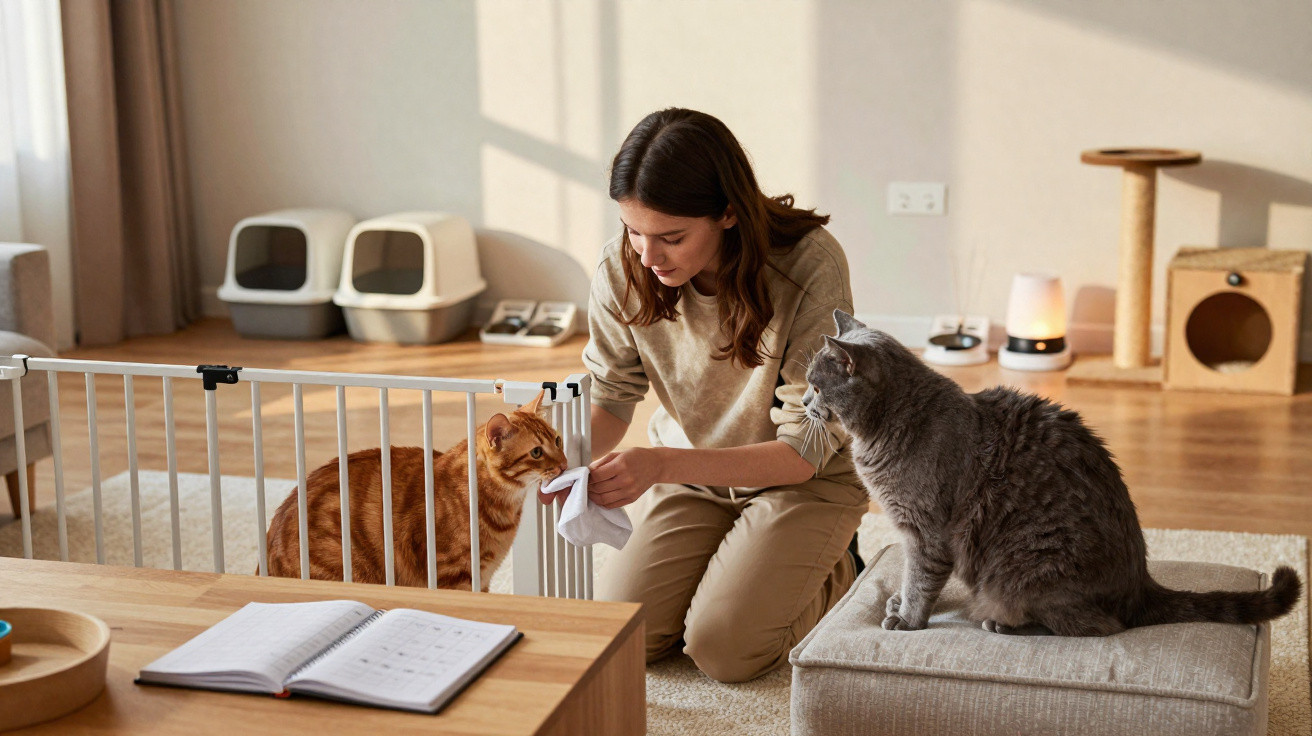
Closed doors, stair gates or room dividers may be useful. The aim is to prevent all direct confrontations for at least several days and, depending on stress levels, sometimes for weeks.
Eliminate hidden sources of conflict
Homes with several cats often contain “bottlenecks”, such as tight corridors, a single litter tray in a passageway or one sought-after window ledge where every cat wants to rest.
Even modest changes to the layout can ease a surprising degree of strain:
- Supply at least one litter tray for each cat, plus one additional tray.
- Place food bowls in separate spots rather than in a row beside one another.
- Create vertical territory with shelves, cat trees and secure window perches.
- Provide several hiding places so each cat can retreat without being seen.
As competition decreases, their body language becomes less tense and they feel less need to defend every resource.
Step-by-step reintroduction: rebuilding trust gradually
After both cats seem calmer within their separate areas, it is possible to restore their relationship through a structured programme. Hurrying this part of the process commonly results in another explosive confrontation.
Moving from scent to sight to shared territory
Behaviourists commonly advise a staged method:
- Scent swapping: Trade blankets, beds or cloths that have been rubbed over each cat’s cheeks and head. Give treats when they respond calmly.
- Positive associations at the door: Feed the cats on either side of a shut door, slowly bringing their bowls closer over time.
- Visual contact with a barrier: Use a stair gate, mesh screen, or a slightly open door fitted with a secure barrier. Make each session brief and positive.
- Supervised meetings: Permit short interactions in a neutral room, with toys and treats available. Finish before the tension rises.
Progress is measured in weeks and months, not days. Patience protects both cats from new setbacks.
Where one cat is especially anxious, calming support such as pheromone diffusers, play sessions based on a regular routine and dependable mealtimes can help the process.
When professional help and difficult decisions are necessary
Not every conflict can be resolved by strategies at home alone. Ongoing serious fights, injuries, or a cat that refuses food when the other cat is close are strong indications that specialist support is required.
A qualified feline behaviourist can:
- Assess subtle body language during encounters.
- Recognise triggers that owners no longer notice.
- Modify the reintroduction plan and the home layout.
- Liaise with your vet about medical or medication options where suitable.
In uncommon cases, one or both cats may remain chronically distressed even after months of effort. Persistent fear, prolonged hiding and stress-associated health issues, such as cystitis, can make it appropriate to consider finding a new home for one cat.
Rehoming a cat after exhausting all other options does not make you a bad owner; it can be an act of care for both animals.
Reading cat body language before a conflict begins
Many owners step in only once their cats are already attacking each other. Earlier, subtler signals are worth recognising.
- Unblinking staring, often across a distance.
- Slowly trailing the other cat from one room to the next.
- Blocking a corridor simply by lying across it, without making an obvious movement.
- Rapid flicking of the tail tip while watching the other cat.
- One cat becoming still or licking its nose as the other approaches.
These small signals often communicate, “I’m worried about you,” or “I want you to back off.” Acting early by interrupting with play, scattering food or gently calling one cat away can stop the pressure from reaching boiling point.
Useful scenarios and what you can do
Scenario 1: a friendly pair becomes hostile after a vet visit
One cat comes back from the veterinary clinic smelling of disinfectant and fear. Although they used to cuddle every night, the other cat now hisses, growls and swats.
Short-term plan:
- Separate them briefly for 24–48 hours.
- Exchange bedding to restore their shared scent.
- Carefully wipe both cats with the same soft cloth, concentrating on the cheeks and head.
- Give them high-value wet food near one another, with a door between them.
In many homes, the tension subsides once the familiar household scent is restored.
Scenario 2: a young new cat bullies an older resident
A young cat with excess energy and too little stimulation may treat a senior cat like a moving toy. The older cat then stops using some rooms, loses weight and sleeps more.
Measures that may help include:
- Planned play sessions with the young cat twice a day to use up energy.
- Elevated resting areas and quiet zones that the senior cat can reach but the youngster finds difficult to access.
- Brief time-outs for the youngster in a separate room when chasing begins.
This approach helps the older cat feel settled, while teaching the younger cat that people, rather than other cats, are its primary play companions.
Key terms that commonly confuse owners
Resource guarding may sound extreme, but it can be very discreet in multi-cat homes. A cat might only lie beside a food bowl or litter tray without attacking, yet the other cat no longer feels able to walk past. The result is identical to an overt fight: one cat loses access to essential resources.
Social incompatibility refers to cats that do not share the same “social style”. One may seek continual interaction, while the other wants space. This difference does not invariably cause open conflict, but it often creates ongoing tension. In these circumstances, increasing space and vertical territory while keeping routines distinctly separate can be the difference between manageable coexistence and daily disruption.
Sharing a home with several cats can be immensely rewarding, as play and companionship can enrich their lives. Yet their social arrangement is delicate. Careful observation, thoughtful use of space and acceptance that peace may require time and structure give multi-cat households a realistic opportunity for lasting harmony.














Comments
No comments yet. Be the first to comment!
Leave a Comment