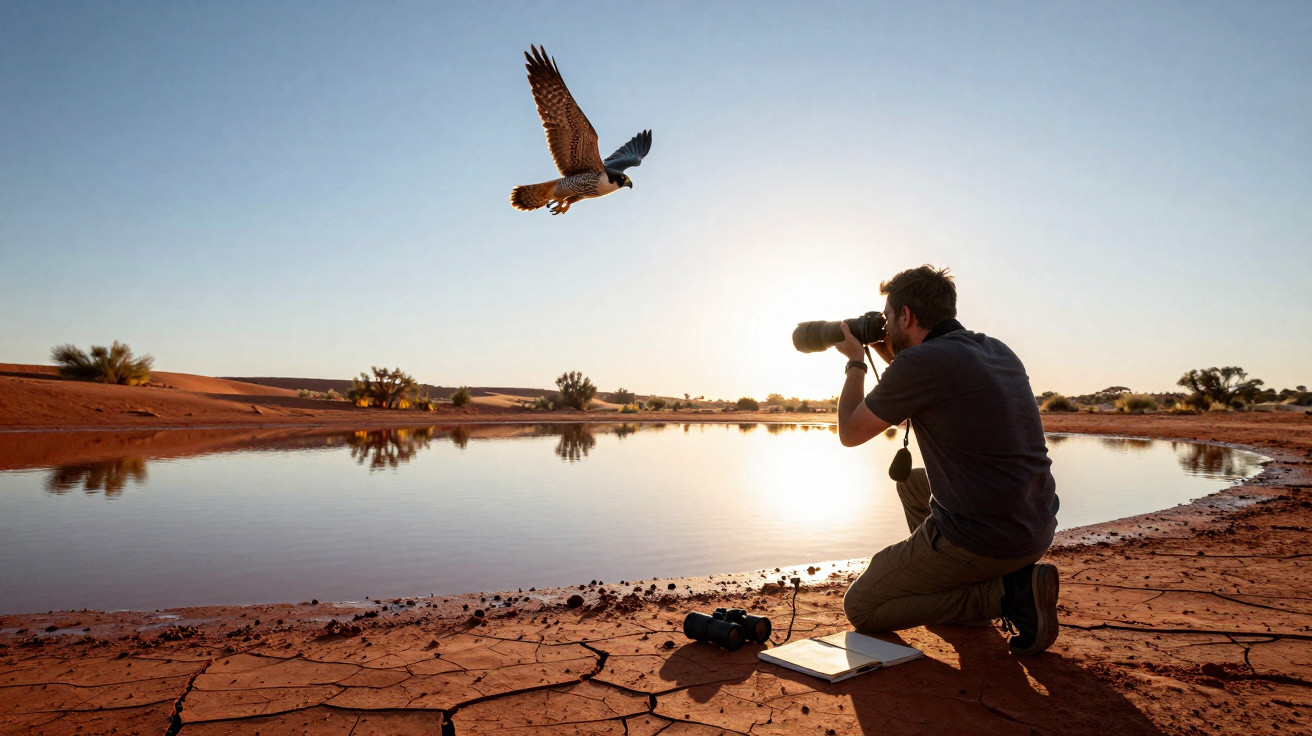
A fleeting photograph taken by a field ecologist in Australia’s red heart has been verified as the first recorded sighting of a Siberian peregrine falcon in the nation’s arid interior. The unexpected discovery is reshaping scientists’ understanding of desert ecosystems and long-distance bird movements.
An unexpected visitor above Australia’s red centre
In February 2025, wildlife ecologist Tim Henderson was surveying raptors over Newhaven Wildlife Sanctuary, north-west of Alice Springs in central Australia. This is normally an unforgiving landscape of undulating sand dunes, spinifex, stony plains and shallow claypans that can remain dry for years.
On this occasion, however, the desert had been transformed. Heavy rainfall during 2024 had converted parched pans into shimmering temporary wetlands, drawing waterbirds and the predators that follow them from distant areas. As he searched the sky, Henderson spotted a falcon travelling at extraordinary speed.
The bird looked different from the peregrines usually seen in inland Australia, so Henderson took a rapid series of photographs to examine later.
After returning to camp and consulting specialists, Henderson identified the bird as a Siberian peregrine falcon (Falco peregrinus calidus), a migratory subspecies that usually breeds on Arctic tundra thousands of miles away across northern Eurasia.
First inland Australian record of a Siberian peregrine
Australian Wildlife Conservancy (AWC), which manages Newhaven Wildlife Sanctuary, confirmed this week that the photograph is the first documented record of a Siberian peregrine in central Australia’s arid interior. Earlier Australian observations have been overwhelmingly concentrated in coastal and near-coastal locations.
Henderson, who documented the discovery in the journal Pacific Conservation Biology, said the bird’s presence so far inland establishes a new reference point for the distance this subspecies can penetrate into desert country when conditions are favourable.
Specialists describe Siberian peregrines in Australia as “rare migrants or vagrants” - birds that typically appear only sporadically, and usually near the sea.
As many as a dozen suspected Siberian peregrines may be reported annually through social media and birdwatching platforms. Most reports originate along the northern and eastern coasts, where there are more people looking skywards and sightings are easier to document. The Newhaven photograph extends the known distribution boundary far into the continent’s centre.
When the desert became a wetland
The remarkable record is closely linked to an exceptionally unusual weather year. In 2024, Australia experienced one of its wettest years since national records started in 1900. The Bureau of Meteorology recorded a national average rainfall total of 596 millimetres (23 inches), approximately 28% above the 1961–1990 average.
The Northern Territory, where Newhaven is located, had its fourth-wettest year on record. Rain gauges at the sanctuary registered 637 mm (25 inches) over 2024, including an extraordinary 316 mm (12 inches) in March alone.
For Newhaven, 2024 was the wettest year since 2001 and the fifth-wettest on record, turning normally dry claypans into short-lived lakes.
These pools of water rapidly became full of life. Waders, ducks and flocks of seed-eating birds arrived to take advantage of new vegetation and insect surges. Their arrival then attracted raptors from well beyond the desert.
Raptor boom in the desert heartland
Henderson’s research records more than the Siberian peregrine: it also identifies a surge in birds of prey using the freshly created wetlands. This brief abundance assembled an unusually diverse group of predators.
- Siberian peregrine falcon, a long-distance Arctic migrant
- Red goshawk, an endangered Australian raptor seldom observed in deserts
- Other diurnal raptors hunting above flooded claypans and dunes
The birds were attracted by dense concentrations of prey at the water margins. For the falcon, Newhaven may have served as a temporary refuelling point during southward travel, or as an opportunistic diversion to a newly productive site.
Newhaven’s dunes and open skies offered ideal hunting conditions for a swift aerial predator. Peregrines can dive from great heights at speeds exceeding 199 mph (320 km/h), taking smaller birds in flight.
Photographing the world’s fastest bird
Capturing a peregrine in flight is difficult even for experienced birdwatchers. Henderson said he was surprised that the image was sharp enough to support identification. The falcon was moving far too fast to distinguish its subspecies in the field, making the camera an essential scientific instrument.
Without that single clear frame, the Siberian peregrine’s visit to Australia’s desert center would almost certainly have gone unnoticed.
Experts closely assessed plumage markings, body structure and other subtle details in the image, enabling them to separate the Siberian bird from resident Australian peregrines. The case demonstrates how digital photography and online collaboration are changing wildlife monitoring, particularly for elusive subspecies and rare visitors.
Why would a Siberian falcon fly into the desert?
The Siberian peregrine breeds throughout Arctic Russia and commonly migrates south after the Northern Hemisphere summer. Many birds spend winter in South and Southeast Asia, the Middle East and parts of Africa. Smaller numbers reach Australia, chiefly along its northern coastline.
A number of factors may have drawn this individual towards the continent’s interior:
| Factor | Possible influence on the falcon |
|---|---|
| Exceptional rainfall | Produced productive inland feeding areas that could be detected from the air across long distances. |
| High prey density | Flocks of waterbirds and other species created appealing hunting opportunities. |
| Migratory flexibility | Peregrines may depart from their usual routes where conditions appear favourable. |
| Under-recording inland | Comparable visits may previously have occurred but remained unrecorded because there are fewer observers. |
Scientists stress that a single observation does not show that Siberian peregrines now routinely use central Australia. Nevertheless, it illustrates how swiftly raptors can react to rare pulses of productivity in areas generally regarded as marginal.
Implications for conservation and climate science
The Newhaven observation contributes to a wider discussion of how climate variability changes landscapes and wildlife movements. Years of intense rainfall, occurring against a background of long-term warming, are shifting the timing and location of food and water in arid regions.
For conservation organisations, these “boom” years offer both promise and concern. They may create breeding opportunities for threatened wildlife and brief periods of plenty. Yet they can also draw migratory animals into habitats that can quickly return to severe dryness, offering scant support to visitors that remain.
Tracking which species respond to these rare wet phases helps land managers plan sanctuaries that can support wildlife under increasingly erratic climate patterns.
Newhaven’s raptor observations, together with rainfall records, provide researchers with a better picture of how predators exploit desert wetlands and which places become vital stepping stones during major climate fluctuations.
Key terms and concepts
For readers unfamiliar with birdwatching and conservation terminology, several definitions help explain the story:
- Subspecies: A distinct population within a species, commonly separated geographically and showing reliable differences in appearance or genetics.
- Vagrant: An individual animal occurring far outside its usual range, often because of weather, navigational mistakes or unusual food availability.
- Claypan: A shallow depression with clay-rich soil that can temporarily retain rainwater, becoming a short-lived wetland.
- Diurnal raptor: A bird of prey that hunts during daylight, including falcons, hawks and eagles.
What birdwatchers and members of the public can do
This one photograph from an isolated sanctuary demonstrates the value of everyday observers. An increasing number of rare birds are initially reported by non-specialists using cameras and birding apps. Uploading clear photographs alongside dates and locations to national databases gives scientists a more detailed map of wildlife movements.
For anyone visiting desert areas during or after major rainfall, binoculars, a basic field guide and a smartphone camera can turn a chance encounter into a useful data point that changes understanding of migration. In regions such as central Australia, where professional surveys are limited, these additional observers can uncover unexpected visitors from as far away as the Arctic tundra.













Comments
No comments yet. Be the first to comment!
Leave a Comment