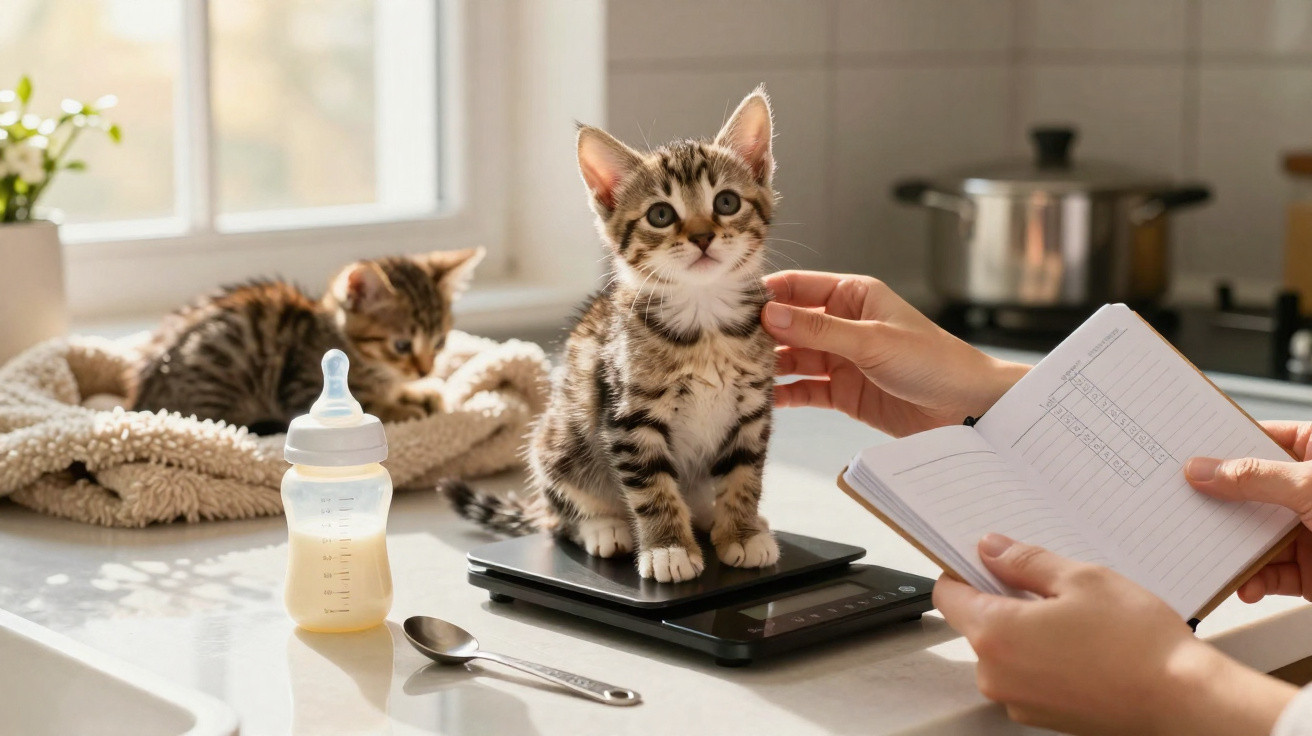
Bringing home a kitten – or an entire litter – comes with plenty of heart-melting moments, but also serious responsibility. These cuddly little furballs may seem sturdy, yet they are in fact exceptionally fragile. Surprisingly, the most reliable way to monitor their development is an ordinary kitchen scale.
Why kitten weight is so important
During their first hours of life, kittens have an extremely fast metabolism. Their tiny bodies hold very little energy in reserve, lose heat quickly and depend entirely on their mother. Every feed, every gram of fat and every protein intake matters.
A mother cat’s milk is a genuine nutritional powerhouse. It contains considerably more protein and fat than cow’s milk, and is tailored to support rapid growth. From a veterinary perspective, a kitten’s weight curve is the most dependable indication of whether this system is working properly or beginning to fail.
Daily weight gain is the most important health check for newborn kittens – even before temperature, activity or coat condition.
A healthy kitten will usually gain 10 to 15 grams per day. If its weight remains unchanged or even falls within 24 hours, urgent action is needed: it may not be receiving enough milk, may be weak or could be starting to become chilled.
The critical first week: doubling weight in just seven days
One key guideline is this: a kitten should roughly double its birth weight during its first week.
For example, a kitten born at around 100 grams should weigh approximately 200 grams by the end of day seven. Minor fluctuations are normal, but the overall trend must clearly be upwards.
- Day 1: approx. 90–110 g (birth weight)
- Day 3: often 120–140 g
- Day 7: target range of around 180–220 g
When a kitten achieves this doubling of weight, it suggests that it is getting enough milk, suckling effectively and staying at a stable temperature in the nest. In large litters, one kitten may lag slightly behind because it has to compete more often with its siblings. That kitten needs closer monitoring and, in some cases, a little human help.
How often owners should weigh their kitten
Veterinarians advise weighing kittens every day at the same time during their first weeks. This makes it easier to identify genuine trends rather than being distracted by random variations.
A basic digital kitchen scale is all that is needed. Many owners use a small bowl or a box lined with a soft cloth, then tare the scale before weighing.
- Gently lift the kitten out of the nest.
- Weigh it quickly but calmly, avoiding draughts.
- Record the result, ideally in a table or app.
- Return the kitten to its mother immediately.
With a full litter, each kitten should have an individual identifier so that weight records can be assigned accurately. This could be a coloured ribbon – not tied too tightly – or a small coloured mark on the fur.
Warning signs: when kitten weight is a real concern
Not every brief slowdown means immediate danger. However, there are clear signs that should prompt owners to act:
- No weight gain for two consecutive days despite regular suckling
- A loss of more than 5–10 grams within 24 hours
- The kitten is noticeably quieter than its littermates and does not seek out a teat
- Its body feels cool, particularly its paws and the inner sides of its ears
- Its coat looks dull, and it mews weakly or not at all
If weight falls or stagnates, dehydration and hypothermia can develop quickly – two risks that can rapidly become life-threatening in newborns.
In these situations, it is important not to wait too long. Initial measures include carefully warming the kitten, checking whether it is suckling from a teat and, if there is any uncertainty, promptly calling the veterinary practice. Acting early can resolve many problems.
When the mother cat does not produce enough milk
Some mother cats simply do not produce sufficient milk, for instance with very large litters, after a difficult birth or because of health issues. This is often apparent when several kittens fail to gain enough weight at the same time.
In these cases, milk replacers designed specifically for kittens may be required. Cow’s milk is unsuitable because it can upset the digestive system and has the wrong nutritional balance.
Bottle-feeding kittens correctly
Anyone supplementing feeds should follow veterinary guidance. Typical points include:
- Always prepare milk replacer according to the instructions on the packet
- Check that it is body temperature, not too hot
- Use very small teats to reduce the risk of choking
- Hold the kitten upright or on its tummy while it drinks, never on its back
- After feeding, gently massage the tummy and anal area to stimulate urination and defecation
The weight curve will show very quickly whether supplementary milk is helping. If weight rises noticeably after one or two days, the kitten is receiving enough energy.
How growth develops after the first week
Once the highly critical early phase has passed, growth remains rapid but becomes somewhat more predictable. By the end of the third week, many kittens weigh around 300 to 400 grams, while many exceed the 500-gram mark at four weeks.
| Kitten age | Typical weight range |
|---|---|
| Birth | 80–120 g |
| 1 week | 160–220 g |
| 2 weeks | 250–350 g |
| 4 weeks | 450–650 g |
These figures can vary according to breed and litter size. Larger breeds such as the Maine Coon are often somewhat heavier, while slender domestic cats may sit at the lower end of the range. What matters is not comparison with a chart, but steady individual weight gain.
What weight reveals about health and development
A scale does more than show whether a kitten is getting enough milk. A sudden drop in weight gain may also point to infections, parasites, congenital abnormalities or metabolic disorders. This is why veterinarians often use weight curves as an early-warning system.
Many owners underestimate how rapidly a newborn kitten’s condition can deteriorate. A kitten that seems reasonably alert in the morning may be severely weakened by evening. Daily weighing often reveals problems hours earlier than observation alone.
The record from the first weeks of life often remains valuable for a lifetime – it can explain later underweight or particular sensitivities in the adult cat.
Kitten weight and behaviour: assess both together
Despite the importance of the figures, regularly observing the nest remains essential. A kitten that gains weight consistently but always lies apart from the others, rarely seeks contact with its mother or cries unusually loudly should still be seen by a vet.
Conversely, a very active and demanding kitten may put on slightly less weight for a short period because it is using more energy. In these circumstances, it is more useful to examine several consecutive days than to focus on one individual measurement.
Practical tips for everyday weighing
Many owners quickly establish a simple weighing routine. A few practical habits can reduce stress:
- Combine weighing time with the routine check of the nesting area
- Use the same bowl and cloth every time to help the kittens stay calm
- Record not only weight, but also any unusual behaviour
- Take photographs of the kittens every week, both as a keepsake and for a visual comparison of development
This turns a necessary task into a small ritual that gives owners reassurance and strengthens their bond with the animals.
When a tiny kitten becomes a healthy young cat
At around eight to ten weeks, the most critical stage of growth has largely passed. The kittens are eating independently, racing around the home and learning litter tray habits and social behaviour. Even so, their earlier weight records remain worth reviewing.
Learning early on to pay attention to figures as well as cuddles and cuteness can do a great deal to support a long, healthy feline life. A kitchen scale tucked away in a cupboard may look unremarkable, but for newborn kittens it is often the most important diagnostic tool in the whole household.

















Comments
No comments yet. Be the first to comment!
Leave a Comment