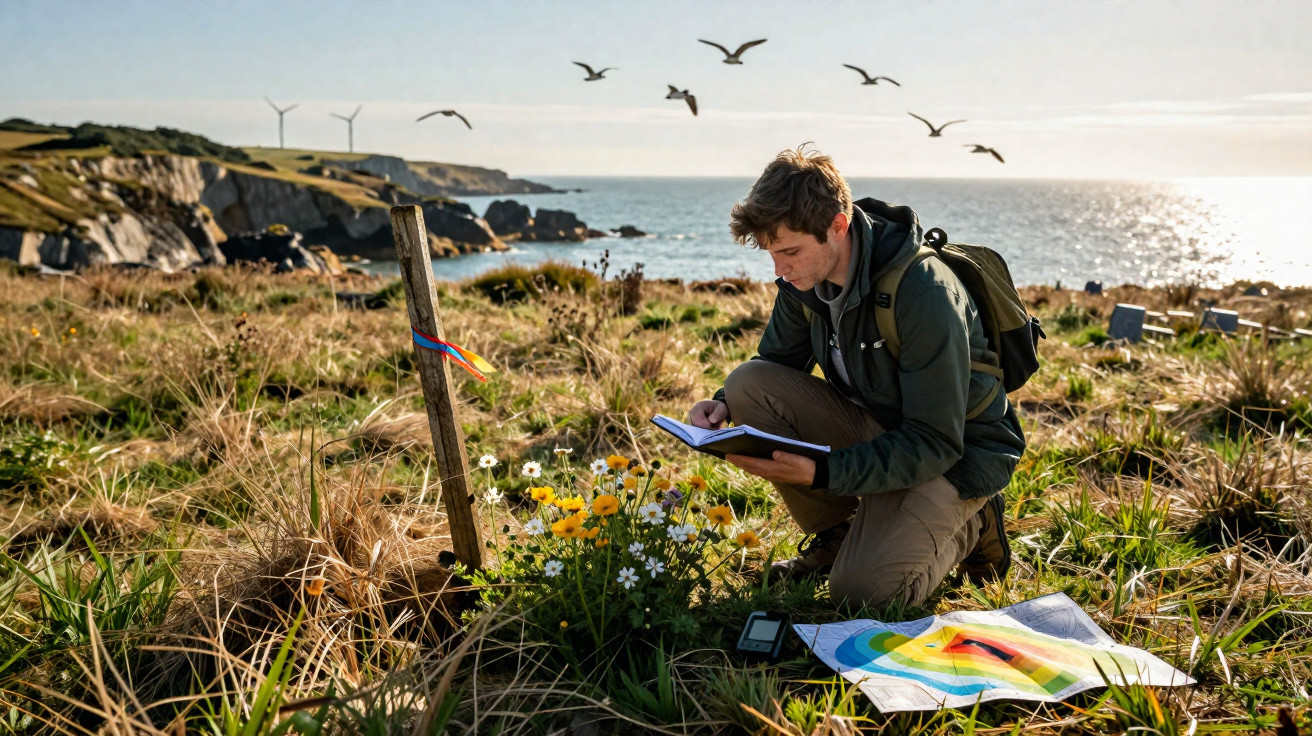
Britain has set ambitious nature targets: stopping species decline by 2030 and lowering extinction risk by 2042.
Both targets rely on the belief that sufficient time remains, and that choices made over the next few decades can reverse damage that is already in progress.
However, a study following more than 1,200 native plants, birds and butterflies has reached another conclusion. The critical period is not still to come: it has begun already, and it will last for around 20 years.
A national forecast for British biodiversity
Dr Rob Cooke, a senior ecologist at the UK Centre for Ecology & Hydrology (UKCEH), led researchers modelling the response of British biodiversity to a warming climate.
The team examined 1,002 plant species, 56 butterflies and 219 breeding bird species. They assessed six possible futures to 2080, with each combining an emissions pathway and a societal pathway.
These ranged from major emissions reductions alongside sustainable land management to unrestricted fossil-fuel use coupled with intensive farming.
Instead of assessing species one by one, the researchers measured how the overall species mix in each place would shift. This method also accounts for rare species that individual-species models can overlook.
Plants fare the worst
Plants suffer most under every scenario. In the most severe future, the composition of around half of Britain’s plant communities would differ from today’s by 2070.
Some 196 plant species - one-fifth of Britain’s native plants - would be on course for extinction. This is more than three times the number Britain has lost since 1500.
They include habitat specialists such as the burnt orchid, grass-of-Parnassus and alpine gentian. Plants still face serious consequences even under the best-case scenario.
Around 134 species would remain on the same path under the most sustainable route. Earlier harm caused by climate change and land-use change continues whatever happens next.
Resilient winged species
Birds and butterflies prove more resilient initially, but after the middle of the century they follow the same direction.
In the worst future, 31 bird species - roughly 14 percent of Britain’s breeding birds - would be heading towards extinction by 2070.
This group includes the merlin, Britain’s smallest bird of prey, as well as seven of Britain’s 56 native butterfly species.
They include the mountain ringlet, which occurs only at high elevations in the Lake District and Scottish Highlands, and the large heath, a specialist of peat bogs.
Upland species face the greatest impacts. Rising temperatures push warmer conditions up hillsides, compressing cool mountain and peat-bog habitats towards the summits.
Species specialised for these environments cannot shift any higher. Their populations are expected to decline before eventually vanishing.
Bioclimates on the move
The forecasts draw on the idea of bioclimates: the combinations of climate and species that characterise a location.
A hilltop is shaped by more than its temperature; it is also defined by the species able to live in those conditions.
A bioclimate is lost when the combination currently found in an area no longer occurs anywhere on the future map. A new bioclimate appears when a future combination has no equivalent today.
Under the worst pathway, plant bioclimates disappear from 72 percent of Britain by 2070, while novel bioclimates extend across 89 percent. The figure for butterflies and birds is nearer one-third.
But a bioclimate predicted by a model cannot exist in practice until species physically arrive there.
In a Britain fragmented by roads, farmland and towns, many of these combinations are likely to be less complete than the projections suggest.
A precise way forward
A more sustainable route changes the trajectory, but it does not succeed in levelling it out.
Relative to the worst future, mitigation in line with the Paris Agreement would reduce the number of plants heading for extinction by 32 percent, butterflies by 14 percent and birds by 20 percent.
Across all three groups, that would mean 69 fewer species lost. The gains would result from changes already emerging in agricultural policy and people’s diets.
It would reduce demand for meat and dairy, increase mixed woodland, and convert farmland into genuinely restored habitat.
Britain fails to meet the international goal of reducing extinction rates tenfold by 2050 in every scenario, including the most sustainable one.
A previous study examining climate change and land-use change as causes of species loss came to similar conclusions.
A 20-year window for British biodiversity
The pressures affecting British biodiversity are not new; they have been recognised for decades.
What is new is the combined assessment of plants, butterflies and birds within a single model.
Victoria Burton, a co-author, described the challenge as one of timing. Nature can recover, but recovering from harm takes longer than current targets allow for.
The extinction debt - species already destined to disappear because of past damage - persists regardless.
“Our results show that the next 20 years will be decisive. The choices we make now will set Britain on a path either towards accelerating biodiversity loss or towards nature recovery,” said Cooke.
The adjustments ahead
Conservation bodies now have a nationwide map identifying where bioclimates are expected to disappear.
The south and east coasts stand out as important areas for plants, while uplands are crucial for butterflies and birds. A previous study of changes in British species ranges found comparable patterns.
Agricultural policy, planning regulations and the expansion of protected areas all fall within the 20-year period identified by the researchers.
The direction taken by these decisions will determine the long-term ceiling for how much British biodiversity endures.
The merlin, mountain ringlet and burnt orchid have belonged to British landscapes for centuries.
Whether they persist for another century depends on choices the country has yet to make. The result remains dependent on decisions that are still unresolved.











Comments
No comments yet. Be the first to comment!
Leave a Comment