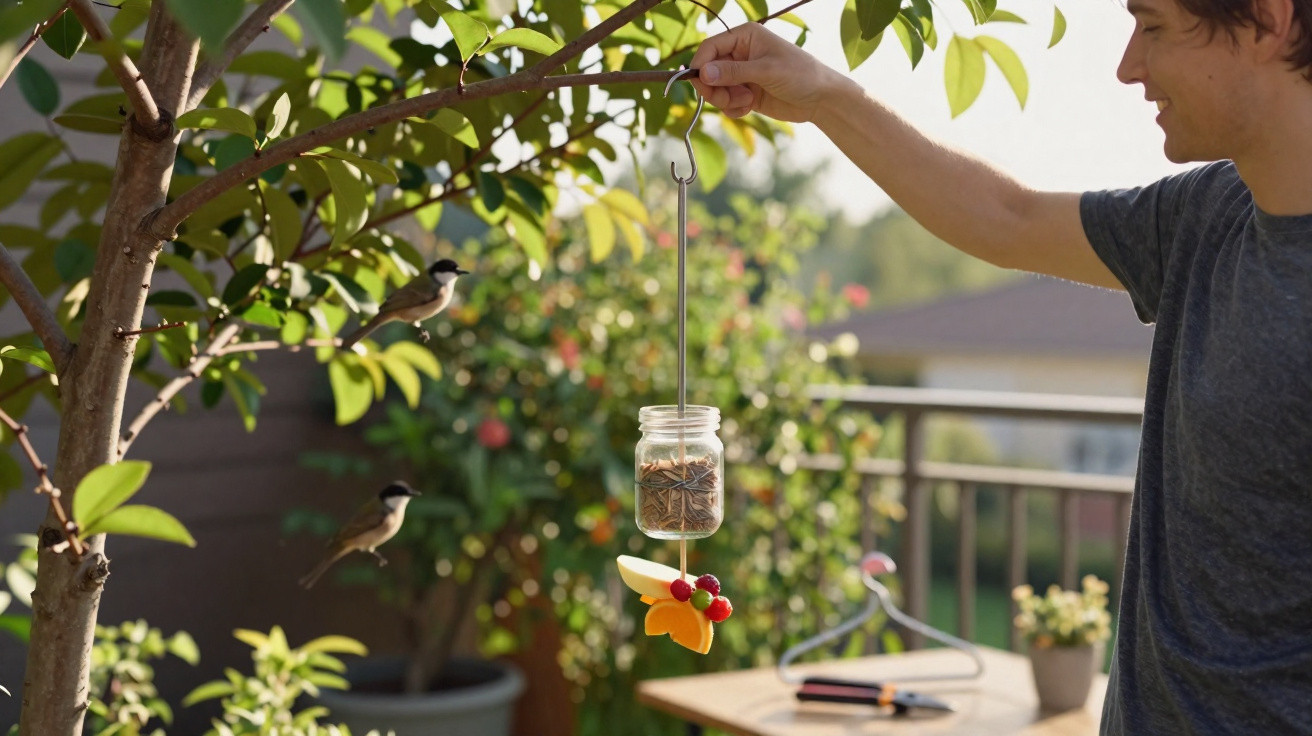
When the first frost arrives, food becomes scarce for wild birds – while shop-bought bird feeders are often absurdly expensive.
Garden centres may tempt shoppers with stylish designs, but for many bird lovers, £30 or £40 for a basic feeding point is simply too much. Yet the material for a sturdy, practical and surprisingly attractive feeding station is often already sitting unused in a cupboard: an unassuming metal coat hanger. With just a few simple steps, it can become a small ‘bird barbecue area’ for fruit and seed – entirely free of charge.
Why a homemade bird feeder is worthwhile
Anyone who pays close attention to birds in the garden or from the balcony soon notices how demanding early spring and the colder months can be for them. They are searching for nesting material, defending territories and require plenty of energy. Providing food helps ease the pressure on them, while giving us a front-row seat to nature’s own cinema.
The trick: a simple wire coat hanger can be turned into a robust, adaptable bird feeder in just a few minutes – without spending a penny.
Ready-made bird feeders are often oversized, difficult to clean or easily damaged in strong winds. A hand-shaped metal hanger is lightweight, easy to move and can be adjusted again and again. You can make several at once and position them around the garden, or hang one from the balcony.
The essential material: turning a forgotten coat hanger into a bird feeder
Why use a metal coat hanger?
Many people know the cheap, slightly misshapen wire hangers from dry cleaners. They are exactly what you need. Made from thin metal, they are easy to bend while remaining strong enough to support fruit or a portion of seed.
- easy to shape, making them ideal for bending and adapting
- strong enough for around 200–300 grams of food
- lightweight and generally very slow to rust
- already lying unused in many cupboards
Rather than throwing it away, the hanger gets a second life – and saves you a trip to the DIY shop.
The only tools you need
A few simple household tools will help prevent injuries and ensure the hanger holds securely when finished:
- Wire cutters, for neatly trimming protruding wire ends
- Flat-nose or round-nose pliers, for precise bends and forming loops
- Work gloves, to prevent cuts from the wire ends
- Fruit or a small container to hold the food – for instance, half an apple or the base of a plastic bottle
If you do not own pliers, you could borrow a sturdy pair of combination pliers or ask a neighbour. They make detailed work far easier than using your hands alone.
Step by step: from coat hanger to feeding station
Straighten the hanger into a rod
Start by dismantling the hanger. It needs to be opened out to create one long, straight section of wire:
- Undo the point where the hanger was originally twisted together, beneath the hook where the wire is intertwined.
- Carefully untwist it with the pliers until the hanger opens into a long length of wire.
- Place the wire on a table and straighten it bit by bit using your hands and the pliers.
You should end up with a reasonably straight metal rod measuring around 70 to 80 centimetres. The straighter it is, the sturdier the finished feeder will appear.
Shape the food holder: fruit skewer or seed dish
This is the creative stage. There are two straightforward options that work particularly well:
Option 1: a fruit skewer for blackbirds and more
This is ideal for pieces of apple, pear or halved fat balls without nets.
- Bend the lower third of the wire into a spiral resembling a snail shell, around five centimetres in diameter.
- Leave a short point projecting upwards from the centre; this is where the fruit will later be skewered.
- The spiral creates a base and stops the fruit from slipping down.
Half an apple pushed onto the central point holds surprisingly securely, allowing birds to peck at it comfortably.
Option 2: a seed bar with a small food bowl
For seed, sunflower hearts or peanuts, use a small container instead.
- Cut the base from a clean plastic bottle using a knife or scissors, making it around four to five centimetres high.
- Bend the lower end of the wire into a tight ring that encloses and firmly holds the bottle base.
- Place the base inside this ring, ensuring the wire grips it closely.
This creates a small bowl holding around 50 to 100 grams of seed. Birds can perch comfortably on the edge and feed.
Form a sturdy hanging hook at the top
To make sure the feeder hangs safely, shape the upper end into a generous hook:
- Bend the upper wire end into a broad curve.
- Use the pliers to pinch the tip slightly closer together so the hook cannot slip off.
- Shape it so that it fits securely over a branch, pole or balcony railing.
The result now looks like a cross between a portable coat hook and a miniature bird restaurant – and it is essentially ready to use.
Choosing food: what really benefits birds
The best treats to offer
People often mean well but choose unsuitable snacks. A few straightforward rules will turn the feeding station into an energy stop rather than a digestive hazard:
- Suitable: unsalted peanuts, sunflower seeds, specialist wild bird food mixes, pieces of apple or pear, and raisins in moderation
- Less suitable in milder weather: very fatty food balls, once daytime temperatures rise
- Avoid: salted nuts, bread, leftovers, and food containing spices or sugar
Around 50 grams of seed or half an apple is often enough to create plenty of activity at the feeder for several hours.
The best location: safe and easy to watch
Birds prefer feeding stations that allow them to keep an eye on their surroundings. At the same time, they need protection from cats and other predators.
- Hang it at least 1.5 metres above ground level.
- A branch or pole that does not run directly alongside a wall is ideal.
- Leave some distance from dense shrubs so cats cannot creep up unnoticed.
- Ideally, position it where it can be seen from indoors – turning the feeder into living decoration.
If you have a balcony, hang the coat hanger on the outside of the railing or from a hook beneath the eaves. A plate placed underneath will catch dropped seed and husks.
Recycling, wildlife care and a daily live concert
Why this craft project is more than just fun
One old coat hanger demonstrates just how simple sustainable everyday choices can be. You save money, reduce waste and support native bird species at the same time. For children, it can quickly become a favourite activity: bending, filling and watching.
You could also keep a small ‘garden logbook’ to record the species that appear: tits, sparrows, blackbirds and robins – the list soon grows. Alongside the feeder, this naturally builds awareness of biodiversity right outside your own front door.
Hygiene and safety: two often overlooked details
To keep birds healthy, inspect the feeding station regularly:
- Replace fruit after two days at the latest, before it begins to rot.
- Rinse the plastic bowl with hot water every few days.
- Dispose of mouldy seed immediately.
- Bend over sharp wire edges with pliers or file them down lightly.
These small measures keep the food source appealing and hygienic. Birds quickly become accustomed to the new ‘address’ and will often make their first visit after only a few hours.
Once you start, you rarely make just one bird feeder
Many crafters report that once their first coat-hanger feeder is successful, more variations soon follow. For example, two hangers can create a double hook with seed on one side and fruit on the other. Some paint the wire with non-toxic paint, while others add leftover pieces of wood as perches.
A tiny recycling project can therefore grow into a small, personal bird paradise. Rather than buying expensive models from the garden centre, the next glance into the wardrobe may lead you to an old metal coat hanger – and anticipation of the next flock gathering at the improvised ‘bird bistro’ outside the window.











Comments
No comments yet. Be the first to comment!
Leave a Comment