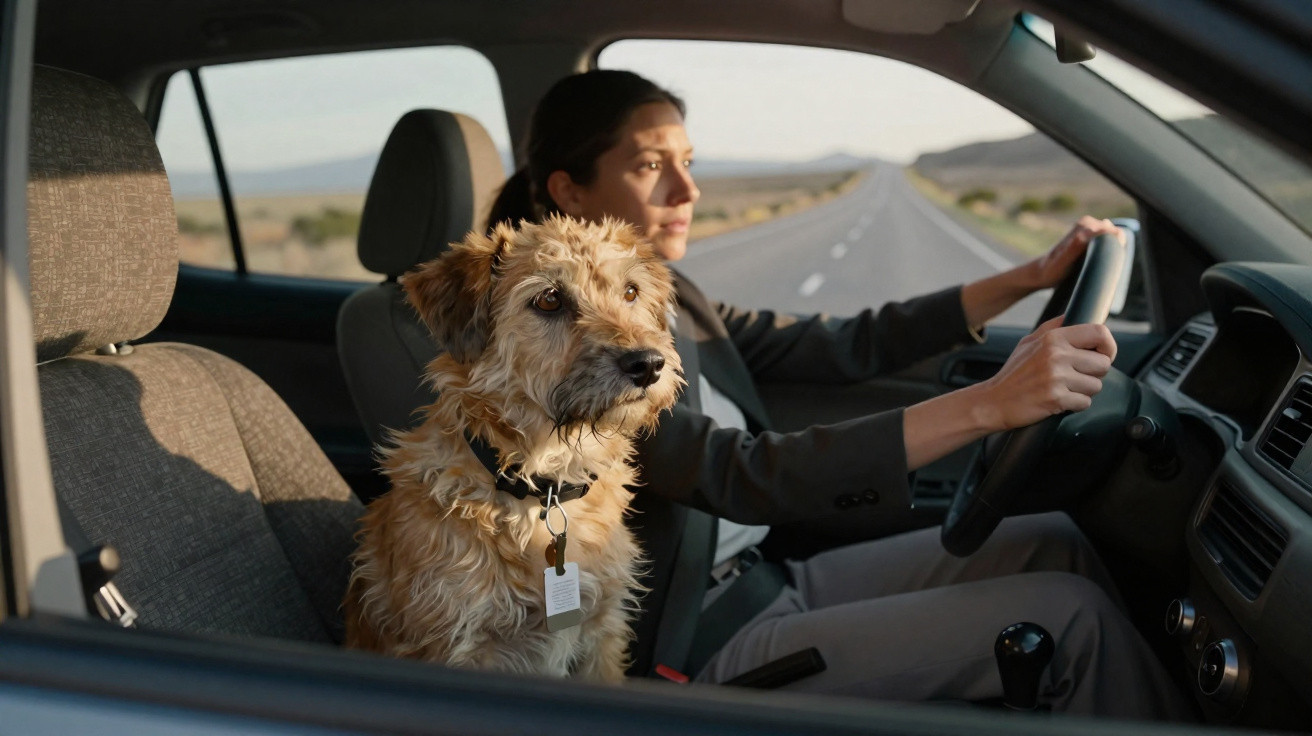
A deserted country road, early morning, rush-hour traffic. What is merely a tiring start to the working day for many becomes an emotional emergency for one woman: in front of her, a frightened dog races after a car that is growing ever smaller in the distance. The incident takes place near Santiago, Chile – and illustrates a problem that is worsening not only there: callous owners simply abandoning their animals.
The moment a commute turns into an emergency
Daniela Nini Castellini is driving to work when the traffic ahead suddenly slows. At first, it appears to be an ordinary queue on a narrow country road. Then she spots the cause: a small, dark dog is running down the middle of the road, completely out of breath.
The animal seems disorientated and stares desperately ahead, towards a vehicle that is accelerating away. Within seconds, Daniela understands what she is seeing: this is not a dog that has simply wandered onto the road – it is fighting not to lose its people.
A small dog runs as though its life depends on it. Ahead is a car that plainly no longer wants him.
Daniela slows down, positions her car behind the dog and tries to shield it with the vehicle. She holds back other cars, keeps enough distance not to make him panic further, yet stays close enough to intervene if necessary.
Dog runs after its owners’ car
Gradually, the reality of what is happening on this country road becomes clear: the small crossbreed has been abandoned. The car he is chasing almost certainly belongs to the people he had previously lived with. To him, they are still his family – even though they apparently deliberately left him in an isolated location.
Sadly, scenes like this are not unusual in Chile. Estimates suggest that several million dogs live on the streets there without a permanent owner. Many come from homes where, at some point, they became “a nuisance”. These animals do not appear in any statistics; they simply disappear from homes, only to reappear on pavements, at rubbish sites or along country roads.
For the dog on this road, there is only one choice at that moment: keep chasing. He knows no other home and no other person. His entire world is driving away in front of him, and he runs until he has nothing left to give.
Five kilometres of desperation – and a brave decision
Daniela does not leave him alone. She follows the animal kilometre after kilometre. She briefly sounds her horn to catch his attention, then allows him to run slightly ahead again so that he is not terrified to death. The dog does not slow down. He keeps running, unmistakably driven only by adrenaline and fear.
After around five kilometres, Daniela realises that this cannot continue. The dog is staggering and his running is becoming increasingly unsteady. At that point, she makes her decision: she brakes firmly, lets the car come to a halt and gets out.
She throws open the door, stands in the animal’s path – and simply picks him up before he can run on into oncoming traffic.
She later explains in a video that the dog would not have stopped by himself for even a moment. She had to physically lift him out of this deadly spiral, preventing him from chasing for more kilometres after a car that had long since given him up, completely exhausted.
Shaking but approachable: the first contact in the car
Inside the car, the full scale of the situation becomes visible. The small dog is trembling all over, his coat looks neglected, and his gaze is fixed, almost vacant. He is not wearing a collar. There is no microchip, no tag and no sign of a family looking for him. Everything points to his former home deliberately wanting to get rid of him “without a trace”.
Even so, the dog shows no aggression. He allows himself to be touched and soothed, cautiously making contact with his rescuer. Many animals that have been abandoned react similarly under stress: they are frightened, yet their bond with people is so deep that they still seek closeness despite their terrible experience.
A second chance in a living room rather than on a country road
Daniela takes the dog home with her. There, she first prepares a quiet space for him, gives him water and something to eat, and gives him time to understand that the desperate chase has ended. At the same time, she starts searching for a new home through social media.
She describes him as friendly, trusting and good with children. This proves crucial later on: a dog that still shows trust after such a traumatic experience has a strong chance of settling into a responsible family again.
Step by step, a shadow being chased down the road becomes a dog with a new future.
Before long, a family comes forward that wants to give the animal a permanent home. The story spreads rapidly online, with many users expressing anger towards the former owners and gratitude towards the woman who did not simply drive past.
Why people abandon dogs in this way
The case raises an uncomfortable question: why do people leave their animal in the middle of nowhere rather than seek help or at least take it to an animal shelter? Specialists cite several reasons:
- Feeling overwhelmed: The dog becomes larger, more energetic or more expensive than expected.
- Lack of information: Owners do not know about alternatives such as animal shelters or animal welfare organisations, or feel ashamed to approach them.
- Convenience: Abandonment seems easier in the short term because it involves no formalities.
- Low regard for animals: In some regions, dogs are still regarded more as disposable objects.
The final point in particular shows how closely cultural attitudes and legal rules are connected. In countries with tough penalties for abandonment and strong public education, the number of such cases falls significantly.
What happens to an abandoned dog’s body
Chasing after the car is not only emotionally devastating; it is medically dangerous too. A dog running continuously for several kilometres on tarmac risks:
- overheating and circulatory collapse
- injuries to its paw pads caused by the surface
- severe exhaustion, potentially ending in collapse
- collisions with vehicles caused by uncontrolled changes of direction
There are also psychological consequences. Vets repeatedly report dogs that suffer from separation anxiety, distrust or panic attacks for a long time after being abandoned. Rebuilding an animal’s trust requires patience, routine and a stable environment.
What to do when you see an abandoned dog
Daniela’s response demonstrates what responsible action can look like without putting your own safety at risk. Anyone who notices a clearly lost dog, or one chasing a vehicle, on a road can follow several basic guidelines:
- Switch on your hazard warning lights and reduce your speed.
- If possible, use your own vehicle to protect the animal from moving traffic.
- Do not run frantically after the dog; approach calmly and patiently instead.
- Only attempt contact when there is no danger from other vehicles.
- Then notify the police, a local animal shelter or an animal welfare organisation.
It is important never to forget that a frightened dog may react unpredictably. Anyone trying to help should remain calm, avoid shouting or approaching the animal head-on, and make no sudden movements.
What this story changes in the long term
The rescued dog from Chile represents countless animals that are not fortunate enough to be spotted in time. His story travelled around the world partly because many people see themselves in Daniela: wondering whether they would intervene in such a moment, and how far they could go to save an animal’s life.
For pet owners, the case demonstrates how much responsibility comes with an animal. Anyone who gets a dog is making a commitment for many years. Illness, moving home and financial worries are all part of life. The answer must never be to leave an animal somewhere like an object and hope that it will “somehow manage”.
At the same time, the story offers hope. It shows how one person, with a decisive braking manoeuvre and a little civic courage, can transform the course of a dog’s entire life – from a desperate chase after a speeding car to a safe place in a new home.









Comments
No comments yet. Be the first to comment!
Leave a Comment