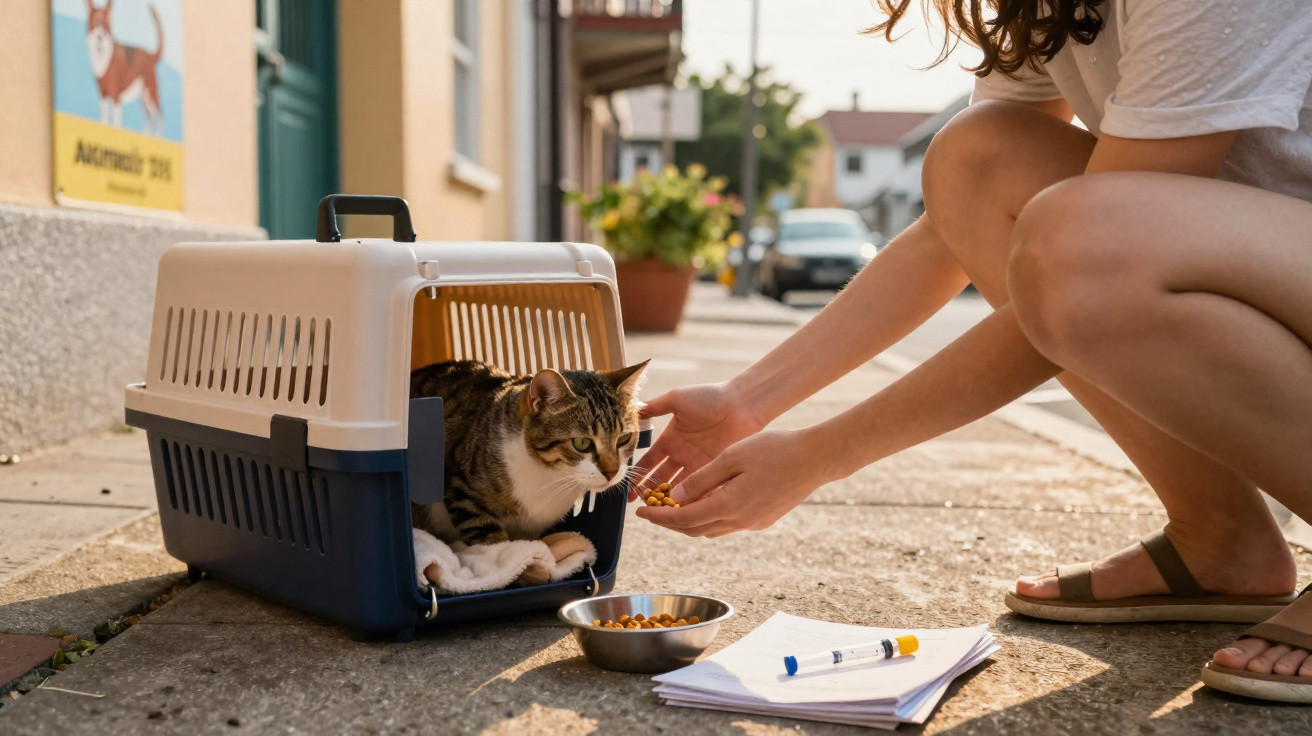
Help can begin here, but it should not end here.
When someone spots a thin stray cat on a freezing night, the instinctive response is understandable: open a tin, put out a bowl and feel reassured. The animal has food in its stomach for the moment, and so does the person’s conscience. Yet its circumstances have barely changed. Anyone who genuinely wants to help a street tomcat or stray cat needs a plan that goes beyond a few handfuls of dry food.
Food keeps a cat alive, but solves none of its problems
A regular meal gives the animal energy, may prevent starvation in extreme cases and can even build trust. Even so, life outdoors remains difficult: traffic, illness, parasites, attacks by other animals or people – these risks do not disappear simply because its bowl is filled each evening.
“Feeding keeps the cat alive, but it does not rescue it from life on the streets.”
There is also an issue many animal lovers would rather avoid discussing: feeding unneutered strays unintentionally creates even more suffering. Help offered with good intentions can therefore become a driver of further animal misery. Those who think long term take the next step.
Secure the cat first, then establish whether it has a home
An animal seen outdoors is not necessarily homeless. Cats allowed outside can sometimes look neglected when they are not. Equally, genuine strays may appear so naturally in residential areas that people assume they belong to a neighbour. That is why the situation must be clarified.
Gentle capture rather than a frantic chase
Chasing, coaxing and grabbing rarely work, and they cause the cat considerable stress. A far better option is gentle capture, for example using a humane trap that many local authorities, animal welfare groups or rescue centres lend out. It closes without harming the animal and makes controlled care possible.
Once the cat has been safely secured, it should be taken straight to a veterinary practice. A scanner can be used to check for a microchip. This check is often free and takes only a few seconds. It can reveal whether a family somewhere is desperately missing the animal.
- Microchip found: The registered owner can be identified through the chip record. The apparent stray may simply be a lost pet or an especially adventurous house cat.
- No microchip: The cat is very likely not officially under anyone’s care. From this point onwards, you become a crucial factor in its life.
“Only once it is clear that no owner exists does real help for a stray begin.”
Neutering, vaccination and essential treatment: the quiet turning point
The basis of lasting help is not donated food, but a straightforward package of veterinary measures. Anyone who wants to genuinely break a stray’s cycle of hardship needs three actions.
The three elements of effective stray cat help
- Capture: Catch the cat safely using a trap or carrier, as quickly and calmly as possible.
- Neuter: This prevents further litters and reduces territorial fighting, spraying and roaming over long distances.
- Vaccinate: This provides protection against serious infections such as cat flu and feline panleukopenia, which spread rapidly outdoors.
The number of unwanted litters rises sharply particularly in late winter and spring. Over time, one unneutered tomcat can lead to dozens of offspring, which then go on to reproduce themselves. Feeding intensifies this effect because well-nourished animals are more fertile and more kittens survive.
“Having a stray neutered not only prevents future suffering, but also makes the animal in front of you calmer and safer.”
Neutering also lowers the risk of serious viral diseases because there is less biting and mating. Vaccinations provide an additional shield against common pathogens in street-cat populations.
Outdoor cat or sofa cat? Finding the right path for the cat
After veterinary care, the key question arises: should the cat return to its familiar territory, or does it need a home with a sofa, heating and a scratching post? The answer depends largely on the animal’s behaviour.
| Cat type | Typical behaviour | Recommended approach |
|---|---|---|
| Very timid cat born “wild” | Hides, hisses, barely tolerates touch and appears panicked indoors | Return it to the capture site as a cared-for, neutered street cat, with a feeding station and monitoring by carers or an animal welfare group |
| Clearly people-oriented cat | Seeks closeness, accepts strokes, purrs and appears relaxed around people | Rehome through a rescue centre or animal welfare group; it should not live permanently on the streets |
Trying to confine a completely feral cat in a small flat can cause severe stress and behavioural problems. Conversely, a people-oriented, affectionate cat can literally freeze outside closed front doors, even though it could be perfectly happy on a sofa.
Why animal welfare groups are indispensable partners
No one has to make these decisions alone. Local rescue centres, cat welfare initiatives and council services are experienced in dealing with strays. They can help with:
- assessing behaviour, whether feral, wary or friendly
- arranging humane traps and veterinary appointments
- funding or subsidising neutering and vaccinations
- finding suitable homes or foster placements
“A lone food provider becomes a genuine animal rescuer when they contact their local animal welfare organisation.”
In areas with large stray-cat populations, organised schemes often exist in which animals live as so-called “managed street cats” after neutering. They are identified, receive veterinary care and are monitored at fixed feeding sites.
Why a “little food” can change entire streets – for better or worse
One bowl may barely be noticed. Several feeding points maintained over months can attract a whole group of cats. Without a neutering plan, noise, smells, disease and conflict with neighbours increase. Anyone managing a feeding point responsibly should therefore always consider two things: veterinary care and agreement with the people living nearby.
Disputes with neighbours can often be eased when it is clear that the cats are neutered, medically cared for and not increasing in number uncontrollably. Openness and visible commitment are more persuasive than secretly leaving bowls out in the dark.
Practical advice for anyone taking “their” stray cat seriously
- Keep a record of feeding: when does the cat appear, what does it look like and does it show any injuries?
- Contact an animal welfare group early rather than waiting until the tenth feed.
- Speak to neighbours to find out whether anyone knows or is missing the animal.
- Clarify costs: many veterinary practices offer reduced rates for strays, while groups may be able to help from donated funds.
- Practise transport: people who already own cats can use borrowed carriers or their own pet carriers.
Taking this approach protects more than the one thin tomcat outside your door; it affects the entire network of cats in your neighbourhood. The risk of new, uncared-for litters falls, while the quality of life for the remaining animals improves considerably.
One final thought: love for animals is shown less by an overflowing food bowl than by a willingness to take responsibility. Those who take the step – to the vet, to an animal welfare group and towards clear decisions – do not merely save one cat from a harsh future on the streets, but also prevent suffering that might otherwise never have become visible.















Comments
No comments yet. Be the first to comment!
Leave a Comment