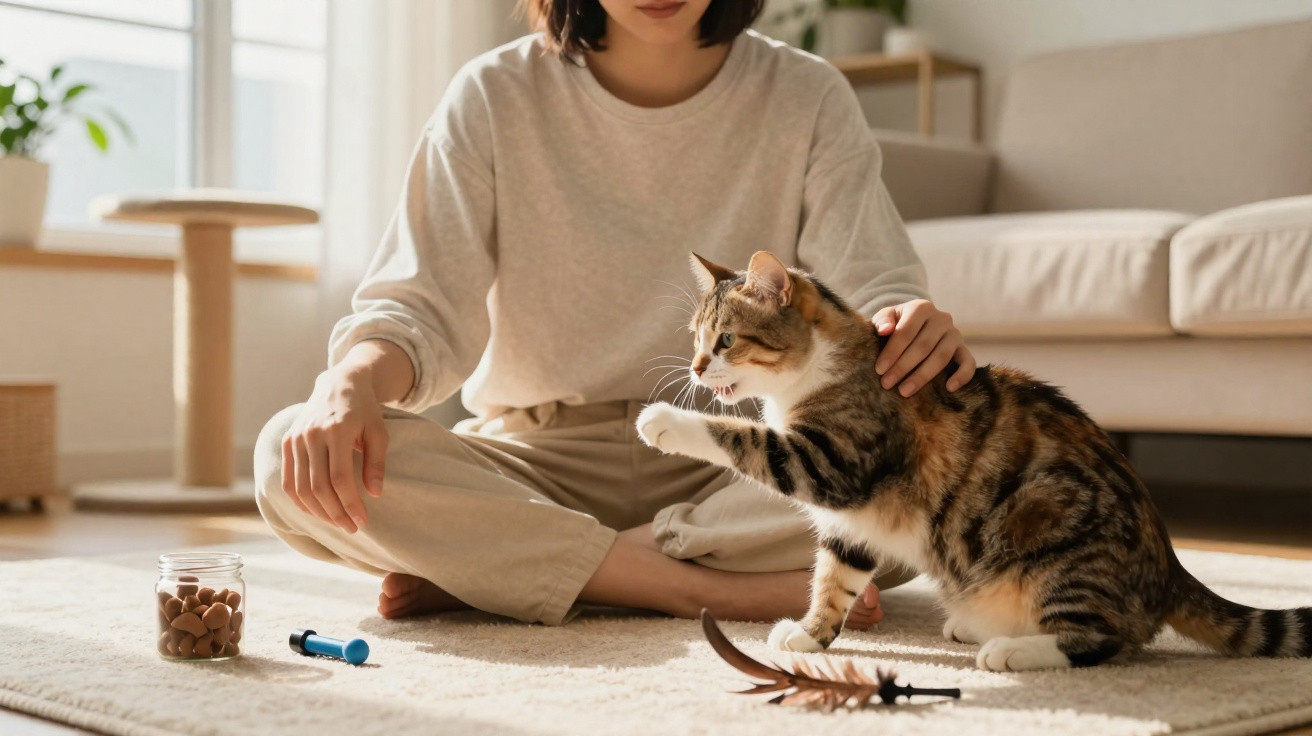
Many owners instinctively react in the wrong way when their pet cat suddenly bites their hand or hooks on with its claws. A cry of pain, a sharp pull of the arm, perhaps some loud telling-off too – entirely understandable for a person, but from a cat’s perspective it is the perfect invitation to attack. Understanding this mechanism can make the atmosphere at home far calmer and noticeably reduce scratches on hands and forearms.
Why our startle response looks like a play cue to cats
Almost every cat owner knows the situation: the cat appears relaxed beside you, rolls onto its back, shows its belly and seems to be asking for a stroke. A moment later, its claws are out, its teeth clamp down and your hand is caught in a rapid rabbit-kicking motion from its back legs.
Most people then do precisely the wrong thing: pull their arm away, shout “Ouch!”, and perhaps reach towards the cat with the other hand. A predator such as a cat interprets this very differently.
“A hand that jerks about and makes noises is not a ‘Stop, that hurts’ signal to a cat, but extremely exciting prey.”
When the hand twitches and struggles, the cat’s attack turns into an exhilarating game. In its view, the “prey” has started to escape, which increases its urge to hunt. As a result, the cat does not let go; instead, it tightens its grip, kicks with its hind legs and bites harder.
Loud scolding or shouting does not help either. Cats do not understand moral lectures. They simply register noise, frantic movement and emotion. This unrest raises their stress level and releases adrenaline – ideal fuel for further aggressive or overexcited behaviour.
The most effective response: stay still and become “boring”
To tackle the issue at its source, you need to overcome that reflex and do exactly the opposite: nothing at all.
Modern cat behaviour guidance relies on a simple approach that can feel unfamiliar to people: do not reinforce unwanted behaviour; let it die out. In other words, the attack must stop being worthwhile for the cat.
The “freeze” method, step by step
- Keep still immediately: Do not jerk or try to yank your hand away. Leave your arm where it is as if frozen.
- Make no sound: No scolding, no “Ouch!”, no hissing. Breathe quietly and remain calm.
- Keep your body neutral: Do not kick your legs, wave your other hand around or stare at the cat.
After a short while, the cat realises that its supposed prey is no longer responding. Nothing moves, cries out or joins in. For a hunter, that is exceptionally dull. In many cases, the cat will release you of its own accord because the entire “game” has lost its appeal.
If your pet cat remains persistent, take the second step: stand up slowly and with as little emotion as possible, carefully remove the affected body part from the situation, and leave the room without a word. Do not look back, speak to the cat or give in. This cool indifference is particularly frustrating for social cats, making it a highly effective consequence.
“The harshest punishment for a cat is not being told off, but the sudden withdrawal of attention and interaction.”
Positive reinforcement: make calm behaviour worthwhile for your cat
Ignoring the behaviour alone is not enough. For a relaxed long-term relationship, you must also repeatedly show your cat that calm, gentle behaviour brings benefits, whereas attacking does not. Cats are practical creatures: they are more likely to repeat what pays off.
How to reward your cat’s peaceful side
- Treats only for calmness: Offer small portions of treats only when your cat is resting quietly beside you without scratching or chasing your hand.
- Choose suitable stroking areas: Many cats enjoy calm, slow strokes at the base of the ears or along the lower back. The belly and paws are often off-limits.
- Take early signals seriously: A twitching tail tip, a slightly rigid body or ears turning backwards are warning signs – end the contact kindly but firmly at that point.
- Stop play immediately when it changes: As soon as your cat’s gaze becomes glazed, its movements turn frantic or it snaps at your hand, put the toy away and leave without comment.
Combining strict non-response during an attack with deliberate rewards for relaxed periods creates clear rules. The cat learns an understandable pattern: losing control leads nowhere, while calm behaviour brings closeness, food and play.
Common triggers for sudden cat bites and scratches
Anyone who understands why cats can suddenly “flip” can defuse many situations before they escalate. This is particularly relevant in spring, when increasing daylight and temperatures make many pet cats more internally excitable.
| Trigger | What happens with the cat | What owners can do |
|---|---|---|
| Overexcited play with hands | The hand is memorised as prey | Only allow chasing with toys, never with bare hands |
| Boredom and pent-up energy | The hunting instinct looks for an outlet | Add more active play sessions and use a puzzle board and scratching post |
| Touching sensitive areas | Discomfort, pain or overstimulation | Arrange a veterinary check, adjust stroking areas and shorten the duration of contact |
| Too much physical contact at once | “Social stress”; the cat feels restricted | Build in breaks, let the cat approach and do not hold it in place |
When a veterinary assessment is appropriate
If behaviour changes dramatically and a normally peaceful cat begins scratching or biting much more often, an underlying health problem may also be responsible. Pain in the joints, teeth or spine can easily cause defensive reactions when the cat is touched in the “wrong” place.
Warning signs that make a veterinary appointment advisable include:
- The cat hisses or bites even when touched lightly.
- It seems stiff, moves unusually slowly or is reluctant to jump.
- There are bald patches, reddened skin or visible injuries.
- The animal increasingly withdraws or appears unusually irritable.
In such cases, behaviour training by itself is not enough. A new way of living together can only truly take hold once pain or illness has been treated.
Practical everyday tips for calmer encounters
Many conflicts arise simply because people and cats are communicating at cross-purposes. A few straightforward adjustments can make daily life much more pleasant:
- Always let the cat initiate physical contact. Constantly touching it as you walk past risks a defensive reaction.
- Plan short but frequent play sessions instead of one wild chase each day.
- Provide at least two or three appealing scratching options so that the cat can release tension.
- Establish routines: set times for food, play and rest provide security and reduce stress.
Children in particular should learn early how to read body language: flattened ears, a lashing tail and dilated pupils are clear signs saying “please give me space now”. Respecting these signals prevents many bloody surprises.
Why human self-control is the most important factor
The most difficult part does not lie with the cat, but with the person: enduring the moment of pain, not pulling your hand away and not raising your voice makes all the difference. Our spontaneous reaction is understandable, but it is simply counterproductive.
Those who can mentally press “pause” in the moment send an unmistakable message: attacking brings no fun, no prey and no spectacle. Combined with consistent rewards for calm closeness, this gradually creates a stable foundation of trust. Forearm scratches become less frequent, and the irritating miniature predator once again becomes the relaxed sofa companion you originally welcomed into your home.














Comments
No comments yet. Be the first to comment!
Leave a Comment